The End of Cheap Food

Ever since the days of Thomas Malthus, who famously predicted in the 18th century that population increases would far outstrip gains in food production, those who have foreseen global famine have been proved relentlessly wrong.

Twice before, our species has been saved from starvation by science. But as we move towards a planet of eight billion people, we are in uncharted territory. Let’s hope a new Norman Borlaug is waiting in the wings.

Shortly after Malthus made his grim prediction, we saw the first Agricultural Revolution – the systematic application of science and technology to farming. New varieties of crops, an understanding of crop rotation and the development of mechanisation saw yields soar. Hunger was also averted by the development of a global trade in food, spurred by the advent of steam ships and refrigeration.

Still, the population kept rising – but along came a saviour in the form of Norman Borlaug, one of the most important human beings ever to have lived. Hitler will always be famous for killing millions; yet Dr Borlaug, an American food scientist, saved billions, and yet relatively few of us have heard of him. In the 1960s, he bred new varieties of wheat and rice and other crops, a breakthrough now called the Green Revolution. If it hadn’t been for him, then Asia and perhaps South America would have seen serious famine in the 1970s.

Now we are reaching the limits of the Green Revolution.


via Can science prevent the great global food crisis? – Telegraph.
Does a Canoe Tip in Quebec?

There is an old joke in the restaurant business – “What’s the difference between a Canadian and a Canoe?..Answer: “A Canoe tips!”.

Apparently some restaurants in Burlington Vermont got so frustrated with French Canadian tourist not tipping that they empowered their wait-staff to add an 18% gratuity to the bill. The link below is to the article that sparked articles and editorials around the world.

Are Burlington Restaurants Discriminating Against Québecois Customers? | Seven Days.

USA has Plenty More Fish in the Sea

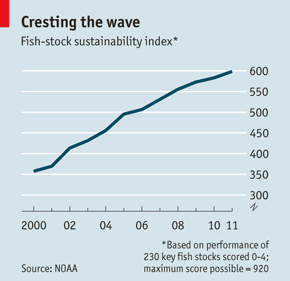
On May 14th the National Oceanic and Atmospheric Administration (NOAA) reported that a record six federal fisheries returned to health last year. After a decade of similar progress, 86% of America’s roughly 250 federally monitored commercial fish stocks were not subject to overfishing; 79% were considered healthy.

The recent recovery of species, including New England scallops, mid-Atlantic bluefish and summer flounder and Pacific lingcod, is the result. This signals another truth: given a break, the marine environment can often replenish itself spectacularly. America’s fisheries are probably now managed almost as well as the world’s best, in Norway, Iceland, New Zealand and Australia

via Fish stocks: Plenty more fish in the sea | The Economist.

Tampa Claims The Cuban Sandwich Is Not From My Ami

Ah, the Cuban sandwich … the succulent pig meats fused with melted Swiss, sharp pickles, yellow mustard and crunchy bread on a hot press. So delectable, so beloved, so redolent of its home in … Tampa?

Yes, Miami, it’s true: That sister burg at the other end of the Tamiami Trail is laying claim to the sandwich that Cuban exiles made famous. Continue reading “Tampa Claims The Cuban Sandwich Is Not From My Ami”

The History Behind Eating Fish On Friday

Let’s start with a quick lesson in theology: According to Christian teaching, Jesus died on a Friday, and his death redeemed a sinful world. People have written of fasting on Friday to commemorate this sacrifice as early as the first century.

Technically, it’s the flesh of warmblooded animals that’s off limits — an animal “that, in a sense, sacrificed its life for us, if you will,” explains Michael Foley, an associate professor at Baylor University and author of Why Do Catholics Eat Fish On Friday?

Fish are coldblooded, so they’re considered fair game. “If you were inclined to eat a reptile on Friday,” Foley tells The Salt, “you could do that, too.”

Alas, Christendom never really developed a hankering for snake. But fish — well, they’d been associated with sacred holidays even in pre-Christian times. And as the number of meatless days piled up on the medieval Christian calendar — not just Fridays but Wednesdays and Saturdays, Advent and Lent, and other holy days — the hunger for fish grew. Indeed, fish fasting days became central to the growth of the global fishing industry. Continue reading “The History Behind Eating Fish On Friday”

Mona Lisa Caffineated

The Mona Lisa, one of the world’s most famous paintings, has been recreated with 3,604 cups of coffee – and 564 pints of milk.The different colours were created by adding no, little or lots of milk to each cup of black coffee.It measures an impressive 20 feet high and 13 feet wide and took a team of eight people three hours to complete.It was created for The Rocks Aroma Festival in Sydney, Australia, and seen by 130,000 people who attended the one-day coffee-lovers event.

This slideshow requires JavaScript.

Elaine Kelly, from event organisers the Sydney Harbour ForeshoreAuthority, was delighted with the result.She said: “Each coffee cup was filled with varying amounts of milk to create the different sepia shades of the painting.”We wanted to create an element of surprise and a sense of fun in the way we engaged with the public.”Once we had the idea of creating an image out of coffee cups we searched for something iconic to reproduce – and opted for the most iconic painting in history.”The Mona Lisa has been reproduced so many times in so many different mediums but, as far as we know, never out of coffee.”The result was fantastic.”After much planning it was great to see if coming together so well and the 130,000 people who attended the event certainly enjoyed it.”

Mona Lisa, also known as La Gioconda, is the 16th century portrait painted in oil by Leonardo Da Vinci during the Italian Renaissance. The work is owned by the French government and hangs in the Musee du Louvre in Paris, France, with the title Portrait of Lisa Gherardini, wife of Francesco del Giocondo. It measures 770 millimetres by 530 millimetres and has prompted debate for years over the reason for her famously enigmatic smile. Extensive scrutiny using X-ray apparatus suggests that restoration work has resulted in the original being painted over three times. Thanks to Juan Marcos.  Mona Lisa recreated with coffee – Telegraph.

Korean Virtual Subway Grocery Store

It’s the future in South Korea now: people don’t even have to go to grocery stores there any more. Tesco installed virtual grocery stores in subway stations, which are basically giant photos of grocery store aisles. Customers can then take photos of the food they want to purchase and have it delivered to their homes later. But what if your train comes while you’re still shopping? That is the kind of problem we’ll all have in the future. Here’s a video: Thanks to Marty Acevedo

via The Future : Eater National.

Why Food Will Become the Biggest Security Threat

The 19th century is the century of chemistry and that gets us chemical weapons in World War I. The 20th century is the century of physics and that gets us nuclear weapons in World War II. But the 21st century? That’s the century of biology, and that gets us biological weaponry and biological terror. My point: obsessing over nuclear terrorism is steering by our rearview mirror. If you think people are afraid of radiation (dirty nukes, etc.), that’s nothing compared to their fear of tainted food. My point: if you’re a terrorist looking to sow fear and confusion, disrupt supply chains and ruin crucial industries, you can’t do much better than to work some biological mischief on food networks.

The average farm-to-fork journey in this world is now about 1,500 miles, and it’s getting longer by the week. Global climate change will make it harder to grow food across a thick band of territory (roughly up to/down to the 35th parallel) centered on the Equator. That’s where most of the population growth and water stress problems will erupt in coming decades, and it’s also where countries all tend to be highly dependent on imported food. See your Arab Spring and realize how much of this unrest is caused by rising food prices and you’ll get the overall picture.

Mark my post: this century is all about biology, rising food demand – and thus dependencies exacerbated by climate change (see the buying-up of arable land in Africa by Arab and Asian nations), and thus biological terror comes to the fore. Forget about energy nets, because they all go far more localized with smart grids, co-located generation/distribution, etc. It’s food that will be the most vulnerable global network in the future.

via The future of Fifth Generation Warfare: Follow the food! – Battleland – TIME.com.

The Great Disruption Has Arrived

Why didn’t more of us see it coming? After all, the signals have been clear enough – signals that the ecological system that supports human society is hitting its limits, groaning under the strain of an economy simply too big for the planet. But we didn’t and, as a result, the time to act preventatively has past.Now we must brace for impact. Now comes The Great Disruption.It is true that the coming years won’t be pleasant, as our society and economy hits the wall and then realigns around what was always an obvious reality: You cannot have infinite growth on a finite planet. Not ‘should not’, or ‘better not’, but cannot. We can, however, get through what’s ahead – if we prepare. Continue reading “The Great Disruption Has Arrived”