
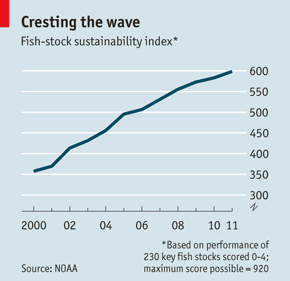
 On May 14th the National Oceanic and Atmospheric Administration (NOAA) reported that a record six federal fisheries returned to health last year. After a decade of similar progress, 86% of America’s roughly 250 federally monitored commercial fish stocks were not subject to overfishing; 79% were considered healthy.
The recent recovery of species, including New England scallops, mid-Atlantic bluefish and summer flounder and Pacific lingcod, is the result. This signals another truth: given a break, the marine environment can often replenish itself spectacularly. America’s fisheries are probably now managed almost as well as the world’s best, in Norway, Iceland, New Zealand and Australia
via Fish stocks: Plenty more fish in the sea | The Economist.
 With monitoring systems that reduce bycatch by as much as 60 percent and regulations providing fishermen with a stake in protecting the wild resource, it is happening. One regulatory scheme, known as “catch shares,” allows fishermen to own shares in a fishery — that is, the right to catch a certain percentage of a scientifically determined sustainable harvest. Fishermen can buy or sell shares, but the number of fish caught in a given year is fixed.