Everyday Things Under The Electron Microscope

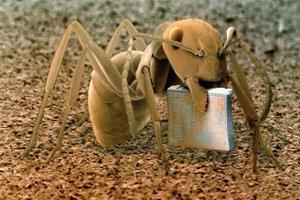
A wood or heathland ant, Formica fusca, holding a microchip

All these 24 pictures are from the book “Microcosmos”, created by Brandon Brill from London. This book includes many scanning electron microscope (SEM) images of insects, human body parts and household items. Click the link to see all 24 pictures.

via Really funny stuff – Amazing Scanning Electron Microscope Pictures (24 pics).

12-Year Old McDonald’s Hamburger

Photograph taken by Karen Hanrahan

The McDonald’s hamburger on the right is from 2008; the one on the left is from 1996. And they both look fairly edible.

Wellness educator and nutrition consultant Karen Hanrahan has kept a McDonald’s hamburger since 1996 to illustrate its nonexistent ability to decay. Aside from drying out and bit and having “the oddest smell,” it apparently hasn’t changed much in the past 12 years.

This isn’t the first time someone kept an uneaten McDonald’s hamburger for an extended period of time for the sake of science. Or in the case of the Bionic Burger Museum, multiple burgers for over 19 years. There are even instructions on how to start your own collection of old, self-preserving burgers. Thanks to Maria Collier, who heard it on NPR

via 12-Year Old McDonald’s Hamburger, Still Looking Good | A Hamburger Today.

The Science of Pouring Champagne

The researchers say they looked at two ways of pouring Champagne: the “traditional” method, with the liquid poured vertically to hit the bottom of the Champagne flute; and the “beer-like way,” executed by tilting the glass and gently sliding in the Champagne.

The scientists at the University of Reims say pouring bubbly at a slant, as you would a beer, preserves more of the tiny gas bubbles that improve the drink’s flavor and aromas.

The study – “On the Losses of Dissolved CO2 During Champagne Serving” – appears this week in the Journal of Agricultural and Food Chemistry, a U.S. publication.

via Champagne fizzics: Science backs pouring sideways.

The End Of Tuna?

The high seas are owned by no one and governed by largely feeble multinational agreements. According to the Sea Around Us project of the University of British Columbia’s Fisheries Center, catches from the high seas have risen by 700 percent in the last half-century, and much of that increase is tuna. Moreover, because tuna cross so many boundaries, even when tuna do leave the high seas and tarry in any one nation’s territorial waters (as Atlantic bluefin usually do), they remain under the foggy international jurisdiction of poorly enforced tuna treaties.

The essentially ownerless nature of tuna has led to the last great wild-fish gold rush the world may ever see. The most noticeable result of this has been the decline of the giant Atlantic bluefin tuna. But the Atlantic bluefin is just a symptom of a metastasizing tuna disease. The United Nations’ Food and Agriculture Organization reports that 7 of the 23 commercially fished tuna stocksare overfished or depleted. An additional nine stocks are also threatened. The Pew Environment Group’s tuna campaign asserts that “the boats seeking these tuna are responsible for more hooks and nets in the water than any other fishery.”

via Tuna’s End – NYTimes.com.

Another Blow To The “Green Revolution”

The “Green Revolution” that lifted millions out of hunger is threatened by a fungus re-appearing in wheat and now the emergence Superweeds.

Just as the heavy use of antibiotics contributed to the rise of drug-resistant supergerms, American farmers’ near-ubiquitous use of the weedkiller Roundup has led to the rapid growth of tenacious new superweeds.To fight them, Mr. Anderson and farmers throughout the East, Midwest and South are being forced to spray fields with more toxic herbicides, pull weeds by hand and return to more labor-intensive methods like regular plowing.

Farm experts say that such efforts could lead to higher food prices, lower crop yields, rising farm costs and more pollution of land and water.

via U.S. Farmers Cope With Roundup-Resistant Weeds – NYTimes.com.

Famine-Causing Stem Rust Threatens World’s Wheat Crop

Stem rust is the polio of agriculture, a plague that was brought under control nearly half a century ago as part of the celebrated Green Revolution. After years of trial and error, scientists managed to breed wheat that contained genes capable of repelling the assaults of Puccinia graminis, the formal name of the fungus.

But now it’s clear: The triumph didn’t last. While languishing in the Ugandan highlands, a small population of P. graminis evolved the means to overcome mankind’s most ingenious genetic defenses. This distinct new race of P. graminis, dubbed Ug99 after its country of origin (Uganda) and year of christening (1999), is storming east, working its way through Africa and the Middle East and threatening India and China. More than a billion lives are at stake. “It’s an absolute game-changer,” says Brian Steffenson, a cereal-disease expert at the University of Minnesota who travels to Njoro regularly to observe the enemy in the wild. “The pathogen takes out pretty much everything we have.”

via Red Menace: Stop the Ug99 Fungus Before Its Spores Bring Starvation | Magazine.

How The French Fry Came To India

INDIA is the third-biggest producer of potatoes in the world. The humble spud finds itself stuffed into flatbread, encrusted in cumin seeds or tucked into pancakes. But the truckloads of large, oblong potatoes that arrive at the McCain Foods plant in the Mehsana district of Gujarat face a more exacting ordeal. Ferried by a conveyor belt and propelled by water, they are sized, steam-peeled, sliced, diced, blanched, dried, fried (for precisely 42 seconds in vegetable oil at 199ºC), chilled, frozen, bagged and then boxed.

The 15kg boxes of fries that emerge at the other end of this pipeline supply the growing chain of McDonald’s restaurants in India. When McDonald’s first entered India in 1996, the food-processing industry was confined largely to ice cream and ketchup. Even importing frozen fries was complicated by the fact that such an exotic item did not appear on India’s schedule of tariffs and quotas. It took McDonald’s roughly six years and $100m to weld a reliable supply chain together.

via Agribusiness in India: Green shoots | The Economist.

The Coming VAT Tax Exemptions Quagmire

“Food of the kind used for human consumption,” to a British bureaucrat, is something “the average person, knowing what it is and how it is used, would consider it to be food or drink; and it is fit for human consumption. . . . The term includes . . . products like flour, which, although not eaten by themselves, are generally recognized food ingredients . . . [but] would not usually include . . . dietary supplements, food additives and similar products, which, although edible, are not generally regarded as food.”And so, in the United Kingdom, according to the regulations of Her Majesty’s Inland Revenue Service, crackers made from tapioca starch carry no tax; prawn crackers made from cereals do. Frozen yogurt that needs to be thawed before eating is zero rated, frozen yogurt bears the tax. Get it? If you don’t, too bad—Her Majesty’s tax collectors are not in the habit of offering an explanation for their regulations.

This process of writing regulations for the VAT man when he cometh is more than merely amusing. For one thing, it confers enormous power on faceless bureaucrats.

They can hand a competing product the advantage in the U.K. of a price 17.5% lower (in Sweden it’s 25%) than a close substitute. That invites both lobbying and corruption and sheer, inexplicable arbitrariness. Get your “sweetened dried fruit” deemed to be “held out for sale as snacking and home baking” and your product will bear a tax and have to compete on grocers’ shelves with zero-rated “sweetened dried fruit held out for sale as confectionary/snacking.” Peddle your sandwiches “as a general grocery item” and consumers pay no tax, but offer them as “part of a buffet service” and the VAT man wants his 17.5%.

via Irwin Stelzer: Small Bras and the Value-Added Tax – WSJ.com.

Chef Of The Mac

0914_mcdonaldsCoudreaut, or Chef Dan as he’s called within McDonald’s, has navigated pretty well within his straits. Since hired on in 2004, he has led the creation of the Snack Wrap, the latest iterations of McDonald’s chicken-topped salad entree, the Fruit and Walnut Salad, McCafé espresso-based coffees, and, most recently, the 1/3-lb. Angus burger. (He has blown it, too. McDonald’s dropped the too-adventurous Hot ‘n’ Spicy McChicken sandwich in 2007 after just six months on the market and disappointing sales.)

The stream of new products is paying off. While restaurant sales have been sinking industrywide since the recession hit in 2007, McDonald’s quarterly same-store sales have continued to climb. The string, which began in 2003, continues into the third quarter, with a 1.7% increase in the U.S. in August and 2.6% in July. CEO James A. Skinner credited the gains to premium coffees and the Angus burger.

via The Challenges for McDonald’s Top Chef – BusinessWeek. Continue reading “Chef Of The Mac”

Wine Making Secrets Exposed

PH02261KDo you know what you were really drinking last night? The dirty secret about wine is that it frequently contains wood chips, chemicals, and something called Mega Purple. Since only a tiny amount is needed to fix an entire barrel, Mega Purple is probably being added to over 25 million bottles of wine annually. Thanks to that lovable Wino, Randy Marks

via The Great Wine Cover-up – The Daily Beast.