
America’s Gift to the World

Numerous world powers served as global or regional hegemons before we came along, and their record on economic development was painfully transparent: Elites got richer, and the masses got poorer. Then America showed up after World War II and engineered an international liberal trade order, one that was at first admittedly limited to the West. But within four decades it went virally global, and now for the first time in history, more than half of our planet’s population lives in conditions of modest-to-mounting abundance — after millennia of mere sustenance.

You may choose to interpret this as some sort of cosmic coincidence, but the historical sequence is undeniable: With its unrivaled power, America made the world a far better place.

via WPR Article | The New Rules: The Rise of the Rest Spells U.S. Strategic Victory.
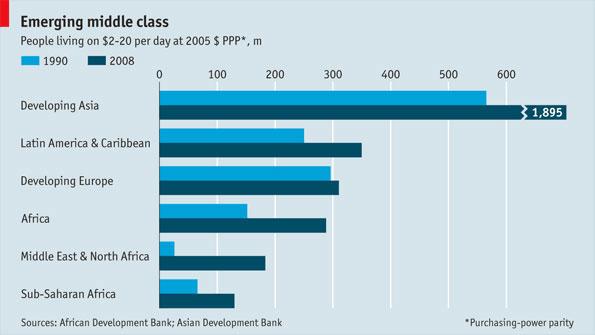
Globalization’s Greatest Victory

The past four years have seen a sharp contrast between recession-hit rich countries and buoyant emerging giants. Estimates from the Asian and African Development Banks, using a rather broad definition of middle class as living on $2-20 a day, confirm the picture. On this measurement, which includes many people who are only just above the poverty line, a third of Africans and three-quarters of Latin Americans were middle class in 2008. Meanwhile, the evidence that this progress will bring political demands that will reshape the developing world is mounting.

People ask, what did America do for the world? It set the conditions for this to happen – and then it defended that system from those who would do it harm. The US is only world power in history whose primary goal has been the peaceful rise of other great powers through trade and development.

via Thomas P.M. Barnett’s Globlogization – Blog – Chart of the Day: globalization’s greatest victory.

China Has Divested 97 Percent of Its Holdings in U.S. Treasury Bills

China has dropped 97 percent of its holdings in U.S. Treasury bills, decreasing its ownership of the short-term U.S. government securities from a peak of $210.4 billion in May 2009 to $5.69 billion in March 2011, the most recent month reported by the U.S. Treasury.

Treasury bills are securities that mature in one year or less that are sold by the U.S. Treasury Department to fund the nation’s debt.

Mainland Chinese holdings of U.S. Treasury bills are reported in column 9 of the Treasury report linked here.

Until October, the Chinese were generally making up for their decreasing holdings in Treasury bills by increasing their holdings of longer-term U.S. Treasury securities. Thus, until October, China’s overall holdings of U.S. debt continued to increase.

Since October, however, China has also started to divest from longer-term U.S. Treasury securities. Thus, as reported by the Treasury Department, China’s ownership of the U.S. national debt has decreased in each of the last five months on record, including November, December, January, February and March.

via China Has Divested 97 Percent of Its Holdings in U.S. Treasury Bills | CNSnews.com.

Why Food Will Become the Biggest Security Threat

The 19th century is the century of chemistry and that gets us chemical weapons in World War I. The 20th century is the century of physics and that gets us nuclear weapons in World War II. But the 21st century? That’s the century of biology, and that gets us biological weaponry and biological terror. My point: obsessing over nuclear terrorism is steering by our rearview mirror. If you think people are afraid of radiation (dirty nukes, etc.), that’s nothing compared to their fear of tainted food. My point: if you’re a terrorist looking to sow fear and confusion, disrupt supply chains and ruin crucial industries, you can’t do much better than to work some biological mischief on food networks.

The average farm-to-fork journey in this world is now about 1,500 miles, and it’s getting longer by the week. Global climate change will make it harder to grow food across a thick band of territory (roughly up to/down to the 35th parallel) centered on the Equator. That’s where most of the population growth and water stress problems will erupt in coming decades, and it’s also where countries all tend to be highly dependent on imported food. See your Arab Spring and realize how much of this unrest is caused by rising food prices and you’ll get the overall picture.

Mark my post: this century is all about biology, rising food demand – and thus dependencies exacerbated by climate change (see the buying-up of arable land in Africa by Arab and Asian nations), and thus biological terror comes to the fore. Forget about energy nets, because they all go far more localized with smart grids, co-located generation/distribution, etc. It’s food that will be the most vulnerable global network in the future.

via The future of Fifth Generation Warfare: Follow the food! – Battleland – TIME.com.

The Catastrophic Failure of European Multiculturalism

Europe’s leaders have realized, and are acknowledging one after another, that that continent’s multiculturalist policy–the idea that geographic areas could be ceded to immigrants from Islamic countries who would treat them as Islamic enclaves, rather than being encouraged to assimilate–has been a disastrous failure. CBN has a good report on the current status of multiculturalism in Europe. It begins:

France has some 751 “No Go” zones. The French government has labeled these areas “sensitive urban zones” that are dangerous for whites and non-Muslims to enter.

(source;http://sig.ville.gouv.fr/Atlas/ZUS/).

This map shows how these “no go zones” are distributed around France:

via Power Line – The Catastrophic Failure of European Multiculturalism.

I asked a French friend if it was really that bad there and got this reply from her:

The basic Idea of the article is wrong . The “Multikulti” comes from Germany (http://en.wikipedia.org/wiki/Multikulti) and it’s goal was to integrate Muslim residents into Society all the whilst respecting their religious beliefs and habits. As far as I know, there was no intention at all to have them live in ethnical enclaves.

A couple of years ago , I wasn’t paying enough attention and accidently took one of Nice North’s exits (l’Ariane) off the highway.(Can’t happen anymore, the exit has been condemned).

Other than the fact, that I was shocked to see such poverty some 10 miles from the flourishing Cote d’Azur ,I still don’t know how I made it out there alive…

Since quite a few years no Pizza guy will deliver anything in this (pretty huge) area.

The last time I read that cops (obviously accidently) drove in there, they found themselves running for their lives (car had been set on fire) and that TOTALLY NAKED.

The first big wave of immigrants (after WW2) worked hard and really tried to integrate. So did their next generation. The third generation however, is searching for an own “identity”, very often going back to old Muslim traditions and/or violence. And there come the problems…

Now you know it all..

The Straw that Broke the Camel’s Back of Dictatorships

Mohamed Bouazizi was 10 years old when he became the main provider for his family, selling fresh produce in the local market. He stayed in high school long enough to sit his baccalaureate exam, but did not graduate. (He never attended university, contrary to what many news organisations have reported).

Bouazizi’s father died when he was three years old. His elder brother lives away from the family, in Sfax. Though his mother remarried, her second husband suffers from poor health and is unable to find regular work.

“He didn’t expect to study, because we didn’t have the money,” his mother said.

At age of 19, Mohamed halted his studies in order to work fulltime, to help offer his five younger siblings the chance to stay in school.

“My sister was the one in university and he would pay for her,” Samya Bouazizi, one of his sisters, said. “And I am still a student and he would spend money on me.”

He applied to join the army, but was refused, as were other successive job applications. With his family dependant on him, there were few options other than to continue going to market.

By all accounts, Bouazizi, just 26 when he died earlier this month, was honest and hardworking. Every day, he would take his wooden cart to the supermarket and load it would fruit and vegetables. Then he would walk it more than two kilometres to the local souk.

Police abuse

And nearly everyday, he was bullied by local police officers.

“Since he was a child, they were mistreating him. He was used to it,” Hajlaoui Jaafer, a close friend of Bouazizi, said. “I saw him humiliated.” Continue reading “The Straw that Broke the Camel’s Back of Dictatorships”

WikiLeaks Reveals Saudi Party Scene

It begins by clearing the prince’s security detail. Next up was a coat-check area where women pulled off their head-to-toe black abayas. Inside, Filipino bartenders served up a cocktail punch using moonshine vodka. An American “energy drink company” – whose name was blacked out on the WikiLeaks release – helped bankroll the bash that included, the diplomat was told, some prostitutes mingling in the crowd.

“The scene resembled a nightclub anywhere outside the kingdom: plentiful alcohol, young couples dancing, a DJ at the turntables and everyone in costume,” the message continued.

Bottles of name-brand booze were behind the bar, but apparently only for display. A black market bottle of Smirnoff, the cable said, can cost up to $400 “when available” compared with about $26 for a bottle of home-brewed vodka.

Wild parties rage behind closed doors in Tehran even as Iran’s hard-liners tighten their grip. Conservative Gulf sheiks make sure their wine cellars are well stocked.Outside Saudi Arabia, it’s not unusual to see a traveler from the desert kingdom hunkered down at an airport bar or letting loose in Bahrain – a favorite party haunt for Saudis who can simply drive over a causeway and, sometimes, weave their way home

via Partying Saudi style: elite, boozy and secret.

China’s Next Generation

“Prison Break” is huge in China and its star, Wentworth Miller is not only mobbed everywhere he goes in China, he’s the frickin’ face of GM on TV commercials!

The show has never been aired on any Chinese TV network, only on the Web.

Xi Jinping (China’s next president and in his late 50s), for example, still remembers vividly being thrown in jail as a kid as a political prisoner on his dad’s behalf during the Cultural Revolution.  He’s China’s leader for the next decade, and his “Sixties’ were a bit different from the Boomers.

Conservatives in the West keep saying, Nixon went to China 40 years ago and look how the Party still rules! They say that because that’s all they want to see.  But we need to go back and read our history here.  The Cultural Revolution was a “long national nightmare” that trumps our Vietnam and Watergate by . . .  more than just a bit.  It was a national insanity and the bite it took out of the national psyche was closer to our Civil War than anything we’ve experienced since

So rather than expecting that much more  by the 50-something crowd, think of this more in terms of post-Cultural Revolution generations.  The first truly post-CR leadership generation comes online in 2022.

Read more: Thomas P.M. Barnett’s Globlogization – Thomas P.M. Barnett’s Globlogization

via Thomas P.M. Barnett’s Globlogization – Thomas P.M. Barnett’s Globlogization.

Global Aging

Worldwide, there is a 50 percent chance that the population will be falling by 2070, according to a recent study published in Nature. By 2150, according to one U.N. projection, the global population could be half what it is today.

Those who predict a coming Asian Century have not come to terms with the region’s approaching era of hyper-aging. Asia will also be plagued by a chronic shortage of women in the coming decades, which could leave the most populous region on Earth with the same skewed sex ratios as the early American West. Due to selective abortion, China has about 16 percent more boys than girls, which many predict will lead to instability as tens of millions of “unmarriageable” men find other outlets for their excess libido. India has nearly the same sex-ratio imbalance and also a substantial difference in birth rates between its southern (mostly Hindu) states and its northern (more heavily Muslim) states, which could contribute to ethnic tension.

Birth rates are falling dramatically across Latin America, especially in Mexico, suggesting a tidal shift in migration patterns. Consider what happened with Puerto Rico, where birth rates have also plunged: Immigration to the mainland United States has all but stopped despite an open border and the lure of a considerably higher standard of living on the continent. In the not-so-distant future, the United States may well find itself competing for immigrants rather than building walls to keep them out.

via Think Again: Global Aging – By Phillip Longman | Foreign Policy.

Our New “Gilded Age”

The Boomers have been a terrible generation of political leaders. As in the case of most revolutionary generations in history, once the initial stab at change in their youth fell to the wayside, the real talent went into business and technology and changed the world–dramatically–for the better. The dregs went into politics and, in the process, have managed to thoroughly discredit it as a career and force for good in our society.

Last time it was this bad in America was those latter decades of the 19th century. The “revolution” then was the U.S. Civil War, and the crew that came out of that crucible was dramatically altered in character and vision and–most importantly–in personal connections. The bonds forged by war led to a lot of follow-on business development during a great and lengthy boom time. But it was an era much like today: frontier integration thanks to a rapidly expanding continental economy, the knitting together of a sectional economy into world-class “rising China” of its age, huge flows of people and FDI into the country–a miniature version of today’s globalization.

And during that age of booms and busts and the early populism that accompanied it, politics became a very dirty profession, so much so that when progressive icon TR decided to step into the fray, his wealthy NYC family begged him not to do so–it was considered such a huge step down from respectable obscurity. Few of us came name any politicians from that era (distant relation Grant being my favorite), but we all remember the industrial-financial titans, whose very names equal wealth: Rockefeller, Carnegie, Morgan, etc.

via Thomas P.M. Barnett’s Globlogization – Thomas P.M. Barnett’s Globlogization.