The Overlooked Big Stories of 2012

Andres Oppenheimer is a Miami Herald syndicated columnist and a member of The Miami Herald team that won the 1987 Pulitzer Prize, has a nifty list of 5 important, but overlooked stories that will have big implications in the years ahead.

  • In 2017, US becomes World’s biggest oil producer
  • Corruption’s threat to China’s Leadership’s legitimacy
  • The Trans Pacific Trade Partnership
  • Secessionist movements shaking Europe

Oppenheimer: The really important news of 2012 – Andres Oppenheimer – MiamiHerald.com.

Rise of the Asian Welfare State

Although poorer countries still limit themselves to ad hoc welfare offerings, fitting the spending level to revenues one budget at a time, there is an increasing trend towards entitlements served by statutory institutions that will outlive the budgetary cycle. As these systems mature, welfare provision will be demand-led, not supply-driven; welfare will become integral to the state. Asia’s tigerish economies are turning marsupial, carrying their dependants along with them as they prowl.

Some of the national leaders who unleashed those tiger economies would be shocked and disturbed by the development. To them the welfare state was a Western aberration that would serve only to undermine thrift, industry and filial duty.

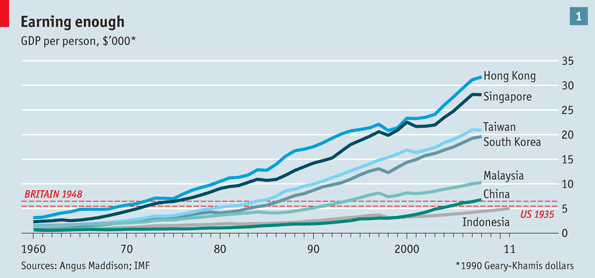
It seems that every country that can afford to build a welfare state will come under mounting pressure to do so. And much of Asia has hit the relevant level of prosperity (see chart 1). Indonesia is now almost as developed as America was in 1935 when it passed the landmark Social Security Act, according to figures compiled by the late Angus Maddison, an economic historian. China is already richer than Britain was in 1948, when it inaugurated the National Health Service (NHS) which, to judge by political ructions—and Olympic opening ceremonies—has become crucial to its sense of national identity.

via Asian welfare states: New cradles to graves | The Economist.

Russia’s Bridge to Nowhere

Alaska doesn’t have the biggest boondoggle bridge project.  Putin just wasted over a billion dollars on a bridge to show off at this week’s 21-member Asia-Pacific Economic Cooperation (APEC) conference.  The bridge to the Russky island, the world’s largest cable-stayed bridge, dead-ends just beyond the bridge, meaning that the 5,000 local residents, who live on the other side of the island and have no access to telephones, public lighting or running water, still have to use a ferry to reach the mainland.

via Bridge to Russky Island – Wikipedia, the free encyclopedia.

Everything You Think You Know About China Is Wrong

For the last 40 years, Americans have lagged in recognizing the declining fortunes of their foreign rivals. In the 1970s they thought the Soviet Union was 10 feet tall — ascendant even though corruption and inefficiency were destroying the vital organs of a decaying communist regime. In the late 1980s, they feared that Japan was going to economically overtake the United States, yet the crony capitalism, speculative madness, and political corruption evident throughout the 1980s led to the collapse of the Japanese economy in 1991.

Could the same malady have struck Americans when it comes to China? The latest news from Beijing is indicative of Chinese weakness: a persistent slowdown of economic growth, a glut of unsold goods, rising bad bank loans, a bursting real estate bubble, and a vicious power struggle at the top, coupled with unending political scandals. Many factors that have powered China’s rise, such as the demographic dividend, disregard for the environment, supercheap labor, and virtually unlimited access to external markets, are either receding or disappearing.

The current economic slowdown in Beijing is neither cyclical nor the result of weak external demand for Chinese goods. China’s economic ills are far more deeply rooted: an overbearing state squandering capital and squeezing out the private sector, systemic inefficiency and lack of innovation, a rapacious ruling elite interested solely in self-enrichment and the perpetuation of its privileges, a woefully underdeveloped financial sector, and mounting ecological and demographic pressures.


via Everything You Think You Know About China Is Wrong – By Minxin Pei | Foreign Policy.

The Empire Strikes Back

Yale Prof. Charles Hill sees two very different kinds of challenges to the liberal, state-based world order. One, the aggressive kind, is exemplified by China. The other, very different, can be seen in the European Union.

“The way the world through almost all of history has been ordered is through empires. The empire was the normal unit of rule. So it was the Chinese empire, the Mughal empire, the Persian empire, and the Roman empire, the Mayan empire.”

What changed this was the Thirty Years War in Europe in the 17th century. “That was a war between the Holy Roman Empire and states, and states were new. They had come forward in northern Italy in the Renaissance and now they were taking hold in what we think of as a state-sized entity. The Netherlands and Sweden and France were among these. . . . France was both an empire and a state—and the key was when [Cardinal] Richelieu took France to the side of the states, which was shocking because France was Catholic and the empire was Catholic and the states were Protestant.”

“My view is that every major modern war has been waged against this international system. That is, the empire strikes back. World War I is a war of empires which comes to its culmination point when a state gets into it. That’s the United States.” And then we get something very interesting added: “That’s Woodrow Wilson and [the promotion of] democracy.”

“World War II, and I think this is uncomprehended although it’s perfectly clear, . . . World War II is a war of empires against the state system. It’s Hitler’s Third Reich. It’s Imperial Japan.” The Axis goal “is to establish an empire. The Nazi empire would be Europe going eastward into the Slavic lands. The Japanese empire in the Greater East Asia Co-Prosperity Sphere, as they called it.”

via The Weekend Interview with Charles Hill: The Empire Strikes Back – WSJ.com. Continue reading “The Empire Strikes Back”

Return of the disparaged “Limits to Growth” Prediction

Carlton Palmer shares this gem with these comments:

Thoughtful, analysis and personal take from a Financial realist .  Civilized not a Rant! Long, Worth the effort. Ex Pat Brit.Jeremy Granthams take on the ongoing food crisis  plus the Game changer implications for the Human condition. Of note “the ethanol/gas” idiocy.

Click on the link to download the .pdf file and take the time to read this 22 page analysis

Ex Pat Brit. Jeremy Granthams take on the ongoing food crisis

Europe’s Other Crisis – Immigration

The EU is a project pursued with unstinting energy by a generation of utopians, to replace accountable national governments with a more distant authority that manages to be simultaneously sinister and naïve. For Laqueur a good symbol of its modus operandi came in late 2010, when the European Commission printed millions of calendar diaries to hand out to schoolchildren: they had the dates for Ramadan and for Hindu and Sikh feast days, but not for Christmas.


ALL WESTERN EUROPEAN countries have some version of this problem, which involves immigration, Islam, dissent from established European culture, and organized violence. Although it has been temporarily overshadowed by budgetary and currency woes, it is Europe’s most significant chronic problem. What to do about it depends on where one thinks the problem lies.

via Christopher Caldwell: Europe’s Other Crisis | The New Republic.

U.S.-China Relations or Rivalry?

America has simply reached the historical limit of its credit, a limit represented not by the federal debt ceiling, but by the widespread global perception that our best days are behind us absent significant restructuring across our economy and government. By and large, neither U.S. political party wants to hear this, much less act upon it. Instead, we Americans either assume that our next “exceptional” rebound will unfold naturally or believe that it can somehow be achieved by sabotaging China’s rise. Our truly unimaginative political leaders in both parties reach for both straws simultaneously, a combination of hubris and fear that is both odd and depressing.

Any expert familiar with China’s current situation recognizes its precariousness: a vast nation of more than 1 billion souls, with more than half of them still living in incredible poverty, attempting to shift — simultaneously! — from extensive to intensive growth and from centralized political authority to something necessarily more federalized and democratized. Amid these combined evolutions, the Chinese Communist Party is most definitely doomed, and it knows it. Already, senior party officials, especially those in retirement, admit this looming reality.

We can only hope that the world will play the Sino-American rivalry more intelligently that either of its combatants do, until generational change on both sides eventually works its political magic. Continue reading “U.S.-China Relations or Rivalry?”

After a 1000 Years – The Arab Spring

The Arab world’s so-called “democracy deficit” is not tied to the Islamic religion but rather to the Arab world’s history and the institutions introduced following conquest by Arab armies over 1000 years ago, according to a new paper presented today at the Spring 2012 Conference on the Brookings Papers on Economic Activity BPEA. Continue reading “After a 1000 Years – The Arab Spring”

Identity Wars -Coming to the Developing World?

The identity wars started in early modern Europe around the time of the Protestant Reformation. After a century of genocidal violence that left most of Germany ruined and depopulated, those wars subsided until the French Revolution set off an even greater and more devastating wave. Closely connected to the industrial revolution and the rise of democracy, nationalism emerged as a dominant political force in 19th century Europe, spreading from northwestern Europe toward the south and east. Over the next 100 years, more than a hundred million people died in wars as multinational empires in Europe and the Middle East ripped themselves apart in paroxysms of war, genocide and ethnic cleansing.

One of the biggest questions in world politics today is whether identity wars (conflicts between groups with different cultural, religious and/or ethnic backgrounds who inhabit the same stretch of land) were a special feature of modern European and Middle Eastern history or whether these conflicts will appear in more of Africa and Asia in the 21st century as development spreads.

Nigeria and Kyrgyzstan are just two of several examples of recent and ongoing ethnic conflict; others include the Sri Lankan civil war that ended brutally in 2009 — as many as 100,000 people may have died. Pakistan, China, India, and various African and Pacific island nations are all struggling with ethnic violence, demands for independence, and conflicts between different groups

via The Scariest Thing In the World | Via Meadia.