
Rise of the Asian Welfare State

Although poorer countries still limit themselves to ad hoc welfare offerings, fitting the spending level to revenues one budget at a time, there is an increasing trend towards entitlements served by statutory institutions that will outlive the budgetary cycle. As these systems mature, welfare provision will be demand-led, not supply-driven; welfare will become integral to the state. Asia’s tigerish economies are turning marsupial, carrying their dependants along with them as they prowl.

Some of the national leaders who unleashed those tiger economies would be shocked and disturbed by the development. To them the welfare state was a Western aberration that would serve only to undermine thrift, industry and filial duty.
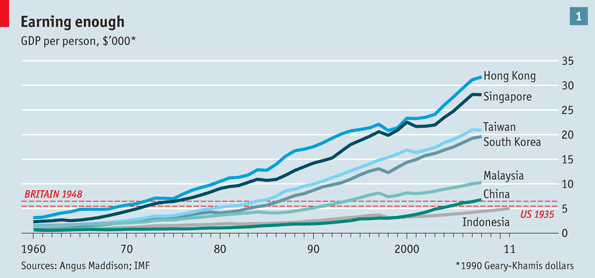
It seems that every country that can afford to build a welfare state will come under mounting pressure to do so. And much of Asia has hit the relevant level of prosperity (see chart 1). Indonesia is now almost as developed as America was in 1935 when it passed the landmark Social Security Act, according to figures compiled by the late Angus Maddison, an economic historian. China is already richer than Britain was in 1948, when it inaugurated the National Health Service (NHS) which, to judge by political ructions—and Olympic opening ceremonies—has become crucial to its sense of national identity.

via Asian welfare states: New cradles to graves | The Economist.

Why the Arabic World Turned Away from Science

From coffee to cheques and the three-course meal, the Muslim world has given us many innovations that we take for granted in daily life. Click on this link to see 20 of the their greatest discoveries. How Islamic inventors changed the world – Science – News – The Independent.

Today Muslims are a fifth of the world’s population, yet contribute only 7% of the world’s GDP. Arabs comprise 5 percent of the world’s population, but publish just 1.1 percent of its books, according to the U.N.’s 2003 Arab Human Development Report. Between 1980 and 2000, Korea granted 16,328 patents, while nine Arab countries, including Egypt, Saudi Arabia, and the U.A.E., granted a combined total of only 370, many of them registered by foreigners.

What went wrong?

The Islamic turn away from scholarship actually preceded the civilization’s geopolitical decline — it can be traced back to the rise of the anti-philosophical Ash’arism school among Sunni Muslims, who comprise the vast majority of the Muslim world.

While the Mu’tazilites had contended that the Koran was created and so God’s purpose for man must be interpreted through reason, the Ash’arites believed the Koran to be coeval with God — and therefore unchallengeable. At the heart of Ash’ari metaphysics is the idea of occasionalism, a doctrine that denies natural causality. Put simply, it suggests natural necessity cannot exist because God’s will is completely free. Ash’arites believed that God is the only cause, so that the world is a series of discrete physical events each willed by God.

The Ash’ari view has endured to this day. Its most extreme form can be seen in some sects of Islamists. For example, Mohammed Yusuf, the late leader of a group called the Nigerian Taliban, explained why “Western education is a sin” by explaining its view on rain: “We believe it is a creation of God rather than an evaporation caused by the sun that condenses and becomes rain.” As Robert R. Reilly argues in The Closing of the Muslim Mind (2010), “the fatal disconnect between the creator and the mind of his creature is the source of Sunni Islam’s most profound woes.”

Inquiry into the history of Arabic science, and the recovery and research of manuscripts of the era, may have a beneficial effect — so long as it is pursued in an analytical spirit. That would mean that Muslims would use it as a resource within their own tradition to critically engage with their philosophical, political, and founding flaws. If that occurs, it will not arise from any Western outreach efforts, but will be a consequence of Muslims’ own determination, creativity, and wisdom — in short, those very traits that Westerners rightly ascribe to the Muslims of the Golden Age
The New Atlantis » Why the Arabic World Turned Away from Science.

Everything You Think You Know About China Is Wrong

For the last 40 years, Americans have lagged in recognizing the declining fortunes of their foreign rivals. In the 1970s they thought the Soviet Union was 10 feet tall — ascendant even though corruption and inefficiency were destroying the vital organs of a decaying communist regime. In the late 1980s, they feared that Japan was going to economically overtake the United States, yet the crony capitalism, speculative madness, and political corruption evident throughout the 1980s led to the collapse of the Japanese economy in 1991.

Could the same malady have struck Americans when it comes to China? The latest news from Beijing is indicative of Chinese weakness: a persistent slowdown of economic growth, a glut of unsold goods, rising bad bank loans, a bursting real estate bubble, and a vicious power struggle at the top, coupled with unending political scandals. Many factors that have powered China’s rise, such as the demographic dividend, disregard for the environment, supercheap labor, and virtually unlimited access to external markets, are either receding or disappearing.

The current economic slowdown in Beijing is neither cyclical nor the result of weak external demand for Chinese goods. China’s economic ills are far more deeply rooted: an overbearing state squandering capital and squeezing out the private sector, systemic inefficiency and lack of innovation, a rapacious ruling elite interested solely in self-enrichment and the perpetuation of its privileges, a woefully underdeveloped financial sector, and mounting ecological and demographic pressures.


via Everything You Think You Know About China Is Wrong – By Minxin Pei | Foreign Policy.

How Our 1% Compares

It’s right out of 1880s America:

In China, less than 1% of households control more than 70% of private financial wealth.

In the US today, we’re talking somewhere between 40 and 45 percent.

Globally, says, John Bussey in the WSJ, the number is “nearly 40%,” so America’s not much off the norm.

For China to truly advance and become a genuine competitive threat, the political system has to decide to divorce wealth from political power.  Otherwise we’re looking at decay and decline and a very short “Chinese century.”

US hit that moment and launched itself into a multi-decade progressive era that cleaned up a lot of things but government most of all.

As I have said many times, the world needs a small army of Teddy Roosevelts right now – but China most of all.

via Thomas P.M. Barnett’s Globlogization – Blog – China’s looming populist problem.

China’s Cash Crunch

At first glance, that proposition seems preposterous. After all, the People’s Bank of China, the central bank, held $3.24 trillion of foreign currency reserves at the end of the first half of this year. Yet foreign currency, no matter how plentiful, has limited usefulness in a local currency crisis. In any event, the PBOC’s foreign currency holdings are almost evenly matched with renminbi-denominated liabilities that were incurred to acquire all those dollars, pounds, euros, and yen. As a result, the central bank cannot use the reserves without driving itself deep—actually, deeper—into insolvency.

When shops close to avoid predatory officials, we know China’s coffers are almost empty.  And to make matters worse, the country’s financial problems will be harder to solve now that the country’s balance of payments has turned negative.  The net outflow in the second quarter of this year was the first since 1998.  The country’s reserves also dropped in Q2.  We should not be surprised: there was perhaps $110 billion of capital flight during that period, and the gusher outflow looks like it continued in June.  Chinese citizens are losing confidence fast.

No developing country has ever escaped a major financial crisis.  The People’s Republic of China is about to have its first one now

via China Is Running Out Of Money – Forbes.

The Empire Strikes Back

Yale Prof. Charles Hill sees two very different kinds of challenges to the liberal, state-based world order. One, the aggressive kind, is exemplified by China. The other, very different, can be seen in the European Union.

“The way the world through almost all of history has been ordered is through empires. The empire was the normal unit of rule. So it was the Chinese empire, the Mughal empire, the Persian empire, and the Roman empire, the Mayan empire.”

What changed this was the Thirty Years War in Europe in the 17th century. “That was a war between the Holy Roman Empire and states, and states were new. They had come forward in northern Italy in the Renaissance and now they were taking hold in what we think of as a state-sized entity. The Netherlands and Sweden and France were among these. . . . France was both an empire and a state—and the key was when [Cardinal] Richelieu took France to the side of the states, which was shocking because France was Catholic and the empire was Catholic and the states were Protestant.”

“My view is that every major modern war has been waged against this international system. That is, the empire strikes back. World War I is a war of empires which comes to its culmination point when a state gets into it. That’s the United States.” And then we get something very interesting added: “That’s Woodrow Wilson and [the promotion of] democracy.”

“World War II, and I think this is uncomprehended although it’s perfectly clear, . . . World War II is a war of empires against the state system. It’s Hitler’s Third Reich. It’s Imperial Japan.” The Axis goal “is to establish an empire. The Nazi empire would be Europe going eastward into the Slavic lands. The Japanese empire in the Greater East Asia Co-Prosperity Sphere, as they called it.”

via The Weekend Interview with Charles Hill: The Empire Strikes Back – WSJ.com. Continue reading “The Empire Strikes Back”

Return of the disparaged “Limits to Growth” Prediction

Carlton Palmer shares this gem with these comments:

Thoughtful, analysis and personal take from a Financial realist .  Civilized not a Rant! Long, Worth the effort. Ex Pat Brit.Jeremy Granthams take on the ongoing food crisis  plus the Game changer implications for the Human condition. Of note “the ethanol/gas” idiocy.

Click on the link to download the .pdf file and take the time to read this 22 page analysis

Ex Pat Brit. Jeremy Granthams take on the ongoing food crisis

Afghanistan to Resume Civil War?

A long sobering look at the strong possibility of a return to Civil War in Afghanistan, after we leave.

Nasir celebrated the American invasion in 2001, and, in the decade that followed, he prospered, and fathered six children. But now, with the United States planning its withdrawal by the end of 2014, Nasir blames the Americans for a string of catastrophic errors. “The Americans have failed to build a single sustainable institution here,” he said. “All they have done is make a small group of people very rich. And now they are getting ready to go.”

These days, Nasir said, the nineties are very much on his mind. The announced departure of American and NATO combat troops has convinced him and his friends that the civil war, suspended but never settled, is on the verge of resuming. “Everyone is preparing,” he said. “It will be bloodier and longer than before, street to street. This time, everyone has more guns, more to lose. It will be the same groups, the same commanders.” Hezb-e-Wahdat and Jamiat-e-Islami and Hezb-e-Islami and Junbish—all now political parties—are rearming. The Afghan Army is unlikely to be able to restore order as it did in the time of Najibullah. “It’s a joke,” Nasir said. “I’ve worked with the Afghan Army. They get tired making TV commercials!”

Europe’s Other Crisis – Immigration

The EU is a project pursued with unstinting energy by a generation of utopians, to replace accountable national governments with a more distant authority that manages to be simultaneously sinister and naïve. For Laqueur a good symbol of its modus operandi came in late 2010, when the European Commission printed millions of calendar diaries to hand out to schoolchildren: they had the dates for Ramadan and for Hindu and Sikh feast days, but not for Christmas.


ALL WESTERN EUROPEAN countries have some version of this problem, which involves immigration, Islam, dissent from established European culture, and organized violence. Although it has been temporarily overshadowed by budgetary and currency woes, it is Europe’s most significant chronic problem. What to do about it depends on where one thinks the problem lies.

via Christopher Caldwell: Europe’s Other Crisis | The New Republic.

Trends In The Spread of Civilization

In his latest book, Civilization, The West and the Rest, the economic and financial historian Niall Ferguson argues that Western civilization’s rise to global dominance over the past 500 years was due mainly to six killer apps, as he calls them: competition, science, rule of law, modern medicine, consumerism, and the work ethic.

While “the Rest” lacked these concepts, they might not for much longer, as emerging markets are quickly catching up. Someday, they could even surpass the West. (On May 22 and 29, PBS will air a program based on Civilization.)

What made the West unusual was that risk takers were not only rewarded but honored, whether in science, exploration, or in trade. Spreading across the Atlantic from Europe is an anti-risk culture that manifests itself in two ways. One is the welfare state, designed to remove risk from your life by guaranteeing you an income from the cradle to the grave. That’s great because it means that nobody is starving in the streets for want of work. But it isn’t great if you create poverty traps and disincentives, so that people in the bottom quintile never work, which is the case in much of Europe.

The other way in which the anti-risk culture manifests itself is with the manic regulatory mentality that tries to prescribe rules for every eventuality, including the tiny, tiny risk that an asteroid will hit this building. Regulations that protect from every eventuality end up being paralyzing because the more things are proscribed, the more the ordinary entrepreneur has to be afraid that if he doesn’t comply, he will get sued.

via Is America Becoming an Anti-Risk Welfare State? – Barrons.com.