Wars are traditionally fought over territory. But the definition of territory has evolved to incorporate five domains: land, air, sea, space, and, most recently, cyberspace. These dimensions of “CLASS war” define the threats facing the world today. The specific triggers, objectives, and battle lines of such conflicts are likely to be determined, to varying degrees, by five factors: creed, clan, culture, climate, and currency. Indeed, these factors are already fueling conflicts around the world.
Category: Geopolitics
See Crowd-Sourced Map of Global Conflict

Click on the map and you are seeing an overview of major global activity each day, as captured by the world’s news media and monitored by the GDELT Project. All protest and conflict events are grouped together by city/location. For the animated map layer, if a location has both protest and conflict events, it is colored by whichever there are more of. All dots on the animated map are the same size, regardless of the number of events at that location, due to current limitations of the animation system. For the daily map layers, dots are displayed separately at each location for protests and conflict and are sized based on the total volume of coverage devoted to that type of event at that location. Thus, locations with more “important” events will be displayed using a larger dot to indicate major evolving situations. Since some events may not have recognizable geographic markers or may occur at the country level, such events are displayed at the centroid of the country, except for the United States, where only events recorded at the state or finer resolution are shown. When your pointer turns into a hand, click and you’ll see the news sources harvested by web bots of the US Institute for Peace.
via Mapping A World in Motion: A Daily Dashboard of Global Conflict | GDELT Official Blog.
A Simple Explanation For The Mess We Are In
So, today, you have three basic systems: order provided by democratic, inclusive governments; order imposed by autocratic exclusivist governments; and ungoverned, or chaotically governed, spaces, where rickety failed states, militias, tribes, pirates and gangs contest one another for control, but there is no single power center to answer the phone — or, if they do, it falls off the wall.
Why is this happening now? Well, just as I’ve argued that “average is over” for workers, now “average is over for states,” too. Without the Cold War system to prop them up, it is not so easy anymore for weak states to provide the minimums of security, jobs, health and welfare. And thanks to rapid advances in the market (globalization), Mother Nature (climate change plus ecological destruction) and Moore’s Law (computing power), some states are just blowing up under the pressure.
via The World According to Maxwell Smart, Part 1 – NYTimes.com.
How We Lost Iraq
Carlton Palmer pointed out this fascinating article, from a man who was intimately involved; as one of a few Arab-speaking US officials in Baghdad. Click on the link for the full article.
By the closing months of 2008, successfully negotiating the terms for America’s continued commitment to Iraq became a top White House imperative. But desperation to seal a deal before Bush left office, along with the collapse of the world economy, weakened our hand.
In an ascendant position, Maliki and his aides demanded everything in exchange for virtually nothing. They cajoled the United States into a bad deal that granted Iraq continued support while giving America little more than the privilege of pouring more resources into a bottomless pit.
With the Obama administration vowing to end Bush’s “dumb war,” and the continued distraction of the global economic crisis, Maliki seized an opportunity. He began a systematic campaign to destroy the Iraqi state and replace it with his private office and his political party, the most powerful man in Iraq and the Middle East, Gen. Qassim Soleimani, the head of the Quds Force unit of Iran’s Revolutionary Guard Corps, warned that those Iraqi leaders who cooperated, would continue to benefit from Iran’s political cover and cash payments, but those who defied the will of the Islamic Republic would suffer the most dire of consequences.
In the long run, wars make us safer and richer – The Washington Post
“The 10 most dangerous words in the English language,” Reagan said on another occasion, “are ‘Hi, I’m from the government, and I’m here to help.’ ” As Hobbes could have told him, in reality the 10 scariest words are, “There is no government and I’m here to kill you.”
So yes, war is hell — but have you considered the alternatives? When looking upon the long run of history, it becomes clear that through 10,000 years of conflict, humanity has created larger, more organized societies that have greatly reduced the risk that their members will die violently. These better organized societies also have created the conditions for their members will die violently. These better organized societies also have created the conditions for higher living standards and economic growth. War has not only made us safer, but richer, too.
 While we a gone from World Wars to Cold Wars this book review, which is continued from the “more” link overlooks the ongoing danger of even a “small” thermonuclear war, between emerging powers, annihilating our 10,00 years of “progress”. The miscalculations of rising powers has contributed to most wars of the Industrial age.
We are now moving into a world of what I call Soft Wars, waged by guerrilla tactics of cyber and economic warfare. And now with so many empowered transnational bad actors on the world stage, it will be hard to determine who really hit you and how do you counter.
via In the long run, wars make us safer and richer – The Washington Post.
The Clash of Systems
Writing recently on the independent Russian website Grani.ru, dissident writer and left-wing activist Alexander Skobov noted that today’s conflict between Russia and the West was not so much a clash of civilizations as a “clash of systems”: “The essential difference between them lies in who has ‘primacy’: the individual or the state, society or the ‘elite’? The conflict over this issue is not between civilizations but within each of them. Every state seeks to dominate the individual; every elite seeks to dominate society. But some countries have succeeded at developing a set of institutions that limit the power of the state and the elite over the individual and society, while others have not.”
Obviously, these institutions don’t always work. Yet, while the United States and the other capitalist liberal democracies may be very far from either the libertarian ideal of freedom or the progressive ideal of social justice, the unvarnished truth is that it’s only within this loosely knit global community — the “global liberal hegemony” deplored by far-left and far-right radicals — that these ideals have any chance to survive and develop. A world in which these values are on the ascendancy rather than in retreat is very much a part of our national interest.
China’s Epic Offshore Wealth Revealed: How Chinese Oligarchs Quietly Parked Up To $4 Trillion In The Caribbean | Zero Hedge
This expose will shake a few cages in China and the Caribbean.
The End of the World as We Know It – Pax Americana
Drawing compelling parallels with today from the over-looked period after Rome fell and before the Middle Ages, known as “Late Antiquity”; highly-respected strategic thinker Robert Kaplan predicts a global return to tribalism and religiosity, as America retreats into isolationism.
 The Pax Romana was a period of relative peace and stability throughout the Greater Mediterranean. By 700 A.D., the Roman Empire had disappeared from the map of the West, the Sassanid Persian Empire had vanished from the Near East, Europe had become Christian, and the Near East and most of North Africa had become Muslim.
Today, tribes with four-wheel-drive vehicles, satellite phones, plastic explosives, and shoulder-fired missiles help close the distance between Late Antiquity and the early 21st century.
We are at the dawn of a new epoch that may well be as chaotic as that one and that may come upon us more quickly because of the way the electronic and communications revolutions, combined with a population boom, have compressed history.
By 700 A.D., the Roman Empire had disappeared from the map of the West, the Sassanid Persian Empire had vanished from the Near East, Europe had become Christian, and the Near East and most of North Africa had become Muslim. – See more at: http://www.foreignpolicy.com/articles/2013/12/03/augustine_s_world_what_antiquity_tells_us_about_syria#sthash.coL1EJCF.dpuf
By 700 A.D., the Roman Empire had disappeared from the map of the West, the Sassanid Persian Empire had vanished from the Near East, Europe had become Christian, and the Near East and most of North Africa had become Muslim. – See more at: http://www.foreignpolicy.com/articles/2013/12/03/augustine_s_world_what_antiquity_tells_us_about_syria#sthash.coL1EJCF.dpuf
By 700 A.D., the Roman Empire had disappeared from the map of the West, the Sassanid Persian Empire had vanished from the Near East, Europe had become Christian, and the Near East and most of North Africa had become Muslim. – See more at: http://www.foreignpolicy.com/articles/2013/12/03/augustine_s_world_what_antiquity_tells_us_about_syria#sthash.coL1EJCF.dpuf
via Augustine’s World. Continue reading “The End of the World as We Know It – Pax Americana”
Did You Ever Think the U.S. Would be largest Energy Producer?
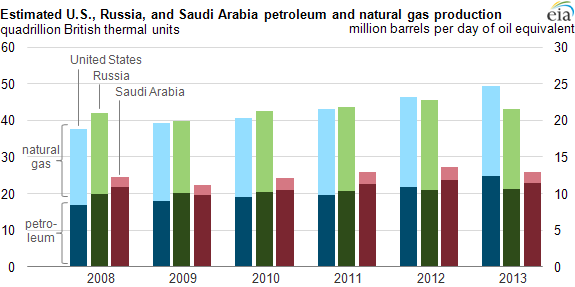 Since 2008, U.S. petroleum production has increased 7 quadrillion Btu, with dramatic growth in Texas and North Dakota. Natural gas production has increased by 3 quadrillion Btu over the same period, with much of this growth coming from the eastern United States. Russia and Saudi Arabia each increased their combined hydrocarbon output by about 1 quadrillion Btu over the past five years. Note: Petroleum production includes crude oil, natural gas liquids, condensates, refinery processing gain, and other liquids, including biofuels. Barrels per day oil equivalent were calculated using a conversion factor of 1 barrel oil equivalent = 5.55 million British thermal units (Btu).
What In The World!
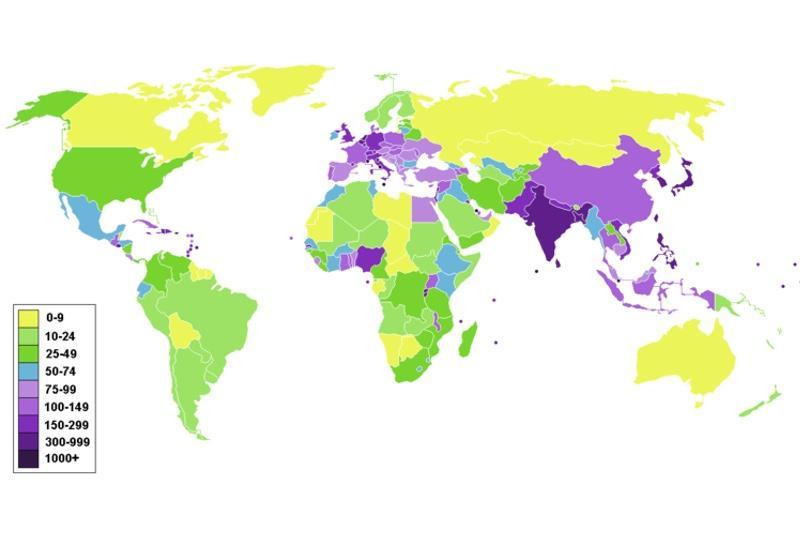
To gain perspective on just how differently people are living on this planet,

(Parts of Malaysia and Indonesia have been intentionally left out—without them, the red regions still contain more than 50.2% of the world’s population.)