
Tag: Technology
New Anti-Censorship Tool Marionette Could Make it Easier to Slip Past China’s Great Firewall | MIT Technology Review
 Governments can now block anticensorship tools such as the Tor anonymity network or encrypted VPN connections, for example. But a new censorship evasion tool called Marionette may help reverse that trend. Marionette helps Internet traffic that would normally be blocked masquerade as ordinary, permitted online behavior. It can be configured to make your activity emulate just about any type of “innocent” activity, such as online gaming or Skype, by analyzing samples of that kind of traffic. Marionette can even be programmed to respond in the right way to maintain its cover if actively probed by a censorship computer system, a tactic China sometimes uses to investigate suspicious connections before blocking them.
Coull hopes that Marionette will one day be integrated into the anonymity network Tor or the censorship evasion tool Lantern—two systems backed by the U.S. government and used by activists, government workers, and NGOs. He’s already talked with Tor developers about Marionette’s open-source code. The system was introduced in a paper at the USENIX Security conference in Washington, D.C., this month, and developed by Coull with Kevin Dyer andThomas Shrimpton of Portland State University
Help Desk

A Simple Explanation For The Mess We Are In
So, today, you have three basic systems: order provided by democratic, inclusive governments; order imposed by autocratic exclusivist governments; and ungoverned, or chaotically governed, spaces, where rickety failed states, militias, tribes, pirates and gangs contest one another for control, but there is no single power center to answer the phone — or, if they do, it falls off the wall.
Why is this happening now? Well, just as I’ve argued that “average is over” for workers, now “average is over for states,” too. Without the Cold War system to prop them up, it is not so easy anymore for weak states to provide the minimums of security, jobs, health and welfare. And thanks to rapid advances in the market (globalization), Mother Nature (climate change plus ecological destruction) and Moore’s Law (computing power), some states are just blowing up under the pressure.
via The World According to Maxwell Smart, Part 1 – NYTimes.com.
World Cup

20 Years Later

Helicopter Cat
 Dutch artist Bart Jansen (R) has found an unusual way paying his last respects to his pet cat Orville, who died after being hit by a car — he turned him into a helicopter, or a quadrocopter to be precise, with four rotors, each fitted to one outstretched paw. Jansen got help from a model airplane pilot, Arjen Beltmann (L), to mount the rotor blades in a way that ensures maximum flight stability.
via Photo Gallery of Cat Helicopter Constructed by Artist Bart Jansen – SPIEGEL ONLINE – International.
What Happens in an Internet Minute?
Do you know what happens in one minute on the Internet? In just one minute, more than 204 million emails are sent. Amazon rings up about $83,000 in sales. Around 20 million photos are viewed and 3,000 uploaded on Flickr. At least 6 million Facebook pages are viewed around the world. And more than 61,000 hours of music are played on Pandora while more than 1.3 million video clips are watched on YouTube.
 Today, the number of networked devices equals the world’s population. By 2015, the number of networked devices is expected to be double the world’s population. And by the time we reach 2015, it would take five years to view all the video content crossing IP networks each second. Click Infrograph to expand.
Hackers Are Winning The CyberWar – So Far
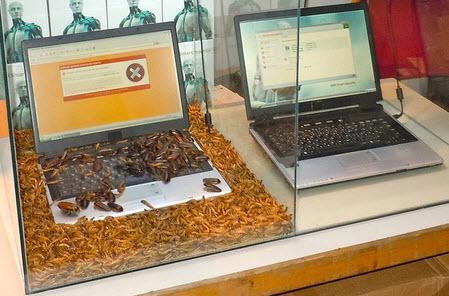
Virus writers are having a field day. A new industry has blossomed called Exploit Kits. Talented programmers sell their exploit kits for $3000 a pop to help their brethren malware writers deliver their payloads more effectively.
Late 2012, the NY Times published a controversial piece questioning the effectiveness of modern antivirus software. The shocking conclusion was that after an exhaustive analysis of over 40 antivirus products, there was only a 5% chance of detecting and defeating a new threat. That is, if a computer had 40+ antivirus products running simultaneously, there is a scant 5% chance that the computer would be safe from new threats.
 The US Department of Homeland Security advised last week that users disable Java. This is unprecedented. The government felt this is a computing problem so severe that it must intervene. Java is a real and present threat to not only our national security but our computers, privacy and wallets. The DHS has no motivation to sow misinformation or fear, and they should be heeded. Continue reading “Hackers Are Winning The CyberWar – So Far”
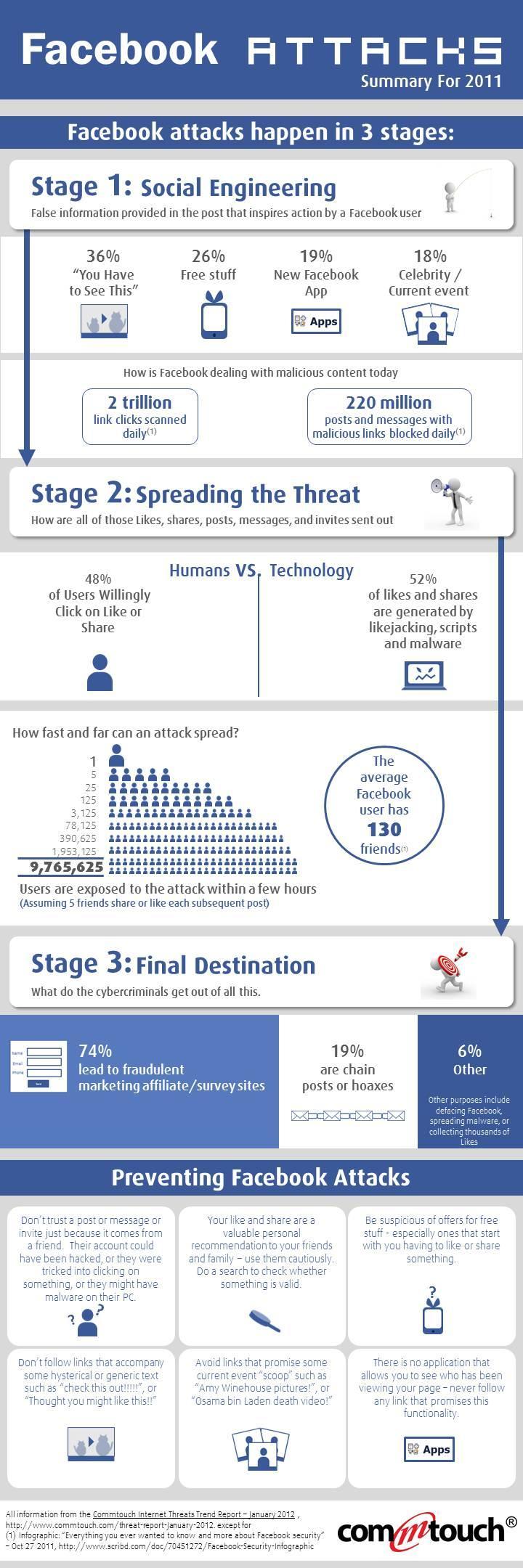
Facebook Attacks 2011