Hackers Are Winning The CyberWar – So Far

Virus writers are having a field day. A new industry has blossomed called Exploit Kits. Talented programmers sell their exploit kits for $3000 a pop to help their brethren malware writers deliver their payloads more effectively.

Late 2012, the NY Times published a controversial piece questioning the effectiveness of modern antivirus software. The shocking conclusion was that after an exhaustive analysis of over 40 antivirus products, there was only a 5% chance of detecting and defeating a new threat. That is, if a computer had 40+ antivirus products running simultaneously, there is a scant 5% chance that the computer would be safe from new threats.

Computer BugsThe US Department of Homeland Security advised last week that users disable Java. This is unprecedented. The government felt this is a computing problem so severe that it must intervene. Java is a real and present threat to not only our national security but our computers, privacy and wallets. The DHS has no motivation to sow misinformation or fear, and they should be heeded. Continue reading “Hackers Are Winning The CyberWar – So Far”

Why Are Indian Reservations So Poor?

At a time when there’s a spotlight on America’s richest 1%, a look at the country’s 310 Indian reservations–where many of America’s poorest 1% live–can be more enlightening. To explain the poverty of the reservations, people usually point to alcoholism, corruption or school-dropout rates, not to mention the long distances to jobs and the dusty undeveloped land that doesn’t seem good for growing much. But those are just symptoms. Prosperity is built on property rights, and reservations often have neither. They’re a demonstration of what happens when property rights are weak or non-existent.

The vast majority of land on reservations is held communally. That means residents can’t get clear title to the land where their home sits, one reason for the abundance of mobile homes on reservations. This makes it hard for Native Americans to establish credit and borrow money to improve their homes because they can’t use the land as collateral–and investing in something you don’t own makes little sense, anyway.

This leads to what economists call the tragedy of the commons: If everyone owns the land, no one does. So the result is substandard housing and the barren, rundown look that comes from a lack of investment, overuse and environmental degradation. It’s a look that’s common worldwide, wherever secure property rights are lacking—much of Africa and South America, inner city housing projects and rent-controlled apartment buildings in the U.S., Indian reservations.

via Why Are Indian Reservations So Poor? A Look At The Bottom 1% – Forbes.

When Will The College Bubble Burst?

Higher education’s business model is simply unsustainable.

Colleges have so far gotten away with their price hikes by making it easy for students to borrow money. But now the customers are tapped out. They owe $1 trillion, and they are having a rough time repaying that debt with the kinds of jobs available in today’s economy. Vedder notes that 115,000 janitors have bachelor’s degrees.

The system is ripe for an upheaval. Cheap online courses seem poised to deliver it. Traditional colleges at opposite ends of the glamour spectrum will probably survive. At one end, community colleges could deliver bankable skills in fields like nursing and computer network installation. At the other end, elite institutions like Princeton will carry on for a few more centuries.

In between? “It’s going to wipe out high-cost mediocre private schools without big endowments,” Vedder says.BSchoolBlues

via How Liberal Arts Colleges Could Go Bankrupt – Forbes.

Balancing the 3 Types of Innovation

efficiency innovations are liberating capital, and in the United States this capital is being reinvested into still more efficiency innovations. In contrast, America is generating many fewer empowering innovations than in the past. We need to reset the balance between empowering and efficiency innovations.

America today is in a macroeconomic paradox that we might call the capitalist’s dilemma. Executives, investors and analysts are doing what is right, from their perspective and according to what they’ve been taught. Those doctrines were appropriate to the circumstances when first articulated — when capital was scarce. But we’ve never taught our apprentices that when capital is abundant and certain new skills are scarce, the same rules are the wrong rules.

It’s as if our leaders in Washington, all highly credentialed, are standing on a beach holding their fire hoses full open, pouring more capital into an ocean of capital. We are trying to solve the wrong problem. The author presents solutions at the end of the article

via A Capitalist’s Dilemma, Whoever Wins the Election – NYTimes.com.

Plutocrats: The Rise of the New Global Super-Rich and the Fall of Everyone Else

Extractive states are controlled by ruling elites whose objective is to extract as much wealth as they can from the rest of society. Inclusive states give everyone access to economic opportunity; often, greater inclusiveness creates more prosperity, which creates an incentive for ever greater inclusiveness. Elites that have prospered from inclusive systems can be tempted to pull up the ladder they climbed to the top. Eventually, their societies become extractive and their economies languish.

Several recent studies have shown that in America today it is harder to escape the social class of your birth than it is in Europe. Educational attainment, which created the American middle class, is no longer rising.

Economists point out that the woes of the middle class are in large part a consequence of globalization and technological change. Culture may also play a role. In his recent book on the white working class, the libertarian writer Charles Murray blames the hollowed-out middle for straying from the traditional family values and old-fashioned work ethic that he says prevail among the rich (whom he castigates, but only for allowing cultural relativism to prevail).

The crony capitalism of today’s oligarchs is far subtler than Venice’s. It works in two main ways.

The first is to channel the state’s scarce resources in their own direction. This is the absurdity of Mitt Romney’s comment about the “47 percent” who are “dependent upon government.” The reality is that it is those at the top, particularly the tippy-top, of the economic pyramid who have been most effective at capturing government support — and at getting others to pay for it.

Exhibit A is the bipartisan, $700 billion rescue of Wall Street in 2008. Exhibit B is the crony recovery. The economists Emmanuel Saez and Thomas Piketty found that 93 percent of the income gains from the 2009-10 recovery went to the top 1 percent of taxpayers. The top 0.01 percent captured 37 percent of these additional earnings, gaining an average of $4.2 million per household.

via The Self-Destruction of the 1 Percent – NYTimes.com.

The Dirty Solar Panel Fight Over Clean Energy

Chinese technocrats set out to create an industry that would dominate the world, and they succeeded. They aided solar cell manufacturers with easy credit from state banks—perhaps as much as $18 billion of cheap loans—and, some say, subsidies. As a result of central and local government support, Chinese manufacturers began to expand rapidly. Chinese competitors now own 70% of the world’s wafer-producing capacity.

Make that overcapacity. “Massive subsidies and state intervention have stimulated overcapacity more than 20 times total Chinese consumption and close to double total global demand,” said Milan Nitzschke, president of EU ProSun, in a statement released late last month. The company alleges that 90% of Chinese production had to be exported and that Beijing used subsidies to keep its manufacturers in business.

The powerful Chinese National Development and Reform Commission wants to see two-thirds of panel makers go out of business.  Only the largest producers, which are presently nonviable, will survive.

In short, central government technocrats, to salvage their industrial policy, will now have to destroy what they worked so hard to create.

via Sun Sets on China’s Solar Industry – Forbes.

Is U.S. Economic Growth Over? Faltering Innovation Confronts the Six Headwinds

The analysis links periods of slow and rapid growth to the timing of the three industrial revolutions (IR’s), that is, IR #1 (steam, railroads) from 1750 to 1830; IR #2 (electricity, internal combustion engine, running water, indoor toilets, communications, entertainment, chemicals, petroleum) from 1870 to 1900; and IR #3 (computers, the web, mobile phones) from 1960 to present. It provides evidence that IR #2 was more important than the others and was largely responsible for 80 years of relatively rapid productivity growth between 1890 and 1972. Once the spin-off inventions from IR #2 (airplanes, air conditioning, interstate highways) had run their course, productivity growth during 1972-96 was much slower than before. In contrast, IR #3 created only a short-lived growth revival between 1996 and 2004. Many of the original and spin-off inventions of IR #2 could happen only once – urbanization, transportation speed, the freedom of females from the drudgery of carrying tons of water per year, and the role of central heating and air conditioning in achieving a year-round constant temperature.

Even if innovation were to continue into the future at the rate of the two decades before 2007, the U.S. faces six headwinds that are in the process of dragging long-term growth to half or less of the 1.9 percent annual rate experienced between 1860 and 2007. These include demography, education, inequality, globalization, energy/environment, and the overhang of consumer and government debt. A provocative “exercise in subtraction” suggests that future growth in consumption per capita for the bottom 99 percent of the income distribution could fall below 0.5 percent per year for an extended period of decades.

via Is U.S. Economic Growth Over? Faltering Innovation Confronts the Six Headwinds.

Rise of the Asian Welfare State

Although poorer countries still limit themselves to ad hoc welfare offerings, fitting the spending level to revenues one budget at a time, there is an increasing trend towards entitlements served by statutory institutions that will outlive the budgetary cycle. As these systems mature, welfare provision will be demand-led, not supply-driven; welfare will become integral to the state. Asia’s tigerish economies are turning marsupial, carrying their dependants along with them as they prowl.

Some of the national leaders who unleashed those tiger economies would be shocked and disturbed by the development. To them the welfare state was a Western aberration that would serve only to undermine thrift, industry and filial duty.

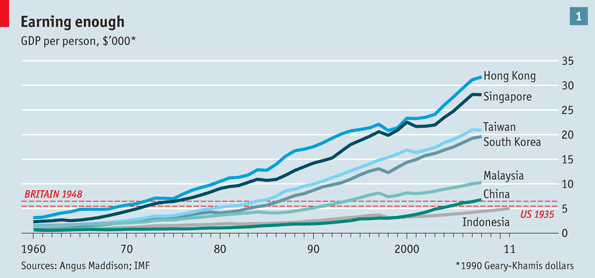
It seems that every country that can afford to build a welfare state will come under mounting pressure to do so. And much of Asia has hit the relevant level of prosperity (see chart 1). Indonesia is now almost as developed as America was in 1935 when it passed the landmark Social Security Act, according to figures compiled by the late Angus Maddison, an economic historian. China is already richer than Britain was in 1948, when it inaugurated the National Health Service (NHS) which, to judge by political ructions—and Olympic opening ceremonies—has become crucial to its sense of national identity.

via Asian welfare states: New cradles to graves | The Economist.

You Can’t Blame Your Stress On Work

Work stress, job satisfaction and health problems due to high stress have more to do with genes than you might think.

The lead author of “Genetic influences on core self-evaluations, job satisfaction, work stress, and employee health: A behavioral genetics mediated model,” published in Organizational Behavior and Human Decision Processes, Judge studied nearly 600 twins — some identical, some fraternal — who were raised together and reared apart. He found that being raised in the same environment had very little effect on personality, stress and health. Shared genes turned out to be about four times as important as shared environment.

via Feeling stressed by your job? Don’t blame your employer, study shows.

Everything You Think You Know About China Is Wrong

For the last 40 years, Americans have lagged in recognizing the declining fortunes of their foreign rivals. In the 1970s they thought the Soviet Union was 10 feet tall — ascendant even though corruption and inefficiency were destroying the vital organs of a decaying communist regime. In the late 1980s, they feared that Japan was going to economically overtake the United States, yet the crony capitalism, speculative madness, and political corruption evident throughout the 1980s led to the collapse of the Japanese economy in 1991.

Could the same malady have struck Americans when it comes to China? The latest news from Beijing is indicative of Chinese weakness: a persistent slowdown of economic growth, a glut of unsold goods, rising bad bank loans, a bursting real estate bubble, and a vicious power struggle at the top, coupled with unending political scandals. Many factors that have powered China’s rise, such as the demographic dividend, disregard for the environment, supercheap labor, and virtually unlimited access to external markets, are either receding or disappearing.

The current economic slowdown in Beijing is neither cyclical nor the result of weak external demand for Chinese goods. China’s economic ills are far more deeply rooted: an overbearing state squandering capital and squeezing out the private sector, systemic inefficiency and lack of innovation, a rapacious ruling elite interested solely in self-enrichment and the perpetuation of its privileges, a woefully underdeveloped financial sector, and mounting ecological and demographic pressures.


via Everything You Think You Know About China Is Wrong – By Minxin Pei | Foreign Policy.