

Category: Economy & Business
The Rise (and Likely Fall) of the Talent Economy
 As recently as 50 years ago, 72% of the top 50 U.S. companies by market capitalization still owed their positions to the control and exploitation of natural resources.
By 2013 more than half the top 50 companies were talent-based, including three of the four biggest: Apple, Microsoft, and Google. (The other was ExxonMobil.) Only 10 owed their position on the list to the ownership of resources. Over the past 50 years the U.S. economy has shifted decisively from financing the exploitation of natural resources to making the most of human talent.
Over the past 13 years the list’s number of hedge fund managers, by far the fastest-growing category, has skyrocketed from four to 31, second only to computer hardware and software entrepreneurs (39) in possessing the greatest fortunes in America.
The Republican Party seems foursquare behind hedge funds, which it sees as embodying capital—even though hedge fund managers are in fact talent, a breakaway branch of labor (their overcharged customers are the real representatives of capital). The Democratic Party, traditionally supportive of organized labor, has increasingly transferred its allegiance to capital, largely because pension funds have become the most important form of capital and their beneficiaries represent the traditional Democratic power base. Neither party represents labor directly.
via The Rise (and Likely Fall) of the Talent Economy – Harvard Business Review.
The Expanded Scope of Conflict Today
Wars are traditionally fought over territory. But the definition of territory has evolved to incorporate five domains: land, air, sea, space, and, most recently, cyberspace. These dimensions of “CLASS war” define the threats facing the world today. The specific triggers, objectives, and battle lines of such conflicts are likely to be determined, to varying degrees, by five factors: creed, clan, culture, climate, and currency. Indeed, these factors are already fueling conflicts around the world.
NBA Ownership – The World’s Most Exclusive Club
NBA teams are clearly ego purchases, but rich guys hate losing money … and that’s about ego, too. In 2010 and 2011, six NBA franchises sold or changed hands, and another four were practically thrown on Craigslist.2 That’s one-third of the league. A steady stream of billionaires crunched numbers and came to the same conclusion: Unless it’s a killer market, the NBA isn’t a good investment. During 2011’s lockout, Philly sold for a measly $280 million as the league frantically looked for a New Orleans buyer (and didn’t find one).
Everything flipped in December of that year, after the NBA negotiated an owner-favorable collective bargaining agreement (and then some) that included a 50-50 revenue split, shorter long-term deals and a more punitive luxury tax system, as well as a pay-per-view event in which David Stern and Adam Silver poured Dom Perignon on each other’s heads and danced over the ruins of Billy Hunter’s career. Fine, I made that last one up. From there, everything kept breaking the NBA’s way. In no particular order …
 • The economy rebounded (at least in rich guy circles).
• LeBron became the league’s most famous and talented superstar since MJ, right as we suddenly had the deepest pool of under-27 stars in 20-plus years.
• The 2013 Finals went down as one of the greatest Finals ever, followed by a LeBron-Durant rivalry emerging that could and should carry the rest of the decade.
• Americans stopped caring about PEDs and started worrying about concussions right when everyone should have started worrying about PEDs in basketball (a sport that rarely has any concussions).
• The YouTube/broadband/iPad/GIF/Instagram/Twitter era turned basketball into a 24/7 fan experience — just the ideal sport for the Internet era, the kind of league in which your buddies email you a bizarre Kobe Bryant tweet, an endearing Spurs team selfie and a ridiculous Blake Griffin dunk GIF in the span of three hours (and by the way, that happened to me yesterday).
• A new multimedia rights deal is coming soon … and it’s going to easily double the current deal.
(Repeat: easily double it.)
And I didn’t even mention basketball grabbing the no. 2 spot behind soccer as the world’s most popular sport. I’m not sure when it happened, but it happened. Buy an NBA franchise in 2014 and deep down, you’re thinking about stuff like, I wonder if fans from 250 countries will be paying for League Pass 20 years from now? Throw in the other breaks and that’s how you end up climbing from here …
What world can teach U.S. about entitlements
Entitlement Lessons From Abroad A new report, by the Center for Strategic and International Studies, notes that many countries have recently enacted reforms that have trimmed benefit formulas, raised retirement ages, and put in place new funded pension systems that supplement or partially substitute for pay-as-you-go government systems.
Several countries – including Germany, Italy, Japan, and Sweden – have gone further and introduced “automatic stabilizers” into their public pension systems that, directly or indirectly, index benefits to the growth in the payroll tax base. These stabilizers may differ in design, but they have two crucial characteristics in common. First, they are all expressly designed to offset the full impact of demographically driven cost growth. And second, they are all self-adjusting. In effect, they put entitlements on a new kind of autopilot – one that is preprogrammed for cost constraint rather than for cost growth.
 It’s ironic that other developed countries, most of which have faster-aging populations and more expansive welfare states than the United States, are leading the way on entitlement reform. Part of the explanation may be that, until recently, America’s age wave still loomed over the horizon, while in Europe and Japan aging populations have been burdening public budgets, forcing up payroll tax rates, and slowing economic growth for decades.
Part of the answer may also lie in America’s peculiar entitlement ethos. In Europe, government benefit programs may be fiercely defended, with the opponents of reform manning the barricades and calling general strikes. But in the end, everyone understands that they are part of a social contract that is subject to renegotiation and revision. In the United States, much of the public views Social Security and Medicare as quasi-contractual arrangements between individuals and the state. This mindset, which is encouraged by the misleading insurance metaphors in which the programs are cloaked, may make old-age benefits more difficult to reform in the United States than in Europe’s large welfare states.
via What world can teach U.S. about entitlements – Global Public Square – CNN.com Blogs.
If You Also Hate The Time Change…
Accord ing to Time and Date, a Norwegian Newsletter dedicated to time zone information, America started using four time zones in 1883. Before that, each city had its own time standard based on its calculation of apparent solar time (when the sun is directly over-head at noon) using sundials. That led to more than 300 different American time zones. This made operations very difficult for the telegraph and burgeoning railroad industry. Railroads operated with 100 different time zones before America moved to four, which was consistent with Britain’s push for a global time standard.
Now the world has evolved further—we are even more integrated and mobile, suggesting we’d benefit from fewer, more stable time zones. Why stick with a system designed for commerce in 1883? In reality, America already functions on fewer than four time zones.
Research based on time use surveys found American’s schedules are determined by television more than daylight. That suggests in effect, Americans already live on two time zones.
via Daylight Saving Time Is Terrible: Here’s a Simple Plan to Fix It – Allison Schrager – The Atlantic.
Did You Ever Think the U.S. Would be largest Energy Producer?
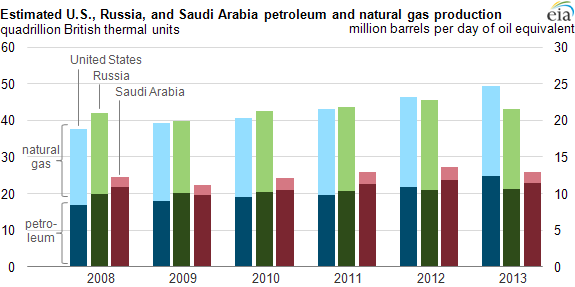 Since 2008, U.S. petroleum production has increased 7 quadrillion Btu, with dramatic growth in Texas and North Dakota. Natural gas production has increased by 3 quadrillion Btu over the same period, with much of this growth coming from the eastern United States. Russia and Saudi Arabia each increased their combined hydrocarbon output by about 1 quadrillion Btu over the past five years. Note: Petroleum production includes crude oil, natural gas liquids, condensates, refinery processing gain, and other liquids, including biofuels. Barrels per day oil equivalent were calculated using a conversion factor of 1 barrel oil equivalent = 5.55 million British thermal units (Btu).
Corporate Logos for the States of America
 The Corporate States of America Made by Steve… – Maps on the Web.
Did Cocaine Fuel the Financial Bubble?
The controversial former drug tsar David Nutt told the London Sunday Times this weekend that cocaine-using bankers with their “culture of excitement and drive and more and more and more … got us into this terrible mess”.
Nutt, who was sacked for claiming that ecstasy was as safe as horse riding, told the Sunday Times that abuse of cocaine caused the financial meltdown.
“Bankers use cocaine and got us into this terrible mess,” he told the paper adding that the drug made them “overconfident” and led to them taking more risks. Nutt, who is professor of neuropsychopharmacology at Imperial College, claimed that cocaine was perfect for a banking “culture of excitement and drive and more and more and more. It is a ‘more’ drug”
There were also lots of stories about some of the big swingers in New York enjoying a line or 10 of an evening. Bernie Madoff’s office was apparently known as “the North Pole” such were the gargantuan quantities of “snow” to be found there and most bankers are aware of the published allegations that Jimmy Cayne (former CEO of Bear Stearns) had an anti-acid medication bottle that was filled with cocaine.
 Dr Chris Luke, an A&E specialist based at Cork University Hospital, Ireland, who has studied the effects of cocaine on bankers, has stated that “prominent figures in financial and political circles made irrational decisions as a result of megalomania brought on by cocaine usage”. He concludes that “people were making insane decisions and thinking they were 110% right … which led to the current chaos.”
Greed, selfishness, ignorance and ruthlessness also played their part, of course, but I think it would be foolish not to see the role that the drug played in creating the bubble.
Did cocaine use by bankers cause the global financial crisis? | Business | The Guardian.
Rich Blocks, Poor Blocks | Neighborhood Income and rent maps of U.S. cities
 Rich Blocks, Poor Blocks is an interactive map (created by Christopher Persaud, a data reporter for a bank website) showing the average income for every neighborhood in America. Type in your address, press search, and there you have it: Your city, shaded by income, according to data from an annual survey conducted by the Census Bureau. The greenest blocks–Census blocks, that is, not city blocks–signify the richest areas, typically bringing in an average household income of $100,000 or more a year. The reddest blocks are the poorest, with annual income somewhere around $20,000. All the rest get some shade of red or green, depending where they fall.
Rich Blocks, Poor Blocks | Neighborhood income and rent maps of U.S. cities.