How Our 1% Compares

It’s right out of 1880s America:

In China, less than 1% of households control more than 70% of private financial wealth.

In the US today, we’re talking somewhere between 40 and 45 percent.

Globally, says, John Bussey in the WSJ, the number is “nearly 40%,” so America’s not much off the norm.

For China to truly advance and become a genuine competitive threat, the political system has to decide to divorce wealth from political power.  Otherwise we’re looking at decay and decline and a very short “Chinese century.”

US hit that moment and launched itself into a multi-decade progressive era that cleaned up a lot of things but government most of all.

As I have said many times, the world needs a small army of Teddy Roosevelts right now – but China most of all.

via Thomas P.M. Barnett’s Globlogization – Blog – China’s looming populist problem.

China’s Cash Crunch

At first glance, that proposition seems preposterous. After all, the People’s Bank of China, the central bank, held $3.24 trillion of foreign currency reserves at the end of the first half of this year. Yet foreign currency, no matter how plentiful, has limited usefulness in a local currency crisis. In any event, the PBOC’s foreign currency holdings are almost evenly matched with renminbi-denominated liabilities that were incurred to acquire all those dollars, pounds, euros, and yen. As a result, the central bank cannot use the reserves without driving itself deep—actually, deeper—into insolvency.

When shops close to avoid predatory officials, we know China’s coffers are almost empty.  And to make matters worse, the country’s financial problems will be harder to solve now that the country’s balance of payments has turned negative.  The net outflow in the second quarter of this year was the first since 1998.  The country’s reserves also dropped in Q2.  We should not be surprised: there was perhaps $110 billion of capital flight during that period, and the gusher outflow looks like it continued in June.  Chinese citizens are losing confidence fast.

No developing country has ever escaped a major financial crisis.  The People’s Republic of China is about to have its first one now

via China Is Running Out Of Money – Forbes.

Return of the disparaged “Limits to Growth” Prediction

Carlton Palmer shares this gem with these comments:

Thoughtful, analysis and personal take from a Financial realist .  Civilized not a Rant! Long, Worth the effort. Ex Pat Brit.Jeremy Granthams take on the ongoing food crisis  plus the Game changer implications for the Human condition. Of note “the ethanol/gas” idiocy.

Click on the link to download the .pdf file and take the time to read this 22 page analysis

Ex Pat Brit. Jeremy Granthams take on the ongoing food crisis

No free beer when frugal Swiss get their say

Swiss research shows that giving citizens a direct say over how their taxes are spent leads to lower public debts, more cost-efficient services and even less tax evasion. “Because Swiss citizens feel they can control politicians’ spending through referendums, they are more prepared to give the government money and have a more positive attitude towards the state,” said Daniel Kuebler, co-director of the Centre for Democracy Studies in the northern Swiss town of Aarau.

To be sure, direct democracy is not the only driver of the Swiss success story. The country’s neutrality, bank secrecy, liberal labor market, low taxes and stable government have all played their part in drawing investment and driving growth. But the system has forced politicians to be more frugal than elsewhere.

In the United States, direct democracy is frequently blamed for the fiscal mess in California, where a 1978 referendum known as Proposition 13 changed the state constitution to ban increases in property taxes in line with inflation. Supporters say the measure put a sensible limit on state spending, but opponents say it warped the property market to benefit the rich, forced other taxes up and made it impossible for towns to keep pace with the cost of public services. This year, three Californian cities filed for bankruptcy in the space of weeks.

Kuebler said Switzerland’s referendums, which allow voters to overrule spending decisions by the legislature, do a better job of encouraging fiscal responsibility. “You might think that direct democracy would lead to greater public spending because anyone can put forward an initiative, for example, proposing free beer for all,” said Kuebler. “But it would never have a chance, because the preference of Swiss citizens is fiscally conservative and not redistributive.”

via No free beer when frugal Swiss get their say | Reuters.

The 11 Ways That Consumers Are Hopeless at Math

You walk into a Starbucks and see two deals for a cup of coffee. The first deal offers 33% extra coffee. The second takes 33% off the regular price. What’s the better deal?

“They’re about equal!” you’d say, if you’re like the students who participated in a new study published in the Journal of Marketing. And you’d be wrong. The deals appear to be equivalent, but in fact, a 33% discount is the same as a 50 percent increase in quantity. Math time: Let’s say the standard coffee is $1 for 3 quarts ($0.33 per quart). The first deal gets you 4 quarts for $1 ($0.25 per quart) and the second gets you 3 quarts for 66 cents ($.22 per quart).

The upshot: Getting something extra “for free” feels better than getting the same for less. The applications of this simple fact are huge. Selling cereal? Don’t talk up the discount. Talk how much bigger the box is! Selling a car? Skip the MPG conversion. Talk about all the extra miles

via Business – Derek Thompson – The 11 Ways That Consumers Are Hopeless at Math – The Atlantic.

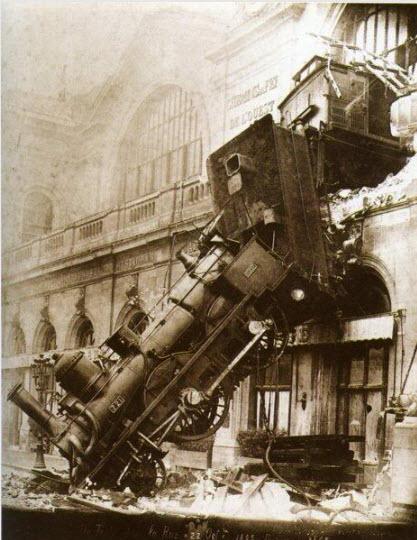
California Doesn’t Learn From China’s Train Wreck

In California’s Legislature just authorized to spend, with Federal assistance, an under-estimated $100 billion to build a route between San Francisco and Los Angeles that will consist of a government monopoly riding on tracks near one of the largest earthquake faults in the world for most of its length, all to deliver passengers slower and at greater overall cost between two fixed points.  Airlines give consumers a choice of carriers and airports on either end of that route, will deliver passengers more quickly, and probably with a much wider choice of departure and arrival times.

In China the problem — beyond the idea of spending untold billions on the antiquated technology of static choo-choo trains — is that the three people making all these wonderful decisions  now have a high-speed rail system plagued by failurecorruption, out-of-control costs and legitimate safety concerns

The fact is that China’s train wreck was eminently foreseeable. High-speed rail is a capital-intensive undertaking that requires huge borrowing upfront to finance tracks, locomotives and cars, followed by years in which ticket revenue covers debt service — if all goes well. “Any . . . shortfall in ridership or yield, can quickly create financial stress,” warns a 2010 World Bank staff report.

Such “shortfalls” are all too common. Japan’s bullet trains needed a bailout in 1987. Taiwan’s line opened in 2007 and needed a government rescue in 2009. In France, only the Paris-Lyon high-speed line is in the black.

via China’s train wreck – The Washington Post.

Trends In The Spread of Civilization

In his latest book, Civilization, The West and the Rest, the economic and financial historian Niall Ferguson argues that Western civilization’s rise to global dominance over the past 500 years was due mainly to six killer apps, as he calls them: competition, science, rule of law, modern medicine, consumerism, and the work ethic.

While “the Rest” lacked these concepts, they might not for much longer, as emerging markets are quickly catching up. Someday, they could even surpass the West. (On May 22 and 29, PBS will air a program based on Civilization.)

What made the West unusual was that risk takers were not only rewarded but honored, whether in science, exploration, or in trade. Spreading across the Atlantic from Europe is an anti-risk culture that manifests itself in two ways. One is the welfare state, designed to remove risk from your life by guaranteeing you an income from the cradle to the grave. That’s great because it means that nobody is starving in the streets for want of work. But it isn’t great if you create poverty traps and disincentives, so that people in the bottom quintile never work, which is the case in much of Europe.

The other way in which the anti-risk culture manifests itself is with the manic regulatory mentality that tries to prescribe rules for every eventuality, including the tiny, tiny risk that an asteroid will hit this building. Regulations that protect from every eventuality end up being paralyzing because the more things are proscribed, the more the ordinary entrepreneur has to be afraid that if he doesn’t comply, he will get sued.

via Is America Becoming an Anti-Risk Welfare State? – Barrons.com.

Boomer or Bust – The War Against Youth

The recession didn’t gut the prospects of American young people. The Baby Boomers took care of that.

David Frum, former George W. Bush speechwriter, had the guts to acknowledge that the Tea Party’s combination of expensive entitlement programs and tax cuts is something entirely different from a traditional political program: “This isn’t conservatism: It’s a going-out-of-business sale for the Baby Boom generation.”

The impasse of the moment is, tragically, the result of the best aspects of the Boomers’ spirit. The native optimism that emerged out of the explosively creative postwar world led them to believe that growth would go on forever; that peace and prosperity were the natural state of things. Their good intentions seem like willful naivete today, but the intentions were genuine. Clinton actually believed that globalization would export the First World rather than bring the Third World home; it did both.

via Young People in the Recession – The War Against Youth – Esquire.

1% Getting Richer In European Welfare States Too

As the chart from the Roine and Waldenström study shows, the share of income for the top 1% in these seven countries generally follows the same trend line. That means domestic policy can’t be the principal reason for the current spread between high earners and others. Since the 1980s, that spread has increased in nearly all seven countries. The U.S. and Sweden, countries with very different systems of redistribution, along with the U.K. and Canada show the largest increase in the share of income for the top 1%.

The main reasons for these increases are not hard to find. Adding a few hundred million Chinese and Indians to the world’s productive labor force after 1980 slowed the rise in income for workers all over the developed world. That’s the most important factor at work. The top 1% gain relatively because they are less affected by the hordes of newly productive workers.

But the top 1% have another advantage. Many of them have unique skills that are difficult to replicate. Our top earners include entrepreneurs, rock stars, professional athletes, surgeons and lawyers. Also included are the managers of large international corporations and, yes, bankers and financiers

via Allan Meltzer: A Look at the Global One Percent – WSJ.com.