 The Arab world’s so-called “democracy deficit” is not tied to the Islamic religion but rather to the Arab world’s history and the institutions introduced following conquest by Arab armies over 1000 years ago, according to a new paper presented today at the Spring 2012 Conference on the Brookings Papers on Economic Activity BPEA. Continue reading “After a 1000 Years – The Arab Spring”
Tag: Religion
The History Behind Eating Fish On Friday
Let’s start with a quick lesson in theology: According to Christian teaching, Jesus died on a Friday, and his death redeemed a sinful world. People have written of fasting on Friday to commemorate this sacrifice as early as the first century.
Technically, it’s the flesh of warmblooded animals that’s off limits — an animal “that, in a sense, sacrificed its life for us, if you will,” explains Michael Foley, an associate professor at Baylor University and author of Why Do Catholics Eat Fish On Friday?
Fish are coldblooded, so they’re considered fair game. “If you were inclined to eat a reptile on Friday,” Foley tells The Salt, “you could do that, too.”
Alas, Christendom never really developed a hankering for snake. But fish — well, they’d been associated with sacred holidays even in pre-Christian times. And as the number of meatless days piled up on the medieval Christian calendar — not just Fridays but Wednesdays and Saturdays, Advent and Lent, and other holy days — the hunger for fish grew. Indeed, fish fasting days became central to the growth of the global fishing industry. Continue reading “The History Behind Eating Fish On Friday”
Ten Rules for Being Human

Atheists have ‘better sex than religious followers who are plagued with guilt’
Atheists have far better sex lives than religious people who are plagued with guilt during intercourse and for weeks afterwards, researchers have found.
But devoutly religious people rated their sex lives far lower than atheists. They also admitted to strong feelings of guilt afterwards.
Strict religions such as Mormons ranked highest on the scale of sexual guilt. Their average score was 8.19 out of 10. They were followed closely behind by Jehovah’s Witness, Pentecostal, Seventh Day Adventist, and Baptist. Catholics rated their levels of sexual guilt at 6.34 while Lutherans came slightly lower at 5.88 . In contrast, atheists and agnostics ranked at 4.71 and 4.81 respectively.
People who had left their beliefs behind said their sex lives were ‘much improved’ and rated their new experiences on average as 7.81 out of ten.
The findings emerged in the ‘Sex and Secularism’ survey of more than 14,500 people carried out by psychologist Darrel Ray and Amanda Brown from Kansas University.
via Atheists have ‘better sex than religious followers who are plagued with guilt’ | Mail Online.
Continue reading “Atheists have ‘better sex than religious followers who are plagued with guilt’”
The Catastrophic Failure of European Multiculturalism
Europe’s leaders have realized, and are acknowledging one after another, that that continent’s multiculturalist policy–the idea that geographic areas could be ceded to immigrants from Islamic countries who would treat them as Islamic enclaves, rather than being encouraged to assimilate–has been a disastrous failure. CBN has a good report on the current status of multiculturalism in Europe. It begins:
France has some 751 “No Go” zones. The French government has labeled these areas “sensitive urban zones” that are dangerous for whites and non-Muslims to enter.

This map shows how these “no go zones” are distributed around France:
via Power Line – The Catastrophic Failure of European Multiculturalism.
I asked a French friend if it was really that bad there and got this reply from her:
The basic Idea of the article is wrong . The “Multikulti” comes from Germany (http://en.wikipedia.org/wiki/Multikulti) and it’s goal was to integrate Muslim residents into Society all the whilst respecting their religious beliefs and habits. As far as I know, there was no intention at all to have them live in ethnical enclaves.
A couple of years ago , I wasn’t paying enough attention and accidently took one of Nice North’s exits (l’Ariane) off the highway.(Can’t happen anymore, the exit has been condemned).
Other than the fact, that I was shocked to see such poverty some 10 miles from the flourishing Cote d’Azur ,I still don’t know how I made it out there alive…
Since quite a few years no Pizza guy will deliver anything in this (pretty huge) area.
The last time I read that cops (obviously accidently) drove in there, they found themselves running for their lives (car had been set on fire) and that TOTALLY NAKED.
The first big wave of immigrants (after WW2) worked hard and really tried to integrate. So did their next generation. The third generation however, is searching for an own “identity”, very often going back to old Muslim traditions and/or violence. And there come the problems…
Now you know it all..
WikiLeaks Reveals Saudi Party Scene
It begins by clearing the prince’s security detail. Next up was a coat-check area where women pulled off their head-to-toe black abayas. Inside, Filipino bartenders served up a cocktail punch using moonshine vodka. An American “energy drink company” – whose name was blacked out on the WikiLeaks release – helped bankroll the bash that included, the diplomat was told, some prostitutes mingling in the crowd.
“The scene resembled a nightclub anywhere outside the kingdom: plentiful alcohol, young couples dancing, a DJ at the turntables and everyone in costume,” the message continued.
Bottles of name-brand booze were behind the bar, but apparently only for display. A black market bottle of Smirnoff, the cable said, can cost up to $400 “when available” compared with about $26 for a bottle of home-brewed vodka.
Wild parties rage behind closed doors in Tehran even as Iran’s hard-liners tighten their grip. Conservative Gulf sheiks make sure their wine cellars are well stocked.Outside Saudi Arabia, it’s not unusual to see a traveler from the desert kingdom hunkered down at an airport bar or letting loose in Bahrain – a favorite party haunt for Saudis who can simply drive over a causeway and, sometimes, weave their way home
The Rise Of Youthful Secularism
The most rapidly growing religious category today is composed of those Americans who say they have no religious affiliation. While middle-aged and older Americans continue to embrace organized religion, rapidly increasing numbers of young people are rejecting it.
 As recently as 1990, all but 7% of Americans claimed a religious affiliation, a figure that had held constant for decades. Today, 17% of Americans say they have no religion, and these new “nones” are very heavily concentrated among Americans who have come of age since 1990. Between 25% and 30% of twentysomethings today say they have no religious affiliation — roughly four times higher than in any previous generation.
Sociologists Michael Hout and Claude Fischer of UC Berkeley were among the first to call attention to the ensuing rise in young “nones,” and in our recent book, “American Grace,” we have extended their analysis, showing that the association between religion and politics (and especially religion’s intolerance of homosexuality) was the single strongest factor in this portentous shift. In religious affinities, as in taste in music and preference for colas, habits formed in early adulthood tend to harden over time. So if more than one-quarter of today’s young people are setting off in adult life with no religious identification, compared with about one-20th of previous generations, the prospects for religious observance in the coming decades are substantially diminished.
via Religion, politics: Walking away from church – latimes.com.
Atheists Most Knowledgeable About Religion
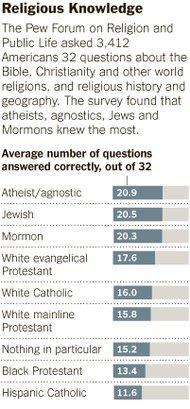 Americans are by all measures a deeply religious people, but they are also deeply ignorant about religion.
On average, people who took the survey answered half the questions incorrectly, and many flubbed even questions about their own faith.
Those who scored the highest were atheists and agnostics, as well as two religious minorities: Jews and Mormons. The results were the same even after the researchers controlled for factors like age and racial differences.
But what really dropped my jaw with surprise were the two lowest-performing groups: Black Protestants (13.4 percent) and Hispanic Catholic (11.6 percent).
via Atheists Outdo Some Believers in Survey on Religion – NYTimes.com.
Religionization of American Politics
Obama isn’t the first president to have to deal with this. Abraham Lincoln, who never joined a church and was notoriously ambiguous and secretive about his religious beliefs, famously said, “The Bible is not my book nor Christianity my profession.” In his later years, despite denouncing those who were “enemies of” or “scoffed at” religion, he reiterated, “My earlier views of the unsoundness of the Christian scheme of salvation and the human origin of the scriptures, have become clearer and stronger with advancing years and I see no reason for thinking I shall ever change them.”
And Lincoln wasn’t alone, either. In fact, the United States was created by a very skeptical group of Founding Fathers. Continue reading “Religionization of American Politics”
The Balfour Declaration: The Origin of the Arab Israeli Conflict
 According to Schneer (London 1900), an expert in modern British history at Georgia Tech, intrigue and British doubledealing defined the 1917 Balfour Declaration of British support for a Jewish “national home” in Palestine as much as bravery and vision, leading to the disillusionment, distrust, and resentment that still dominate the region today. British Jewish chemist and Zionist leader Chaim Weizmann orchestrated the campaign to persuade powerful men that support for Zionism would benefit Britain’s wartime cause and the ensuing peace. Perhaps most shrewdly, Weizmann lobbied former prime minister Arthur James Balfour, then a member of Britain’s War Council. Meanwhile, Grand Sharif Hussein and his sons had won British backing for an Arab kingdom, which would presumably include Palestine, and with British encouragement rebelled against the Ottomans in 1916. Through British duplicity, the French also believed they had a interest in Palestine. And three months after the Balfour Declaration, British prime minister Lloyd George proposed a separate peace with Turkey, with the Ottomans remaining in Palestine.
via Amazon.com: The Balfour Declaration: The Origins of the….