The Conversion of a Climate-Change Skeptic

$150K, which was the largest funding source for this research came from the Koch foundation. The Koch brothers are billionaire conservative benefactors and probably hadn’t expected or wanted these results.

Our results show that the average temperature of the earth’s land has risen by two and a half degrees Fahrenheit over the past 250 years, including an increase of one and a half degrees over the most recent 50 years.  Why it is man-made is based simply on the close agreement between the shape of the observed temperature rise and the known greenhouse gas increase.

It’s a scientist’s duty to be properly skeptical. I still find that much, if not most, of what is attributed to climate change is speculative, exaggerated or just plain wrong. I’ve analyzed some of the most alarmist claims, and my skepticism about them hasn’t changed.Hurricane Katrina cannot be attributed to global warming. The number of hurricanes hitting the United States has been going down, not up; likewise for intense tornadoes. Polar bears aren’t dying from receding ice, and the Himalayan glaciers aren’t going to melt by 2035. And it’s possible that we are currently no warmer than we were a thousand years ago, during the “Medieval Warm Period” or “Medieval Optimum,” an interval of warm conditions known from historical records and indirect evidence like tree rings. And the recent warm spell in the United States happens to be more than offset by cooling elsewhere in the world, so its link to “global” warming is weaker than tenuous.

The careful analysis by our team is laid out in five scientific papers now online at BerkeleyEarth.org. That site also shows our chart of temperature from 1753 to the present, with its clear fingerprint of volcanoes and carbon dioxide, but containing no component that matches solar activity.

via The Conversion of a Climate-Change Skeptic – NYTimes.com.

Some corals like it hot: Heat stress may help coral reefs survive climate change

“Until recently, it was widely assumed that coral would bleach and die off worldwide as the oceans warm due to climate change,” says lead author Jessica Carilli, a post-doctoral fellow in Australian Nuclear Science and Technology Organisation’s (ANSTO) Institute for Environmental Research. “This would have very serious consequences, as loss of live coral — already observed in parts of the world — directly reduces fish habitats and the shoreline protection reefs provide from storms.”

“Even through the warming of our oceans is already occurring, these findings give hope that coral that has previously withstood anomalously warm water events may do so again,” says Carilli. “While more research is needed, this appears to be good news for the future of coral reefs in a warming climate.”

via Some corals like it hot: Heat stress may help coral reefs survive climate change.

Ice Island Breaks off Greenland; Bigger Than Manhattan

No this video isn’t of this arctic event, but shows the force unleashed just by a large chunk. One piece flew off and broke womans leg – you can see a piece of ice whistle by the cameraman.

An ice chunk four times the size of Manhattan has broken off of Greenland’s Petermann glacier—possibly the biggest glacier collapse in recorded history, scientists announced Friday.(Greenland map).

via Ice Island Breaks off Greenland; Bigger Than Manhattan.


Arctic ‘tipping point’ Unlikely Soon

Danish researchers analyzed ancient pieces of driftwood in north Greenland which they say is an accurate way to measure the extent of ancient ice loss. Writing in the journal Science, the team found evidence that ice levels were about 50% lower 5,000 years ago. They say changes to wind systems can slow down the rate of melting. They argue, therefore, that a tipping point under current scenarios is unlikely.

A Danish team believes it has found an indirect method that gives a clear picture of the ice loss dating back 11,000 years.Dr Svend Funder from the Natural History Museum of Denmark led several expeditions to inhospitable regions of Northern Greenland. On these frozen shores the Danish team noticed several pieces of ancient driftwood. They concluded that it could be an important method of unlocking the secrets of the ancient ice.

“Driftwood cannot float across the water, it has to be ferried across the ocean on ice, and this voyage takes several years, which means that driftwood is actually a signal of multi-year sea ice in the ocean and it is this ice that is at risk at the moment” said Dr Funder.

Carbon dating was used to determine the age of the wood. And figuring out its origins also yielded important information.

“It’s so lovely that drift wood from Siberia is mainly larch and from North America is mainly spruce. So if we see there was more larch or spruce we can see that the wind system had changed and in some periods there was little spruce and in other periods there was lots,” he said.

via BBC News – Arctic ‘tipping point’ may not be reached.

China’s Burning Coal Has Cooled the Climate

In Proceedings of the National Academy of Sciences, concludes that smog from the extra coal acted to mask greenhouse warming. China’s coal use doubled 2002-2007, according to US government figures.

Although burning the coal produced more warming carbon dioxide, it also put more tiny sulphate aerosol particles into the atmosphere which cool the planet by reflecting solar energy back into space.

Piers Forster from the UK’s Leeds University, who led the IPCC chapter analysing factors affecting global temperatures, said the new study was “interesting and worthwhile”.”The masking of CO2-induced global warming by short term sulphur emissions is well known – it’s believed that the flattening off of global mean temperatures in the 1950s was due to European and US coal burning, and just such a mechanism could be operating today from Chinese coal,” he told BBC News.

via BBC News – Global warming lull down to China’s coal growth.

Our Sick Oceans

Life on Earth has gone through five “mass extinction events” caused by events such as asteroid impacts; and it is often said that humanity’s combined impact is causing a sixth such event. The IPSO report concludes that it is too early to say definitively. But the trends are such that it is likely to happen, they say – and far faster than any of the previous five.

“What we’re seeing at the moment is unprecedented in the fossil record – the environmental changes are much more rapid,” Professor Rogers told BBC News. “We’ve still got most of the world’s biodiversity, but the actual rate of extinction is much higher [than in past events] – and what we face is certainly a globally significant extinction event.”

The report also notes that previous mass extinction events have been associated with trends being observed now – disturbances of the carbon cycle, and acidification and hypoxia (depletion of oxygen) of seawater. Levels of CO2 being absorbed by the oceans are already far greater than during the great extinction of marine species 55 million years ago (during the Paleocene-Eocene Thermal Maximum), it concludes.

via BBC News – World’s oceans in ‘shocking’ decline.

Why Food Will Become the Biggest Security Threat

The 19th century is the century of chemistry and that gets us chemical weapons in World War I. The 20th century is the century of physics and that gets us nuclear weapons in World War II. But the 21st century? That’s the century of biology, and that gets us biological weaponry and biological terror. My point: obsessing over nuclear terrorism is steering by our rearview mirror. If you think people are afraid of radiation (dirty nukes, etc.), that’s nothing compared to their fear of tainted food. My point: if you’re a terrorist looking to sow fear and confusion, disrupt supply chains and ruin crucial industries, you can’t do much better than to work some biological mischief on food networks.

The average farm-to-fork journey in this world is now about 1,500 miles, and it’s getting longer by the week. Global climate change will make it harder to grow food across a thick band of territory (roughly up to/down to the 35th parallel) centered on the Equator. That’s where most of the population growth and water stress problems will erupt in coming decades, and it’s also where countries all tend to be highly dependent on imported food. See your Arab Spring and realize how much of this unrest is caused by rising food prices and you’ll get the overall picture.

Mark my post: this century is all about biology, rising food demand – and thus dependencies exacerbated by climate change (see the buying-up of arable land in Africa by Arab and Asian nations), and thus biological terror comes to the fore. Forget about energy nets, because they all go far more localized with smart grids, co-located generation/distribution, etc. It’s food that will be the most vulnerable global network in the future.

via The future of Fifth Generation Warfare: Follow the food! – Battleland – TIME.com.

The Great Disruption Has Arrived

Why didn’t more of us see it coming? After all, the signals have been clear enough – signals that the ecological system that supports human society is hitting its limits, groaning under the strain of an economy simply too big for the planet. But we didn’t and, as a result, the time to act preventatively has past.Now we must brace for impact. Now comes The Great Disruption.It is true that the coming years won’t be pleasant, as our society and economy hits the wall and then realigns around what was always an obvious reality: You cannot have infinite growth on a finite planet. Not ‘should not’, or ‘better not’, but cannot. We can, however, get through what’s ahead – if we prepare. Continue reading “The Great Disruption Has Arrived”

Extreme Weather – The New Normal?

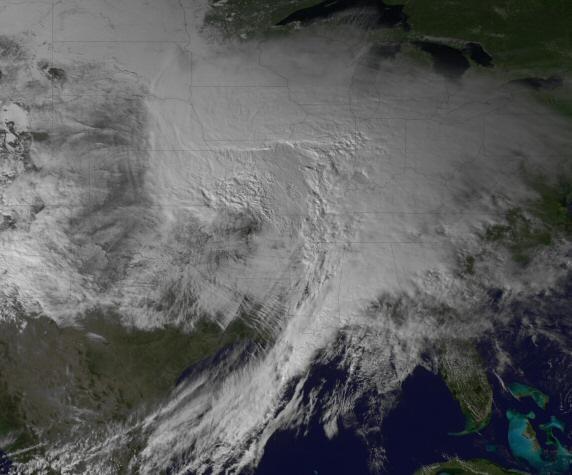
2011 Blizzard

The Earth’s northern magnetic pole was moving towards Russia at a rate of about five miles annually. That progression to the East had been happening for decades.

Suddenly, in the past decade the rate sped up. Now the magnetic pole is shifting East at a rate of 40 miles annually, an increase of 800 percent. And it continues to accelerate.

Recently, as the magnetic field fluctuates, NASA has discovered “cracks” in it. This is worrisome as it significantly affects the ionosphere, troposphere wind patterns, and atmospheric moisture. All three things have an effect on the weather.

Forget about global warming—man-made or natural—what drives planetary weather patterns is the climate and what drives the climate is the sun’s magnetosphere and its electromagnetic interaction with a planet’s own magnetic field.  At the conclusion of this alarming article comes this prediction…

One of the most stunning signs of the approaching Ice Age is the world’s precessional wobble has stopped.

So, the start of a new Ice Age is marked by a magnetic pole reversal, increased volcanic activity, larger and more frequent earthquakes, tsunamis, colder winters, superstorms and the halting of the Earth’s precessional wobble.

Unfortunately, all of those conditions are being met. Continue reading “Extreme Weather – The New Normal?”

Greenhouse Gases: Who’s Cheating?

Consider sulfur hexafluoride (SF6), a man-made gas used to insulate transformers and other electrical equipment. It’s a potent greenhouse gas, 23,900 times more powerful than CO2. That means under cap and trade, the price you pay for the right to emit one ton of SF6 is also 23,900 higher than the price of CO2—which is now $18 per metric ton in Europe. Under the U.N. Framework Convention on Climate Change, industrialized countries report how much of the stuff they’re pumping into the atmosphere. They calculate emissions using information on how much SF6 manufacturers sell to customers and estimates of how much escapes to the atmosphere from devices or production facilities. If you believe the reports, emissions of SF6 are declining.

The reports are wrong. When researchers actually measure the chemical in the air, they find it in quantities more than three times greater than what the reported amounts would indicate—and levels are increasing, not declining. The findings were a surprise, says NOAA’s Tans: “It wasn’t on anyone’s radar screen.”

via Greenhouse Gases: Who’s Cheating? – BusinessWeek.