Cancer Leading Cause of Death in China

Cancer is now the leading cause of death in China. Chinese Ministry of Health data implicate cancer in close to a quarter of all deaths countrywide. As is common with many countries as they industrialize, the usual plagues of poverty — infectious diseases and high infant mortality — have given way to diseases more often associated with affluence, such as heart disease, stroke, and cancer.

While this might be expected in China’s richer cities, where bicycles are fast being traded in for cars and meat consumption is climbing, it also holds true in rural areas. In fact, reports from the countryside reveal a dangerous epidemic of “cancer villages” linked to pollution from some of the very industries propelling China’s explosive economy. By pursuing economic growth above all else, China is sacrificing the health of its people, ultimately risking future prosperity.

Lung cancer is the most common cancer in China. Deaths from this typically fatal disease have shot up nearly fivefold since the 1970s. In China’s rapidly growing cities, like Shanghai and Beijing, where particulates in the air are often four times higher than in New York City, nearly 30 percent of cancer deaths are from lung cancer.

via Cancer is now the leading cause of death in China | Grist.

Oil in Shale – New US Energy Source

Based on the industry’s plans, shale and other “tight rock” fields that now produce about half a million barrels of oil a day will produce up to three million barrels daily by 2020, according to IHS CERA, an energy research firm. Oil companies are investing an estimated $25 billion this year to drill 5,000 new oil wells in tight rock fields, according to Raoul LeBlanc, a senior director at PFC Energy, a consulting firm.

“This is very big and it’s coming on very fast,” said Daniel Yergin, the chairman of IHS CERA. “This is like adding another Venezuela or Kuwait by 2020, except these tight oil fields are in the United States.”

In the most developed shale field, the Bakken field in North Dakota, production has leaped to 400,000 barrels a day today from a trickle four years ago. Experts say it could produce as much as a million barrels a day by the end of the decade.

The Eagle Ford, where the first well was drilled only three years ago, is already producing more than 100,000 barrels a day and could reach 420,000 by 2015, almost as much as Ecuador, according to Bentek Energy, a consultancy.

via Oil in Shale Sets Off a Boom in Texas – NYTimes.com.

Peak Oil? Now it’s Peak Cars

Australian and world peak car ownership per capita was in 2004 and since has shown a slow decline. It marks an end to car dependence. Teenage car ownership has dropped markedly. Figures suggest a big cultural shift as well as structural change within cities. Some very large cities such as Beijing and Shanghai have made it almost impossible to buy a new car. Car transport has reached a limit. Shanghai built a metro system in 10 years, which covers 80% of the city and carries 8 million passengers each day. Metros are being built in 82 Chinese cities and 14 Indian cities. Peter Newman compares the cost of constructing roads and railways and says both cost about $50million per kilometre. But rail carries 8-20 times the passengers carried by road. With the price of gasoline heading north, people are moving back into cities and not wanting to be as dependant on cars as they were. Thanks to Carlton Palmer

via Peak oil? Now it’s peak cars – Science Show – 7 May 2011.

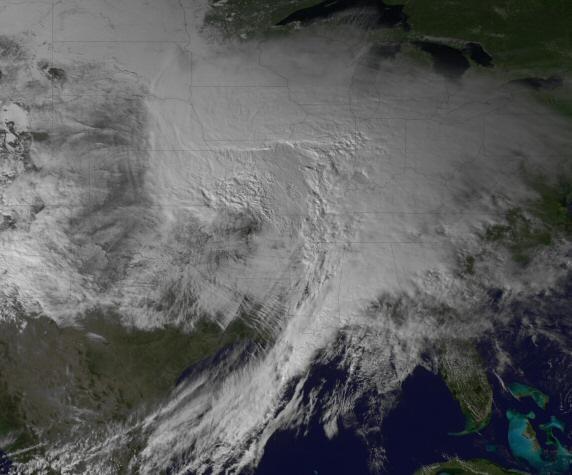
Extreme Weather – The New Normal?

2011 Blizzard

The Earth’s northern magnetic pole was moving towards Russia at a rate of about five miles annually. That progression to the East had been happening for decades.

Suddenly, in the past decade the rate sped up. Now the magnetic pole is shifting East at a rate of 40 miles annually, an increase of 800 percent. And it continues to accelerate.

Recently, as the magnetic field fluctuates, NASA has discovered “cracks” in it. This is worrisome as it significantly affects the ionosphere, troposphere wind patterns, and atmospheric moisture. All three things have an effect on the weather.

Forget about global warming—man-made or natural—what drives planetary weather patterns is the climate and what drives the climate is the sun’s magnetosphere and its electromagnetic interaction with a planet’s own magnetic field.  At the conclusion of this alarming article comes this prediction…

One of the most stunning signs of the approaching Ice Age is the world’s precessional wobble has stopped.

So, the start of a new Ice Age is marked by a magnetic pole reversal, increased volcanic activity, larger and more frequent earthquakes, tsunamis, colder winters, superstorms and the halting of the Earth’s precessional wobble.

Unfortunately, all of those conditions are being met. Continue reading “Extreme Weather – The New Normal?”

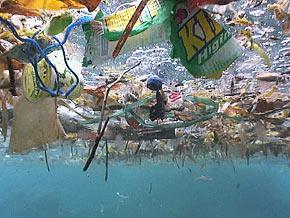
‘Great Garbage Patch’ in the Pacific Ocean Exaggerated

Claims that the “Great Garbage Patch” between California and Japan is twice the size of Texas is “grossly exaggerated” said the research which reckons it is more like one per cent the size.

Further reports that the oceans are filled with more plastic than plankton, and that the patch has been growing tenfold each decade since the 1950s are equally misleading, the new research claimed.

In reality it often cannot even be seen from the deck of a passing boat, said the latest analysts from the Oregon State University professor of oceanography Angelicque White.

Recent research by scientists at the Woods Hole Oceanographic Institution found that the amount of plastic, at least in the Atlantic Ocean, hasn’t increased since the mid-1980s – despite greater production and consumption of materials made from plastic, she pointed out.

via ‘Great Garbage Patch’ in the Pacific Ocean not so great claim scientists – Telegraph.

Blame the Cold Winters on Global Warming

As global temperatures have warmed and as Arctic sea ice has melted over the past two and a half decades, more moisture has become available to fall as snow over the continents. So the snow cover across Siberia in the fall has steadily increased.

The sun’s energy reflects off the bright white snow and escapes back out to space. As a result, the temperature cools. When snow cover is more abundant in Siberia, it creates an unusually large dome of cold air next to the mountains, and this amplifies the standing waves in the atmosphere, just as a bigger rock in a stream increases the size of the waves of water flowing by.

The increased wave energy in the air spreads both horizontally, around the Northern Hemisphere, and vertically, up into the stratosphere and down toward the earth’s surface. In response, the jet stream, instead of flowing predominantly west to east as usual, meanders more north and south. In winter, this change in flow sends warm air north from the subtropical oceans into Alaska and Greenland, but it also pushes cold air south from the Arctic on the east side of the Rockies. Meanwhile, across Eurasia, cold air from Siberia spills south into East Asia and even southwestward into Europe.

via Bundle Up, It’s Global Warming – NYTimes.com.

Bear Chasing Bison Photos

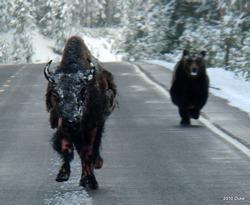
“I thought I was having a hallucination or something,” said Wypyszinski. “I couldn’t believe what that buffalo looked like.”

It was a bison, badly burned from an encounter with one of the numerous hot spots in Yellowstone National Park.

A grizzly was chasing the buffalo (which was practically cooked already) and gaining quickly.

Wypyszinski stopped his car on the desolate highway and took out his camera. “I stood along the car as long as I thought it was safe.” The two beasts passed the man by without paying any notice.

We pick our tale up where the photos end.

Wypiszinski says once in the safety of the woods the bison out maneuvered the grizzly, escaping to live exactly one more day. Park rangers had to put the bison down due to the injuries it sustained. The result: these 14 hair-raising pictures at the link below thanks to Chris Mergenthaler

via The bison got away | KTVQ.com | Q2 | Billings, Montana.