Everyday Things Under The Electron Microscope

A wood or heathland ant, Formica fusca, holding a microchip

All these 24 pictures are from the book “Microcosmos”, created by Brandon Brill from London. This book includes many scanning electron microscope (SEM) images of insects, human body parts and household items. Click the link to see all 24 pictures.

via Really funny stuff – Amazing Scanning Electron Microscope Pictures (24 pics).

Hawaiian Fire Tornado

According to KITV, the daunting spectacle was a product of a brush fire that firefighters were attempting to contain near the Pohakuloa Training Area on the Big Island on Sunday. The blaze claimed at least 1,400 acres. You can actually see the tornadic-cloud rotation around the flame increasing in size.

And Now – The Potato Battery

Potato battery basic composition and performance. Potato Zn/Cu galvanic cell battery basic structure. The battery (Kcell = 15.5 cm) was used to light two white LEDs.

The bioelectrolytic low power electrical energy source introduced in this study brings an extra dimension to the utilization of the globally fourth most abundant crop, accessible essentially all over the world, made of solid components, and requires low initial financial investment compared with solar or conventional batteries. Boiling and the simple assembly do not require special skills; it is both easy to operate and environment friendly. Last but not least, the power generated by Zn/Cu-potato is much cheaper than any conventional portable battery and produces with LED’s substantially cheaper lighting than kerosene. The proposed technology may be immediately implemented in the developing countries for improving the life quality on numerous people who do not have access to grid electricity.

via Zn/Cu-vegetative batteries, bioelectrical characterizations, and primary cost analyses | Issue 3 – Journal of Renewable and Sustainable Energy.

NASA Warns of 2013 Solar Storm

Every 22 years the Sun’s magnetic energy cycle peaks while the number of sun spots – or flares – hits a maximum level every 11 years. Dr Fisher, a Nasa scientist for 20 years, said these two events would combine in 2013 to produce huge levels of radiation.

We know it is coming but we don’t know how bad it is going to be,” Dr Richard Fisher, the director of Nasa’s Heliophysics division, said in an interview with The Daily Telegraph.

“It will disrupt communication devices such as satellites and car navigations, air travel, the banking system, our computers, everything that is electronic. It will cause major problems for the world.

“Large areas will be without electricity power and to repair that damage will be hard as that takes time.”

via Nasa warns solar flares from ‘huge space storm’ will cause devastation – Telegraph.

Flights, girls and cash buy Japan whaling votes

A SUNDAY TIMES investigation has exposed Japan for bribing small nations with cash and prostitutes to gain their support for the mass slaughter of whales.

The undercover investigation found officials from six countries were willing to consider selling their votes on the International Whaling Commission (IWC).

The revelations come as Japan seeks to break the 24-year moratorium on commercial whaling. An IWC meeting that will decide the fate of thousands of whales, including endangered species, begins this month in Morocco.Thanks Michelle Hester.

Flights, girls and cash buy Japan whaling votes – Times Online.

Stingray Migration

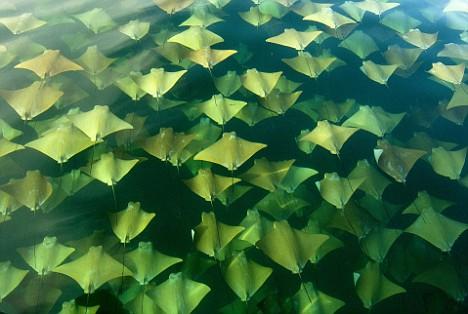
Like autumn leaves floating in a sunlit pond, this vast expanse of magnificent stingrays animates the bright blue seas of the Gulf of Mexico.

Taken off the coast of Mexico’s Holbox Island by amateur photographer Sandra Critelli, this breathtaking picture captures the migration of thousands of rays as they follow the clockwise current from Mexico’s Yucatan peninsula to western Florida.

Measuring up to 6ft 6in across, poisonous golden cow-nose rays migrate in groups – or ‘fevers’ – of up to 10,000 as they glide their way silently towards their summer feeding grounds. Thanks to Ramon Brunings.

via The great ocean migration… thousands of majestic stingrays swim to new seas | Mail Online.

Giant 125 year-old Rhododendron

This 125 year old Rhododendron is about 25 ft high and 30 ft wide.
It is in down town Ladysmith, Vancouver Island, B.C.Thanks to Mike Douso. From this link you can “enlarge Wall

paper” to download it.

Giant rhododendron – Flowers Wallpaper 371355 – Desktop Nexus Nature.

And You Think We Got It Bad In The Gulf…

It is impossible to know how much oil is spilled in the Niger delta each year because the companies and the government keep that secret. However, two major independent investigations over the past four years suggest that as much is spilled at sea, in the swamps and on land every year as has been lost in the Gulf of Mexico so far.

One report, compiled by WWF UK, the World Conservation Union and representatives from the Nigerian federal government and the Nigerian Conservation Foundation, calculated in 2006 that up to 1.5m tons of oil – 50 times the pollution unleashed in the Exxon Valdez tanker disaster in Alaska – has been spilled in the delta over the past half century. Last year Amnesty calculated that the equivalent of at least 9m barrels of oil was spilled and accused the oil companies of a human rights outrage.

With 606 oilfields, the Niger delta supplies 40% of all the crude the United States imports and is the world capital of oil pollution. Life expectancy in its rural communities, half of which have no access to clean water, has fallen to little more than 40 years over the past two generations. Locals blame the oil that pollutes their land and can scarcely believe the contrast with the steps taken by BP and the US government to try to stop the Gulf oil leak and to protect the Louisiana shoreline from pollution. Thanks to Caroline Collier

via Nigeria’s agony dwarfs the Gulf oil spill. The US and Europe ignore it | Environment | The Observer.

Coast Guard Sank Oil Rig

Mike Miller has run Calgary-based Safety Boss — which established an international reputation after successfully fighting the Kuwait well fires after the first Gulf War — for more than 30 years.

The U.S. Coast Guard erred, Miller said, in how it dealt with the fire aboard the Deepwater Horizon after the explosion on April 20 and before the drilling rig sank two days later.

He remains convinced that two days of pouring water on the fire swamped the ship, causing it to sink and sever the connection from the ocean floor to the surface, where it would have been easier to deal with the fire and contain the flow.

Oil well firefighters would know not to do that, he said.

“If you’re not successful in an hour you’re not ever going to be successful,” he told CBC News.

The U.S. Coast Guard made a 'colossal' mistake in how it fought  the fire on the Deepwater Horizon, says Mike Miller.The U.S. Coast Guard made a ‘colossal’ mistake in how it fought the fire on the Deepwater Horizon, says Mike Miller. (Associated Press/U.S. Coast Guard)

“You have to hit these fires with overwhelming force. They’re not like a forest fire where you fight them for days at a time. Why they went on with that was just beyond me.”

The resulting aerial pollution would have been far less of a threat than oil in water, especially given that booms have limitations. In the Exxon Valdez tanker spill in 1989, booms only collected four per cent of the oil, and that was in an enclosed bay
Read more: http://www.cbc.ca/money/story/2010/06/02/f-gulf-spill-canadian-oil-industry.html#ixzz0pjLHVR87

via CBC News – Money – A game changer for Canada’s oil industry.