Just What We Need – Something Else To Worry About

solarstorm1On July 23, 2012, the sun unleashed two massive clouds of plasma that barely missed a catastrophic encounter with the Earth’s atmosphere.  These plasma clouds, known as coronal mass ejections (CMEs), comprised a solar storm thought to be the most powerful in at least 150 years.

Fortunately, the blast site of the CMEs was not directed at Earth.  Had this event occurred a week earlier when the point of eruption was Earth-facing, a potentially disastrous outcome would have unfolded.

Analysts believe that a direct hit … could cause widespread power blackouts, disabling everything that plugs into a wall socket.  Most people wouldn’t even be able to flush their toilet because urban water supplies largely rely on electric pumps.

“In my view the July 2012 storm was in all respects at least as strong as the 1859 Carrington event,” Baker tells NASA. “The only difference is, it missed.”

During the Carrington event, the northern lights were seen as far south as Cuba and Hawaii according to historical accounts.  The solar eruption “caused global telegraph lines to spark, setting fire to some telegraph offices,” NASA  notes. The infamous solar storm of 1921 caused “the entire signal and switching system of the New York Central Railroad below 125th Street to be put out of operation, followed by a fire in the control tower at 57th Street and Park Avenue.”  global manufacturing capacity for high voltage transformers is estimated to be only about 70 units per year. A repeat of the 1921 space weather event might damage at least several hundred such units worldwide, with replacement of so many transformers taking a year or more

Though it’s impossible for scientists to predict exactly when or where the next solar storm happen, what they do know is that with more sunspots come more stoms. And the fall of 2013 is when the Sun is set to reach the crest of its 11-year sunspot cycle.

via How a solar storm two years ago nearly caused a catastrophe on Earth.
Can Innovation Save Our Future?

A Saudi oil minister once said, the Stone Age didn’t end for lack of stone. Ecologists call this “niche construction”—that people (and indeed some other animals) can create new opportunities for themselves by making their habitats more productive in some way. Agriculture is the classic example of niche construction: We stopped relying on nature’s bounty and substituted an artificial and much larger bounty.

Economists call the same phenomenon innovation. What frustrates them about ecologists is the latter’s tendency to think in terms of static limits. Ecologists can’t seem to see that when whale oil starts to run out, petroleum is discovered, or that when farm yields flatten, fertilizer comes along, or that when glass fiber is invented, demand for copper falls.

That frustration is heartily reciprocated. Ecologists think that economists espouse a sort of superstitious magic called “markets” or “prices” to avoid confronting the reality of limits to growth. The easiest way to raise a cheer in a conference of ecologists is to make a rude joke about economists.

If I could have one wish for the Earth’s environment, it would be to bring together the two tribes—to convene a grand powwow of ecologists and economists. I would pose them this simple question and not let them leave the room until they had answered it: How can innovation improve the environment?

via The World’s Resources Aren’t Running Out – WSJ.com.

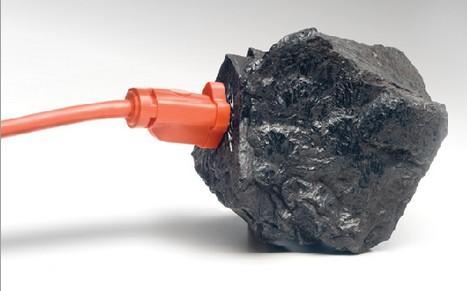
coalplugThe technological optimists crowd writing, in the current issue of Wired magazine, visits huge Chinese projects to sequester the Co2 from burning coal. An interesting read

Did You Ever Think the U.S. Would be largest Energy Producer?

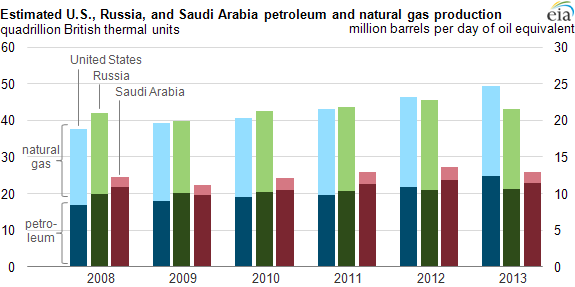
productionSince 2008, U.S. petroleum production has increased 7 quadrillion Btu, with dramatic growth in Texas and North Dakota. Natural gas production has increased by 3 quadrillion Btu over the same period, with much of this growth coming from the eastern United States. Russia and Saudi Arabia each increased their combined hydrocarbon output by about 1 quadrillion Btu over the past five years. Note: Petroleum production includes crude oil, natural gas liquids, condensates, refinery processing gain, and other liquids, including biofuels. Barrels per day oil equivalent were calculated using a conversion factor of 1 barrel oil equivalent = 5.55 million British thermal units (Btu).

via U.S. expected to be largest producer of petroleum and natural gas hydrocarbons in 2013 – Today in Energy – U.S. Energy Information Administration (EIA).

Volcanic Vortices

Volcanic Vortices bruce-omori-Extreme-Exposures-Fine-Art-Gallery-HiloBruce Omori, owner of Extreme Exposures Fine Art Gallery in Hilo, received the Windland Smith Rice International Award for his lava photo titled “Volcanic Vortices,” which will be displayed at the Smithsonian Museum of Natural History’s annual exhibition in June. His winning photograph was selected from almost 20,000 submissions from photographers in 46 countries.

“On an early morning shoot at the Waikupanaha ocean entry, lava from the Kilauea volcano poured into the sea. This created a huge escape of steam, and as it rose, multiple vortices began spinning off of the huge plume,” Omori described in his photo submission description. “A vortex or two is a pretty rare sight—but when one after another kept forming, my fumbling with the lenses turned into a panicked rush to switch my telephoto to wide angle lens to capture this awesome scene of seven vortices in a row.” Thanks to Muriel Lighter

via Hilo Photographer Receives Smithsonian Museum Award | Hawaii Business.

How Many Animals Can You See?

how_many_animals_can_you_seeThis beautiful painting by Donald Rusty hides more than meets the eye! Check it out and see if you can spot all the animals hidden somewhere inside it. How many are there? Don’t forget the proper way to submit your findings is using the “submit illusion” email link that can be found at the very bottom of this site. You are also free to post your outlined solution pics using “add image” option underneath the comment box. Happy hunting!

via Mount Zoomore Optical Illusion | Mighty Optical Illusions.

Fracking without Water

It’s possible to fracture gas-rich rock formations without using any water at all. Indeed, gas and oil companies have been using carbon dioxide this way for decades, albeit on a limited basis. Right now carbon dioxide fracking is used in places, like Wyoming, that already have carbon dioxide pipelines. But if this approach is going to be used on a large scale, it will require a major investment in infrastructure for getting carbon dioxide to fracking sites. And in some cases a price on carbon emissions may be the only way to make the economics work.

A price on carbon, for example, could create a big supply of cheap carbon dioxide by giving utilities incentive to capture it from power plants’ smokestacks. This might make sense in China, where the best shale gas deposits are in arid areas (see “China Has Plenty of Shale Gas, but It Will Be Hard to Mine”).

via Fracking with Carbon Dioxide Could Help Shale Gas Production in Arid Areas | MIT Technology Review.

Extreme Weather – The New Norm

The climate will swing to extremes as it tries to find a new equilibrium, in response to the warming climate. Siberian winters will be colder, heat waves extended, etc. This report says that if you are in a rainy location, expect more deluges, and if you live in a dry area, expect more droughts. Specifically, the new study found that although the 14 climate models differ when it comes to the amount of rainfall in individual locations such as cities, over larger areas, they all point to the same average picture. That is, for every single degree Fahrenheit the global average temperature climbs, heavy rainfall will increase in wet areas by 3.9 percent, while dry areas will experience a 2.6 percent increase in time periods without any rainfall.

Rain will get more extreme thanks to global warming, says NASA study | The Verge.

World’s Tallest Palm Trees

Wax PalmsColombia’s lush Cocora Valley, part of Los Nevados National Park, is the principal home for the country’s national tree, the palma de cera, or wax palm. The lanky tree is the world’s tallest palm tree, reaching up to 200 feet tall. Photograph by Alex Treadway

via Cocora Valley, Colombia — Travel 365 — National Geographic.

Video -Humongous Greenland Glacier Collapse

On May 28, 2008, Adam LeWinter and Director Jeff Orlowski filmed a historic breakup at the Ilulissat Glacier in Western Greenland. The calving event lasted for 75 minutes and the glacier retreated a full mile across a calving face three miles wide. The height of the ice is about 3,000 feet, 300-400 feet above water and the rest below water.

Chasing Ice won the award for Excellence in Cinematography at the 2012 Sundance Film Festival, and has won 24 awards so far this year. Playing in theaters now. Thanks to Valerie Sanders. Click on the YouTube logo, choose the HD option and go Full Screen for the full effect.