Cute Kitty the Killer

A new study by the Smithsonian Conservation Biology Institute and the Fish and Wildlife Service estimated that domestic cats in the United States kill a median of 2.4 billion birds and 12.3 billion mammals a year, most of them native mammals like shrews, chipmunks and voles rather than introduced pests like the Norway rat.

The estimated kill rates are two to four times higher than mortality figures previously bandied about, and position the domestic cat as one of the single greatest human-linked threats to wildlife in the nation. More birds and mammals die at the mouths of cats, the report said, than from automobile strikes, pesticides and poisons, collisions with skyscrapers and windmills and other so-called anthropogenic causes.

KittyThe KillerYet the new study estimates that free-roaming pets account for only about 29 percent of the birds and 11 percent of the mammals killed by domestic cats each year, and the real problem arises over how to manage the 80 million or so stray or feral cats that commit the bulk of the wildlife slaughter.

via That Cuddly Kitty Is Deadlier Than You Think – NYTimes.com.

Is Great White Following Kayak Picture Real?

Great White and Kayak

I’ve always wondered if the well-circulated image was rea. The Photographer’s notes sound quite convincing.
©Thomas P. Peschak
When this photograph was first published in Africa Geographic, BBC Wildlife and later in Paris Match and the Daily Mail (London) it resulted in a flurry of e-mails, phone calls and letters from around the world asking if the image was a fake. The image became the most talked about of shark photograph ever.

The photograph is real, no photoshop, no digital manipulation, no nothing, in fact it was shot on slide film Fuji Provia 100 using a Nikon F5 Camera and 17-35 mm lens. For those conspiracy fans who still doubt its authenticity please read how I took the photograph.

To capture this image I tied myself to the tower of the research boat Lamnidae and leaned into the void, precariously hanging over the ocean while waiting patiently for a white shark to come along. I wanted to shot a photograph that would tell the story of our research efforts to track white sharks using kayaks. When the first shark of the day came across our sea kayak it dove to the seabed and inspected it from below. I quickly trained my camera on the dark shadow which slowly transformed from diffuse shape into the sleek outline of a large great white. When the shark’s dorsal fin broke the surface I thought I had the shot, but hesitated a fraction of a second and was rewarded with marine biologist Trey Snow in the kayak turning around to look behind him. I pressed the shutter and the rest was history. Throughout the day I shot many more images, most showing the kayak following the shark, but all lacked the power of that first image of the great white tracking the kayak.

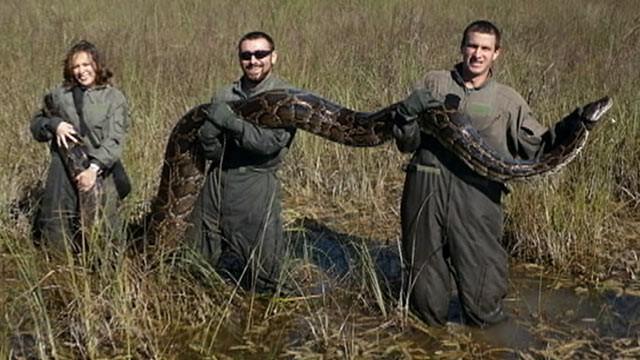
17′ Florida Python – The hunt is on for a new record

FlaPythonSome estimate that nearly 150,000 pythons are living in the Florida Everglades. Officials say the Burmese pythons are eating wildlife and with no natural predator, the population is overwhelming. The Everglades have become crowded with the snakes and the pythons have started to move into nearby neighborhoods. Last year, a Burmese python was caught and registered more than 17 feet long and 160 pounds. The catch set a new Everglades National Park record.

via Florida Python Hunt Launched to Curb Slithering Population – ABC News.

Vanishing Act: Camouflage in Nature

animal-camouflage-photography-art-wolfe-1In this astonishing new book, legendary wildlife photographer Art Wolfe turns to one of nature’s most fundamental survival techniques: the vanishing act. His portraits show animals and insects disappearing into their surroundings, using deceptions, disguises, lures, and decoys to confuse the eye of both predator and prey. Click on this link and hit the “Slideshow” option and see how many you can find.

Vanishing Act: Camouflage in Nature | Art Wolfe Stock Photography 888-973-0011.

animal-camouflage-photography-art-wolfe-2

How Leaded Gasoline Caused Our Violent Crime Wave.

Starting in the 1960s, America saw a huge increase in levels of violent crime that peaked in the early 1990s, then steadily declined, and continues to decline today. All kinds of theories have been promulgated to explain this peak and decline in crime, and plenty of politicians in the 1990s took credit for it. Lead emissions from automobiles explain 90 percent of the variation in violent crime in America. Toddlers who ingested high levels of lead in the ’40s and ’50s really were more likely to become violent criminals in the ’60s, ’70s, and ’80s.

And with that we have our molecule: tetraethyl lead, the gasoline additive invented by General Motors in the 1920s to prevent knocking and pinging in high-performance engines. As auto sales boomed after World War II, and drivers in powerful new cars increasingly asked service station attendants to “fill ‘er up with ethyl,” they were unwittingly creating a crime wave two decades later.

The use of lead pipes to carry water to wealthy neighLeadedCrimeWaveborhoods is claimed to be one major factor that contributed to the weakening and eventual destruction of the Roman Empire. At least we had the Science to discover our lead folly and correct it, even though much is to still be remediated. But the huge penal/judicial/police industrial complex budget justifications are threatened by such a simple crime source. Turns out criminologists were blaming the wrong Lead, when some accused the music of Led Zeppelin, among others.

via America’s Real Criminal Element: Lead | Mother Jones.

Extreme Firewood Stacking

Firewood keeps you warm, when you’re cutting, hauling, splitting and stacking it, in addition to when you actually burn it. Now that the Winter weather is really here, it is time to reflect on how some other folks have gone beyond just stacking up wood to keep warm. .

This slideshow requires JavaScript.

How To Properly Stack Firewood – Yellow Bullet Forums. Click for more examples of Extreme Firewood Stacking

More Deaths Caused by Obesity than Hunger

Obesity has become a bigger threat to global health than child hunger, according to a major study.

More than three million deaths in 2010 were attributable to excess body weight, three times the death toll due to malnutrition.

The largest investigation of disease ever undertaken, published yesterday, also found that high blood pressure, smoking and drinking alcohol have become the world’s biggest health risks.

So-called diseases of the western industrialised nations have become more prevalent as developing nations become more affluent. Fewer infants are dying of starvation in the poorest countries while a fast expanding middle-class in the emerging economies. ibeatanorexia

Obesity kills more than hunger in march of ‘progress’ | The Times.

Mt. Everest – In Incredible Composite Detail

This gigapixel image of the Khumbu glacier was captured by David Breashears during the spring of 2012, from the Pumori viewpoint near Mount Everest. The Khumbu Icefall is clearly visible here, and one can easily see the hustle and bustle of Everest Base Camp below.

EverestClick the image to enter gigapixel navigation, then use the controls at the bottom of the screen to zoom and pan and find climbers on the glacier and around the base camp tents, which will give you perspective on the scale of what you are viewing.

via Khumbu Glacier – Mt. Everest – The Glaciers of the Himalayas.

Arctic Ocean Flowers

ArcticOcean Flowers These spiky little bunches of ice form on thin and new ice in the Arctic Ocean. But these badboys can only form under very special conditions:

1) Calm winds. We can’t have these beauties blown away can we?

2) Cold, cold air. It has to be about 20C less than the water and since seawater freezes around -2C, that means the air must be about -22C or -7.6F. BRRR.

Frost flowers form when newly formed ice sublimates, that is ice changes directly from a solid to a gas totally bypassing the liquid stage. Initially, the water vapor formed by sublimation is the same temperature as the sea ice, but gets quickly cooled by the cold air. The air is then becomes supersaturated with water vapor, which means the air has too water much in it. Air really doesn’t want to hold all that excess water vapor, so when the supersaturated air touches another ice crystal the water vapor quickly turns back into ice. (Click the image to enlarge)

via The icy plumage of the Arctic | Deep Sea News. Continue reading “Arctic Ocean Flowers”