Can Innovation Save Our Future?

A Saudi oil minister once said, the Stone Age didn’t end for lack of stone. Ecologists call this “niche construction”—that people (and indeed some other animals) can create new opportunities for themselves by making their habitats more productive in some way. Agriculture is the classic example of niche construction: We stopped relying on nature’s bounty and substituted an artificial and much larger bounty.

Economists call the same phenomenon innovation. What frustrates them about ecologists is the latter’s tendency to think in terms of static limits. Ecologists can’t seem to see that when whale oil starts to run out, petroleum is discovered, or that when farm yields flatten, fertilizer comes along, or that when glass fiber is invented, demand for copper falls.

That frustration is heartily reciprocated. Ecologists think that economists espouse a sort of superstitious magic called “markets” or “prices” to avoid confronting the reality of limits to growth. The easiest way to raise a cheer in a conference of ecologists is to make a rude joke about economists.

If I could have one wish for the Earth’s environment, it would be to bring together the two tribes—to convene a grand powwow of ecologists and economists. I would pose them this simple question and not let them leave the room until they had answered it: How can innovation improve the environment?

via The World’s Resources Aren’t Running Out – WSJ.com.
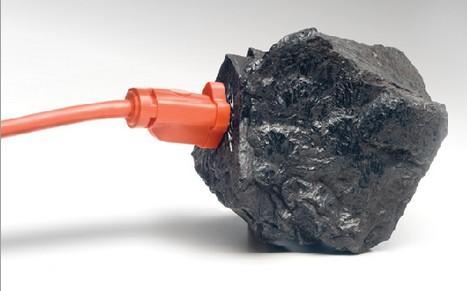
coalplugThe technological optimists crowd writing, in the current issue of Wired magazine, visits huge Chinese projects to sequester the Co2 from burning coal. An interesting read

The Clash of Systems

Writing recently on the independent Russian website Grani.ru, dissident writer and left-wing activist Alexander Skobov noted that today’s conflict between Russia and the West was not so much a clash of civilizations as a “clash of systems”: “The essential difference between them lies in who has ‘primacy’: the individual or the state, society or the ‘elite’? The conflict over this issue is not between civilizations but within each of them. Every state seeks to dominate the individual; every elite seeks to dominate society. But some countries have succeeded at developing a set of institutions that limit the power of the state and the elite over the individual and society, while others have not.”

Obviously, these institutions don’t always work. Yet, while the United States and the other capitalist liberal democracies may be very far from either the libertarian ideal of freedom or the progressive ideal of social justice, the unvarnished truth is that it’s only within this loosely knit global community — the “global liberal hegemony” deplored by far-left and far-right radicals — that these ideals have any chance to survive and develop. A world in which these values are on the ascendancy rather than in retreat is very much a part of our national interest.

via The Problem With the New Isolationism | TIME.com.

What world can teach U.S. about entitlements

Entitlement Lessons From Abroad A new report, by the Center for Strategic and International Studies, notes that many countries have recently enacted reforms that have trimmed benefit formulas, raised retirement ages, and put in place new funded pension systems that supplement or partially substitute for pay-as-you-go government systems.

Several countries – including Germany, Italy, Japan, and Sweden – have gone further and introduced “automatic stabilizers” into their public pension systems that, directly or indirectly, index benefits to the growth in the payroll tax base. These stabilizers may differ in design, but they have two crucial characteristics in common. First, they are all expressly designed to offset the full impact of demographically driven cost growth. And second, they are all self-adjusting. In effect, they put entitlements on a new kind of autopilot – one that is preprogrammed for cost constraint rather than for cost growth.

ChangeInEntitlementBenefits 2010to2040It’s ironic that other developed countries, most of which have faster-aging populations and more expansive welfare states than the United States, are leading the way on entitlement reform.  Part of the explanation may be that, until recently, America’s age wave still loomed over the horizon, while in Europe and Japan aging populations have been burdening public budgets, forcing up payroll tax rates, and slowing economic growth for decades.

Part of the answer may also lie in America’s peculiar entitlement ethos.  In Europe, government benefit programs may be fiercely defended, with the opponents of reform manning the barricades and calling general strikes. But in the end, everyone understands that they are part of a social contract that is subject to renegotiation and revision.  In the United States, much of the public views Social Security and Medicare as quasi-contractual arrangements between individuals and the state.  This mindset, which is encouraged by the misleading insurance metaphors in which the programs are cloaked, may make old-age benefits more difficult to reform in the United States than in Europe’s large welfare states.

via What world can teach U.S. about entitlements – Global Public Square – CNN.com Blogs.

Why CBS Chose Colbert

The ideal television viewer is now in his twenties or thirties, lives in a city, has plenty of disposable income and is highly active on social media so that his or her brand choices influence their peers. He bought a new smartphone in the last 12 months and the next gaming console, he goes to bars and night clubs, spends $400 on video games and $300 on music. He is more likely to do these things than to become a parent, invest in stocks or buy a home.

Colbert_and_sons_by_David_Shankbone

CBS’s Hawaii Five-O may be highly rated, but it skews to older audiences, which is why it costs $58,000 to advertise on it, while Grimm, which has a smaller audience, charged $82,000. Both shows are about even in the demo,  but Grimm’s viewers are valued more. Blue Bloods may have fantastic ratings, but its audience is old, so it’s also down at the $58,000 level.

via CBS, Colbert and Contempt for America | FrontPage Magazine.

The End of the World as We Know It – Pax Americana

Drawing compelling parallels with today from the over-looked period after Rome fell and before the Middle Ages, known as “Late Antiquity”; highly-respected strategic thinker Robert Kaplan predicts a global return to tribalism and religiosity, as America retreats into isolationism.

Fall of RomeThe Pax Romana was a period of relative peace and stability throughout the Greater Mediterranean. By 700 A.D., the Roman Empire had disappeared from the map of the West, the Sassanid Persian Empire had vanished from the Near East, Europe had become Christian, and the Near East and most of North Africa had become Muslim.

Today, tribes with four-wheel-drive vehicles, satellite phones, plastic explosives, and shoulder-fired missiles help close the distance between Late Antiquity and the early 21st century.
We are at the dawn of a new epoch that may well be as chaotic as that one and that may come upon us more quickly because of the way the electronic and communications revolutions, combined with a population boom, have compressed history.

By 700 A.D., the Roman Empire had disappeared from the map of the West, the Sassanid Persian Empire had vanished from the Near East, Europe had become Christian, and the Near East and most of North Africa had become Muslim. – See more at: http://www.foreignpolicy.com/articles/2013/12/03/augustine_s_world_what_antiquity_tells_us_about_syria#sthash.coL1EJCF.dpuf

via Augustine’s World. Continue reading “The End of the World as We Know It – Pax Americana”

Good Riddance to Brotherhood’s Fake Democrats

The saving grace in Egypt, King Abdulla of Jordan said, was that Mursi seemed too unsophisticated to successfully pull off his vision. “There’s no depth to the guy,” he said of Mursi. The king compared him unfavorably to Recep Tayyip Erdogan, the Islamist prime minister of Turkey. Like Mursi, the king asserted, Erdogan was also a false democrat, but one with patience. “Erdogan once said that democracy for him is a bus ride,” Abdullah said. “Once I get to my stop, I’m getting off.”

Unlike Mursi, however, Erdogan was masterful at manipulating a system that didn’t trust him, the king said. “Instead of the Turkish model, taking six or seven years — being an Erdogan — Mursi wanted to do it overnight.” Recent events in Turkey, including the government’s miscalculated response to mass protests, have shown that perhaps even Erdogan isn’t an Erdogan anymore.

Political IslamHad the military not intervened, though, the Muslim Brotherhood may have tried, over time, to make sure that Egypt’s first free and fair election was also its last. A number of Egyptian friends have written me in the past day, arguing that what the Egyptian people did — or, more to the point, what the Egyptian army, responding to the will of the people, did — was to forestall the rise of a new Hitler. If the Germans, who chose Adolf Hitler in a democratic election, had turned on him a year later, well, you know the rest. The analogy is overdone for so many reasons, but it is absolutely true that the Muslim Brotherhood is a totalitarian cult, not a democratic party.

via Good Riddance to Brotherhood’s Fake Democrats – Bloomberg.

Why Is Gay Porn So Popular in Pakistan?

As of this writing, Pakistan is by volume the world leader for Google searches of the terms “shemale sex,” “teen anal sex,” and “man fucking man,” according to Google Trends. Pakistan also ranks second in the world (after similarly gay-intolerant Kenya) for volume of searches for the search term “gay sex pics.”

In its report, Pew noted that countries exhibiting the highest levels of gay tolerance are largely secular, whereas nations where religion is central to public lifesuch as Egypt, Nigeria, and Pakistantend to reject homosexuality. But in Pakistan, what’s even more peculiar is that the highest number of hits for some of these terms, including “shemale sex,” come not from Pakistan’s cosmopolitan centers, but from Peshawar, a bastion of conservative Islam, lately known in the West as a counterterrorism frontline.

Farahnaz Ispahbikini_burkhaani, an expert in Pakistani minorities at the Woodrow Wilson International Center for Scholars and a former member of Pakistan’s parliament, says that homosexuality is a taboo subject throughout the country. In major cities such as Lahore and Karachi, gays can develop a network of allies outside their tribe or family, but in conservative Peshawar, gay identity is more complicated. Part of the popularity of gay porn could stem from the fact that even highly observant Muslim males often have physical relationships with men without considering themselves gay, she says.

“The real love they can have that most of us find with a partner, they find with men,” Ispahani says. “They mostly see their wives as the mother of their children.”

Why Is Gay Porn So Popular in Pakistan? | Mother Jones.

Why Are Indian Reservations So Poor?

At a time when there’s a spotlight on America’s richest 1%, a look at the country’s 310 Indian reservations–where many of America’s poorest 1% live–can be more enlightening. To explain the poverty of the reservations, people usually point to alcoholism, corruption or school-dropout rates, not to mention the long distances to jobs and the dusty undeveloped land that doesn’t seem good for growing much. But those are just symptoms. Prosperity is built on property rights, and reservations often have neither. They’re a demonstration of what happens when property rights are weak or non-existent.

The vast majority of land on reservations is held communally. That means residents can’t get clear title to the land where their home sits, one reason for the abundance of mobile homes on reservations. This makes it hard for Native Americans to establish credit and borrow money to improve their homes because they can’t use the land as collateral–and investing in something you don’t own makes little sense, anyway.

This leads to what economists call the tragedy of the commons: If everyone owns the land, no one does. So the result is substandard housing and the barren, rundown look that comes from a lack of investment, overuse and environmental degradation. It’s a look that’s common worldwide, wherever secure property rights are lacking—much of Africa and South America, inner city housing projects and rent-controlled apartment buildings in the U.S., Indian reservations.

via Why Are Indian Reservations So Poor? A Look At The Bottom 1% – Forbes.

Balancing the 3 Types of Innovation

efficiency innovations are liberating capital, and in the United States this capital is being reinvested into still more efficiency innovations. In contrast, America is generating many fewer empowering innovations than in the past. We need to reset the balance between empowering and efficiency innovations.

America today is in a macroeconomic paradox that we might call the capitalist’s dilemma. Executives, investors and analysts are doing what is right, from their perspective and according to what they’ve been taught. Those doctrines were appropriate to the circumstances when first articulated — when capital was scarce. But we’ve never taught our apprentices that when capital is abundant and certain new skills are scarce, the same rules are the wrong rules.

It’s as if our leaders in Washington, all highly credentialed, are standing on a beach holding their fire hoses full open, pouring more capital into an ocean of capital. We are trying to solve the wrong problem. The author presents solutions at the end of the article

via A Capitalist’s Dilemma, Whoever Wins the Election – NYTimes.com.

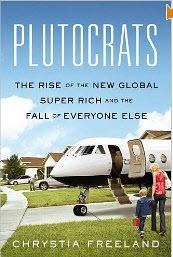
Plutocrats: The Rise of the New Global Super-Rich and the Fall of Everyone Else

Extractive states are controlled by ruling elites whose objective is to extract as much wealth as they can from the rest of society. Inclusive states give everyone access to economic opportunity; often, greater inclusiveness creates more prosperity, which creates an incentive for ever greater inclusiveness. Elites that have prospered from inclusive systems can be tempted to pull up the ladder they climbed to the top. Eventually, their societies become extractive and their economies languish.

Several recent studies have shown that in America today it is harder to escape the social class of your birth than it is in Europe. Educational attainment, which created the American middle class, is no longer rising.

Economists point out that the woes of the middle class are in large part a consequence of globalization and technological change. Culture may also play a role. In his recent book on the white working class, the libertarian writer Charles Murray blames the hollowed-out middle for straying from the traditional family values and old-fashioned work ethic that he says prevail among the rich (whom he castigates, but only for allowing cultural relativism to prevail).

The crony capitalism of today’s oligarchs is far subtler than Venice’s. It works in two main ways.

The first is to channel the state’s scarce resources in their own direction. This is the absurdity of Mitt Romney’s comment about the “47 percent” who are “dependent upon government.” The reality is that it is those at the top, particularly the tippy-top, of the economic pyramid who have been most effective at capturing government support — and at getting others to pay for it.

Exhibit A is the bipartisan, $700 billion rescue of Wall Street in 2008. Exhibit B is the crony recovery. The economists Emmanuel Saez and Thomas Piketty found that 93 percent of the income gains from the 2009-10 recovery went to the top 1 percent of taxpayers. The top 0.01 percent captured 37 percent of these additional earnings, gaining an average of $4.2 million per household.

via The Self-Destruction of the 1 Percent – NYTimes.com.