
 Thanks to Bluesman from Vegas
Category: Humor
There is the 99% and the 1% – And Now the 2%

The Difference Between the Israeli and Greek Wailing Wall
Wailing Wall in Israel

Greek Wailing Wall

Mona Lisa Caffineated

The Mona Lisa, one of the world’s most famous paintings, has been recreated with 3,604 cups of coffee – and 564 pints of milk.The different colours were created by adding no, little or lots of milk to each cup of black coffee.It measures an impressive 20 feet high and 13 feet wide and took a team of eight people three hours to complete.It was created for The Rocks Aroma Festival in Sydney, Australia, and seen by 130,000 people who attended the one-day coffee-lovers event.

Elaine Kelly, from event organisers the Sydney Harbour ForeshoreAuthority, was delighted with the result.She said: “Each coffee cup was filled with varying amounts of milk to create the different sepia shades of the painting.”We wanted to create an element of surprise and a sense of fun in the way we engaged with the public.”Once we had the idea of creating an image out of coffee cups we searched for something iconic to reproduce – and opted for the most iconic painting in history.”The Mona Lisa has been reproduced so many times in so many different mediums but, as far as we know, never out of coffee.”The result was fantastic.”After much planning it was great to see if coming together so well and the 130,000 people who attended the event certainly enjoyed it.”
Mona Lisa, also known as La Gioconda, is the 16th century portrait painted in oil by Leonardo Da Vinci during the Italian Renaissance. The work is owned by the French government and hangs in the Musee du Louvre in Paris, France, with the title Portrait of Lisa Gherardini, wife of Francesco del Giocondo. It measures 770 millimetres by 530 millimetres and has prompted debate for years over the reason for her famously enigmatic smile. Extensive scrutiny using X-ray apparatus suggests that restoration work has resulted in the original being painted over three times. Thanks to Juan Marcos. Mona Lisa recreated with coffee – Telegraph.
E-Trade Baby Hit By the Market
Sign That A Terrorist May Be At The Airport
 Thanks to the ever-vigilant Chris Yates.
Up, Up & Away, In My Beautiful Balloon
 Thanks to Mike Douso
Bella Vita Baby!

4 Stages of Life

The Invention of Ctrl+Alt+Delete
At this rate, even with 12 of the country’s best engineers working round-the-clock, IBM was never going to deliver its first computer prototype to Microsoft in a matter of four months. The parts were all new. The software. The hardware. Even the names “software” and “hardware.” They were treading new ground. There had never been a “PC,” a personal computer, until this group of programmers built the first one in that lab.
So, as you can imagine, there was a lot of frustrating rebooting going on as Dave Bradley tried to get the CPU – the central processing unit, which they named – to talk to a printer or a monitor for the first time, code he had spent months writing.
He needed a quicker way to restart, to refresh, to escape from a computer quagmire than just switching the computer off and waiting for it to reboot. So he wrote nine lines of code, a “10-minute job,” Bradley remembers. He wanted to make sure it wasn’t something you could just press by accident and wipe out your work. He wrote it so that with his left hand, he held down the keys Ctrl+Alt. With his right hand, he pressed Del.
The screen went black, came back to life and voilà: A cultural icon was created and some great one-liners from the creator, such as “I got to meet Bill Gates when he was only worth millions” .
Actually, about that meeting – At a panel discussion with Gates for the 20-year anniversary of the PC, Bradley was asked about how he created the keystroke. Google Dave Bradley and Bill Gates to see video of Bradley quipping, “I may have invented it, but I think Bill made it famous.” The crowd rolls with laughter. Bill Gates, frozen in a smile-shaped grimace, is not amused. 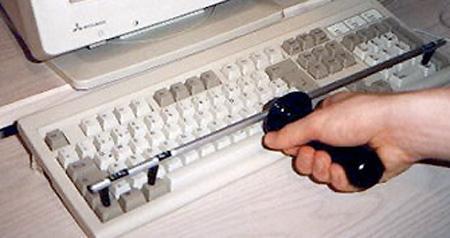
Read more at Palm Beach Post : In flash of keystrokes, Dave Bradley changed computer history..
Click more to see the video Continue reading “The Invention of Ctrl+Alt+Delete”