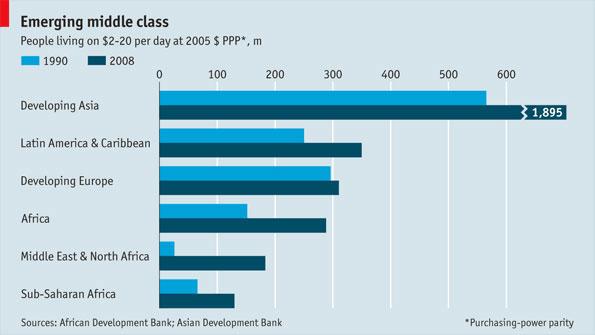
The past four years have seen a sharp contrast between recession-hit rich countries and buoyant emerging giants. Estimates from the Asian and African Development Banks, using a rather broad definition of middle class as living on $2-20 a day, confirm the picture. On this measurement, which includes many people who are only just above the poverty line, a third of Africans and three-quarters of Latin Americans were middle class in 2008. Meanwhile, the evidence that this progress will bring political demands that will reshape the developing world is mounting.
People ask, what did America do for the world? It set the conditions for this to happen – and then it defended that system from those who would do it harm. The US is only world power in history whose primary goal has been the peaceful rise of other great powers through trade and development.
Barbosa, who served as ambassador to Washington during the Luiz Inácio Lula de Silva government and now heads the foreign trade council of Brazil’s powerful FIESP industrialists federation, said Brazilian executives working for Chinese firms are also complaining about “long work days, frequent overtime, teleconferences in the wee hours, and production goals that are unrealistic and non-negotiable.”
As a result, 42 percent of Brazilian executives working for Chinese firms quit their jobs in their first year, he said, quoting a story in the daily Folha de Sao Paulo. Barbosa concluded that China’s business practices “should be followed with attention” by government authorities, labor unions and business associations.
Almost simultaneously, a new study by the United Nations Commission for Latin America and the Caribbean (ECLAC), “Overview of Latin America’s insertion in the world economy,” shows that 87 percent of Latin America’s exports to Asia — mainly China — are raw materials, while only 13 percent are manufactured goods.
Citing an article in The Economist on China’s investments in Africa, Barbosa says that China “is destroying parks and forests in search of mineral and agricultural resources, and routinely violates the most elementary labor laws. Roads and Hospitals built by the Chinese are badly finished, among other things because their construction companies pay bribes to local officials.”
The People’s Bank of China (PBoC) accumulated its forex reserves by borrowing yuan from the Chinese people. The U.S. dollar assets and yuan liabilities are roughly balanced on the central bank’s balance sheet. If the U.S. government is addicted to debt, so is China’s.
The purpose of that precarious balance sheet is to subsidize exports by keeping the yuan’s value low and deferring inflation. An economy like China’s that is enjoying rapid productivity growth would normally see rising real wages and hence benign inflation that would increase the cost of its exports. Because that process has been stopped, China’s exporters remain competitive across a range of labor-intensive products such as shoes and garments in which the country no longer has a true comparative advantage.
Were the PBoC to stop buying U.S. Treasurys and other dollar assets, the result would be an immediate increase in the yuan’s value. The losses on U.S. investments as the yuan slowly appreciates are one part of the cost for the export-subsidy policy.
In the short term Chinese threats to stop buying U.S. debt are empty, since there are no other asset markets deep and liquid enough to absorb the purchases needed to keep the yuan stable. Were China to buy euros or yen in sufficiently large quantities, it would soon run into a protectionist backlash in Europe and Japan as those nations ran trade deficits. The U.S. willingness to run a persistent trade deficit is key to the dollar’s status as a reserve currency.
China has emerged as the world’s predominant supplier, controlling 97 percent of the global market for rare earths. In recent years, lawmakers have expressed concerns about China’s “rare earth” dominance, and these concerns were heightened when Beijing temporarily halted exports to Japan last year during a territorial dispute. Despite having such obscure names as praseodymium, promethium and samarium – no copper or zinc here – they are necessary for such routine contemporary technologies as magnets, laser pointers and miniature electronics, such as iPods.
Quantum acquired a circular piece of land – a bit more than 4 miles in diameter – near Elk Creek late last year. The land, which the U.S. Geological Survey projects may have one of the world’s largest deposits of niobium and rare earths, has since been poked, prodded and drilled to determine whether it held any niobium, which has never been mined in the U.S., or rare earths, which the U.S. has not mined in almost 10 years
China has dropped 97 percent of its holdings in U.S. Treasury bills, decreasing its ownership of the short-term U.S. government securities from a peak of $210.4 billion in May 2009 to $5.69 billion in March 2011, the most recent month reported by the U.S. Treasury.
Treasury bills are securities that mature in one year or less that are sold by the U.S. Treasury Department to fund the nation’s debt.
Mainland Chinese holdings of U.S. Treasury bills are reported in column 9 of the Treasury report linked here.
Until October, the Chinese were generally making up for their decreasing holdings in Treasury bills by increasing their holdings of longer-term U.S. Treasury securities. Thus, until October, China’s overall holdings of U.S. debt continued to increase.
Since October, however, China has also started to divest from longer-term U.S. Treasury securities. Thus, as reported by the Treasury Department, China’s ownership of the U.S. national debt has decreased in each of the last five months on record, including November, December, January, February and March.
The 19th century is the century of chemistry and that gets us chemical weapons in World War I. The 20th century is the century of physics and that gets us nuclear weapons in World War II. But the 21st century? That’s the century of biology, and that gets us biological weaponry and biological terror. My point: obsessing over nuclear terrorism is steering by our rearview mirror. If you think people are afraid of radiation (dirty nukes, etc.), that’s nothing compared to their fear of tainted food. My point: if you’re a terrorist looking to sow fear and confusion, disrupt supply chains and ruin crucial industries, you can’t do much better than to work some biological mischief on food networks.
The average farm-to-fork journey in this world is now about 1,500 miles, and it’s getting longer by the week. Global climate change will make it harder to grow food across a thick band of territory (roughly up to/down to the 35th parallel) centered on the Equator. That’s where most of the population growth and water stress problems will erupt in coming decades, and it’s also where countries all tend to be highly dependent on imported food. See your Arab Spring and realize how much of this unrest is caused by rising food prices and you’ll get the overall picture.
Mark my post: this century is all about biology, rising food demand – and thus dependencies exacerbated by climate change (see the buying-up of arable land in Africa by Arab and Asian nations), and thus biological terror comes to the fore. Forget about energy nets, because they all go far more localized with smart grids, co-located generation/distribution, etc. It’s food that will be the most vulnerable global network in the future.
Why didn’t more of us see it coming? After all, the signals have been clear enough – signals that the ecological system that supports human society is hitting its limits, groaning under the strain of an economy simply too big for the planet. But we didn’t and, as a result, the time to act preventatively has past.Now we must brace for impact. Now comes The Great Disruption.It is true that the coming years won’t be pleasant, as our society and economy hits the wall and then realigns around what was always an obvious reality: You cannot have infinite growth on a finite planet. Not ‘should not’, or ‘better not’, but cannot. We can, however, get through what’s ahead – if we prepare. Continue reading “The Great Disruption Has Arrived”
Twenty-five vessels and 560 people are currently being held for ransom by pirates. Continuing to expand their geographical reach, pirates are the maritime industry. Mixed opinions about how best to moderate the effects of piracy were revealed during a Wednesday session at the 2011 Breakbulk Europe Transportation Conference and Exhibition.
Dirk Steffen, Director of Consultancy for Risk Intelligence, outlined the extent of the problem, saying that one out of every five pirate attacks is successful.
Pirate tactics continue to evolve. For example, many have managed to extend the period of time during which they can attack, Steffen said. Until late last year most piracy attacks were linked directly to the monsoon season, but now there is a new tactic in that the Somali pirates are capturing large fishing vessels and using them as mother ships, which enables them to continue operating in monsoon-hit areas.
In another twist, the main “commodity” captured is now considered to be the crew rather than the vessel, Steffen said. In several cases vessels have been captured and later set adrift once the pirates had taken the crew prisoner. Continue reading “Somali Pirates Still Going Strong”
Europe’s leaders have realized, and are acknowledging one after another, that that continent’s multiculturalist policy–the idea that geographic areas could be ceded to immigrants from Islamic countries who would treat them as Islamic enclaves, rather than being encouraged to assimilate–has been a disastrous failure. CBN has a good report on the current status of multiculturalism in Europe. It begins:
France has some 751 “No Go” zones. The French government has labeled these areas “sensitive urban zones” that are dangerous for whites and non-Muslims to enter.
I asked a French friend if it was really that bad there and got this reply from her:
The basic Idea of the article is wrong . The “Multikulti” comes from Germany (http://en.wikipedia.org/wiki/Multikulti) and it’s goal was to integrate Muslim residents into Society all the whilst respecting their religious beliefs and habits. As far as I know, there was no intention at all to have them live in ethnical enclaves.
A couple of years ago , I wasn’t paying enough attention and accidently took one of Nice North’s exits (l’Ariane) off the highway.(Can’t happen anymore, the exit has been condemned).
Other than the fact, that I was shocked to see such poverty some 10 miles from the flourishing Cote d’Azur ,I still don’t know how I made it out there alive…
Since quite a few years no Pizza guy will deliver anything in this (pretty huge) area.
The last time I read that cops (obviously accidently) drove in there, they found themselves running for their lives (car had been set on fire) and that TOTALLY NAKED.
The first big wave of immigrants (after WW2) worked hard and really tried to integrate. So did their next generation. The third generation however, is searching for an own “identity”, very often going back to old Muslim traditions and/or violence. And there come the problems…
 The past four years have seen a sharp contrast between recession-hit rich countries and buoyant emerging giants. Estimates from the Asian and African Development Banks, using a rather broad definition of middle class as living on $2-20 a day, confirm the picture. On this measurement, which includes many people who are only just above the poverty line, a third of Africans and three-quarters of Latin Americans were middle class in 2008. Meanwhile, the evidence that this progress will bring political demands that will reshape the developing world is mounting.