

Category: Art
How Many Animals Can You See?
 This beautiful painting by Donald Rusty hides more than meets the eye! Check it out and see if you can spot all the animals hidden somewhere inside it. How many are there? Don’t forget the proper way to submit your findings is using the “submit illusion” email link that can be found at the very bottom of this site. You are also free to post your outlined solution pics using “add image” option underneath the comment box. Happy hunting!
via Mount Zoomore Optical Illusion | Mighty Optical Illusions.
Helicopter Cat
 Dutch artist Bart Jansen (R) has found an unusual way paying his last respects to his pet cat Orville, who died after being hit by a car — he turned him into a helicopter, or a quadrocopter to be precise, with four rotors, each fitted to one outstretched paw. Jansen got help from a model airplane pilot, Arjen Beltmann (L), to mount the rotor blades in a way that ensures maximum flight stability.
via Photo Gallery of Cat Helicopter Constructed by Artist Bart Jansen – SPIEGEL ONLINE – International.
Earth As Art
Click on the link to earth_art-ebook to download a pdf file of an amazing collection of earth views from 16 NASA satellites
Some of the instruments aboard the satellites collect data in different ranges of wavelengths of light. These “spectral bands” break up all the visible and invisible light into chunks: the reds, the blues, the greens and even infrared, a wavelength of light that humans can’t see.
When researchers piece the image data back together, they can be selective about which “bands” of light are displayed in the final image. “The selection depends on the intent of the analysis,” Friedl wrote in an email. “An analysis of vegetation would probably select the red, green and infrared bands — vegetation is ‘bright’ in those bands and the analyst could differentiate between the types or health of vegetation.”

Friedl says analysts generally don’t go out of their way to make images look surreal, but this kind of spectral analysis can be used to great effect. “There are whole books written on what band combinations to use to bring out certain features,” he told me. Like rocks: When studying the retreat of the glaciers of the Himalayas, Friedl says, you can train software to recognize the light signature of exposed rock. And instead of directly measuring the glaciers themselves, you can see where new rock is getting exposed year over year.
via Earth As Art: ‘How Did Nature Do That?’ : The Picture Show : NPR.
What If Robots Designed and Played Guitars?
Thanks to Guitarist Dave Bryan. Could he be concerned that guitar players will be out-sourced to machines?
34 Famous Photos in History Colorized
 Reddit user mygrapefruit and self-taught colorizer Sanna Dullaway has colorized famous photographs in history. You can find the entire 34-image collection on Imgur . http://imgur.com/a/wapUe Using a Wacom bamboo tablet and Photosohp, each photo takes anywhere from 20 minutes to 2 hours.
.
Pink Floyd “Dark Side of the Moon” Illusion
 Originally titled “Here comes another seizure“, the disturbing background pattern used in this tremendous optical illusions comes from Tautvydas Davainis’s digital studio.
via Pulsating Nightmare Optical Illusion | Mighty Optical Illusions.
Last Known Painting of Ancient Vesuvius

“Michaelangelo” of Pumpkin Carving
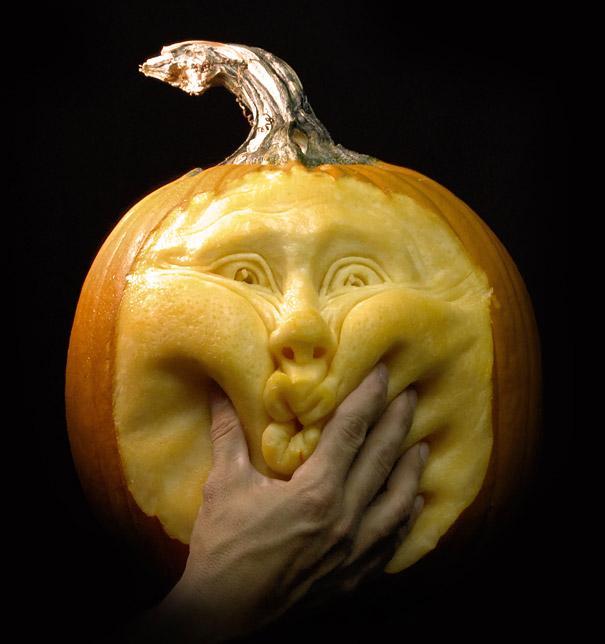 In 2007 Villafane was contacted by High Noon Entertainment and asked to participate in the Food Network’s Challenge Show for a segment called “Outrageous Pumpkins”. He competed against three other professional pumpkin sculptors and won all three rounds to receive the grand prize.[2] The Food Network contacted Villafane again in 2009 to come back to the show and defend his title. He was also the grand prize winner for the “Outrageous Pumpkin Challenge II”. In 2011, he carved the world’s biggest pumpkin to resemble zombies.[3] From Wkipedia
The Pumpkins « Villafane Studios – Pumpkin Carving, Sand Sculpting, Action Figure Creating.
Easter Island Heads Have Bodies!
 Our EISP excavations recently exposed the torsos of two 7 m tall statues (Figure 4). Hundreds, perhaps thousands, of visitors to the island have been astonished to see that, indeed, Easter Island statues have bodies! More important, however, we discovered a great deal about the Rapa Nui techniques of ancient engineering:
- the dirt and detritus partially burying the statues was washed down from above and not deliberately placed there to bury, protect, or support the statues
- the statues were erected in place and stand on stone pavements.
- post holes were cut into bedrock to support upright tree trunks
- rope guides were cut into bedrock around the post holes
- posts, ropes, stones, and different types of stone tools were all used to carve and raise the statues upright Thanx to Neil Rooney Read More