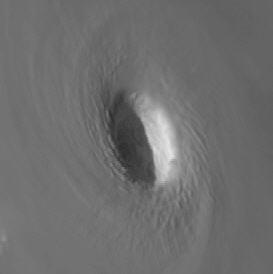
 A time-lapse video of Category 4 Hurricane Igor. Click on the link below and be patient. It is a big file to load.Thanks to mariner Peter Chance.
100913_g15_igor_vis_anim_1931-2033UTC.gif (GIF Image, 960×720 pixels).
A time-lapse video of Category 4 Hurricane Igor. Click on the link below and be patient. It is a big file to load.Thanks to mariner Peter Chance.
100913_g15_igor_vis_anim_1931-2033UTC.gif (GIF Image, 960×720 pixels).
The concession came three days after the World Meteorological Organization posted a snippet on its Web site saying a panel of experts reviewing extreme weather and climate data turned up a 253 mph gust on Australia’s Barrow Island during Cyclone Olivia in 1996.
That tops the 231 mph record set atop Mount Washington on April 12, 1934. “Somehow it fell through the cracks and the Australians didn’t think it was a big deal,” he said. “We hear that, and it kinds of blows our minds, but of course, we’re weather fans and we’re tuned into that sort of thing.” http://news.yahoo.com/s/ap/20100126/ap_on_sc/us_wind_record_toppled
 Click on this image to see a video composite of all of the cloud movements for the last 24 hours (in 3 hour increments) in relation to the Earth below.
 Click Picture for Slide Show
Extraordinary Clouds and The Cloud Collector’s Handbook – Telegraph.
Our modern way of life, with its reliance on technology, has unwittingly exposed us to an extraordinary danger: plasma balls spewed from the surface of the sun could wipe out our power grids, with catastrophic consequences.
The “perfect storm” is most likely on a spring or autumn night in a year of heightened solar activity – something like 2012. Around the equinoxes, the orientation of the Earth’s field to the sun makes us particularly vulnerable to a plasma strike.
 The projections of just how catastrophic make chilling reading. “We’re moving closer and closer to the edge of a possible disaster,” says Daniel Baker, a space weather expert based at the University of Colorado in Boulder, and chair of the NAS committee responsible for the report.
According to the NAS report, the impact of what it terms a “severe geomagnetic storm scenario” could be as high as $2 trillion. And that’s just the first year after the storm. The NAS puts the recovery time at four to 10 years.
via Space storm alert: 90 seconds from catastrophe – space – 23 March 2009 – New Scientist.
Heat and drought caused 19.6 percent of total deaths from natural hazards, with summer thunderstorms causing 18.8 percent and winter weather causing 18.1 percent, the team at the University of South Carolina found. Earthquakes, wildfires and hurricanes combined were responsible for fewer than 5 percent of all hazard deaths.
The most dangerous places to live are much of the South, because of the heat risk, the hurricane coasts and the Great Plains states with their severe weather, Cutter said.
The south-central United States is also a dangerous area, with floods and tornadoes. California is relatively safe, they found.
via Reuters AlertNet – ‘Death map’ shows heat a big hazard to Americans.
In 15 minutes, the water rose 12 feet, then receded. And then it happened again. It occurred three times, she said, each time ripping apart docks and splitting wooden pilings.
via Massive waves a mystery at Maine harbor – The Boston Globe
Here’s a peek to see what it’s like in the middle of a raging storm, courtesy of the aircraft carrier USS Kitty Hawk in the Western Pacific. To put in perspective, the Kitty Hawk is more than 1,000 feet long and the deck is about 70 feet above the ocean surface. Her cruising speed is 30 knots (34.5 MPH) and she’s probably going about 20 knots in this video. I’m sure they wished they moved that helicopter farther back off the deck before those seas hit.
Winds: 40-50 knots. Seas: 35-45 feet.
What kind of surf would this storm send us? After significant swell decay within the first 1000 miles and a slower rate of decay after 2000 miles from the storm fetch. For most surf spots:
Estimated Surf 1000 miles away: 15-30 foot+ faces
Estimated Surf 2000 miles away: 12-20 foot faces
Estimated Surf 4000 miles away: 8-12 foot faces
Estimated Surf 5000 miles away: 6-10 foot faces
[vodpod id=ExternalVideo.701469&w=425&h=350&fv=%26file%3Dhttp%3A%2F%2Fmedia1.surfline.com%2F2008%2F09_sep%2Fheavy_seas_forecasters_640.flv%E2%84%91%3Dhttp%3A%2F%2Fwww.surfline.com%2Fforecasters%2Fblog%2Fboat.jpg%26backcolor%3D000033%26frontcolor%3D336699%26lightcolor%3Dff9900%26stretching%3Dfill]

Click on this link from Randy Marks for a 28 picture slide show.
The short – but eventful – life of Ike – The Big Picture – Boston.com

