Honey Boo Boo vs. Duck Dynasty

While Conservatives bemoan the crudeness of popular culture, there are 12 million viewers tuning in to watch the Season Premiere of the comparatively-positive  White Trash role model  “Duck Dynasty”.  The largest audience ever for a reality show on cable. They’re even releasing a Holiday record “Duck the Halls”. Now those rich rednecks know how to market themselves.
As reality’s first family, the Kardashians, have seen their ratings steadily decline over the past several years, shows like “Pawn Stars,” “American Restoration” and “Duck Dynasty” have risen to dominate basic cable.

Reality Cable StarsLast year, “Here Comes Honey Boo Boo,” which features a cornucopia of social ills, was TLC’s highest-rated show, attracting more cable viewers than the Republican National Convention, which had the misfortune to share the time slot with the charmers from Georgia. The show’s matriarch, June Shannon, has four daughters by four men, one of whose names she can’t recall.

Students of Arnold Toynbee, the English historian, will recognize what is going on here. In a chapter of his “A Study of History” entitled “Schism in the Soul,” Toynbee argued that it is a sign that a society is disintegrating when it takes its cues for manners and customs from the underclass. He describes such societies as being “truant” to their own values.

Toynbee is the guide to what we see all around us today.

We modern philistines tell ourselves that rejecting the customs and conventions of a stuffy, old elite will release creativity and bring about a renaissance. Nothing could be further from the truth. According to Toynbee, self-expression replaces creativity when disintegrating societies look downward.

Aspiration is replaced by complacency. Shame vanishes. Any criticism becomes “haters gonna hate,” or the White Trash motto: “It don’t make no difference.”

White Trash signifiers have changed of course — the foreclosed McMansion with the mosquito-infested swimming pool has replaced the rusting tractor permanently bivouacked on cement blocks in the front yard. But it’s the same general idea.

Obesity, the product of a lack of discipline, sloppy dressing, loud and intimate cellphone chats broadcast to a captive audience and foul language nonchalantly uttered in the ATM line are all forms of this “self-expression.”

Pre-White Trash, physical intimacy was reserved to private places. Now it’s reserved for the subway. You no longer have to live in a one-room shack to learn the facts of life early. Just walk down the toy aisle at Toys “R” Us for a sexpot Bratz Doll.

Children who see daytime television, broadcast in public areas, are inevitably treated to Jerry Springer reruns. How do you explain “Honey, I’m a Ho,” or “Transsexuals Attack” to a tot? Oh, wait, the tot explains it to you.

Tattoos are form of self-expression that have moved from gangs and prisons to the mainstream.

via When did white trash become normal? | New York Post.

If You Also Hate The Time Change…

AccordUS Time Zonesing to Time and Date, a Norwegian Newsletter dedicated to time zone information, America started using four time zones in 1883. Before that, each city had its own time standard based on its calculation of apparent solar time (when the sun is directly over-head at noon) using sundials. That led to more than 300 different American time zones. This made operations very difficult for the telegraph and burgeoning railroad industry. Railroads operated with 100 different time zones before America moved to four, which was consistent with Britain’s push for a global time standard.

Now the world has evolved further—we are even more integrated and mobile, suggesting we’d benefit from fewer, more stable time zones. Why stick with a system designed for commerce in 1883? In reality, America already functions on fewer than four time zones.

 Research based on time use surveys found American’s schedules are determined by television more than daylight.  That suggests in effect, Americans already live on two time zones.

via Daylight Saving Time Is Terrible: Here’s a Simple Plan to Fix It – Allison Schrager – The Atlantic.

The Science of Snobbery

Articles on this wine research recommend that serving cheap wine in fancy bottles or reaching for bottom shelf wine. Does that mean you should constantly deceive yourself into enjoying cheap wine? Or never spend more than $10 since we often mistake $10 bottles with $100 bottles? In that case, will you never spend over $10 on sushi for same reason? Or never spend over $30 at a fancy restaurant because the ambiance often tricks people into thinking a simple chicken dish is fancy?

j0178091Ordinary consumers don’t think hard and deliberately when sipping wine over a conversation with friends or listening to a concert. Even when thinking deliberatively, overcoming our intuitive impressions is difficult for experts and amateurs alike. This article has referred to the influence of price tags and context on products and experiences like wine and classical music concerts as tricks that skew our perception. But maybe we should consider them a real, actual part of the quality.

What does this all say about wine snobs? The answer is just as unclear. Due to the way that appreciation of wine, fancy food, and other aspects of high culture is often used to police class lines, studies demonstrating the limitations of expert judgment in these areas become fodder for class warfare and takedowns of wine snobs.

That’s fair. Many boorish people talking about the ethereal qualities of great wine probably can’t even identify cork taint because their impressions are dominated by the price tag and the wine label. But the classic defense of wine – that you need to study it to appreciate it – is also vindicated by Master Sommeliers. The open question – which is both editorial and empiric – is what it means for the industry that constant vigilance and substantial study is needed to dependably appreciate wine for the product quality alone. But the questions is relevant to the enjoyment of many other products and experiences that we enjoy in life

via The Science of Snobbery.

Why Is Gay Porn So Popular in Pakistan?

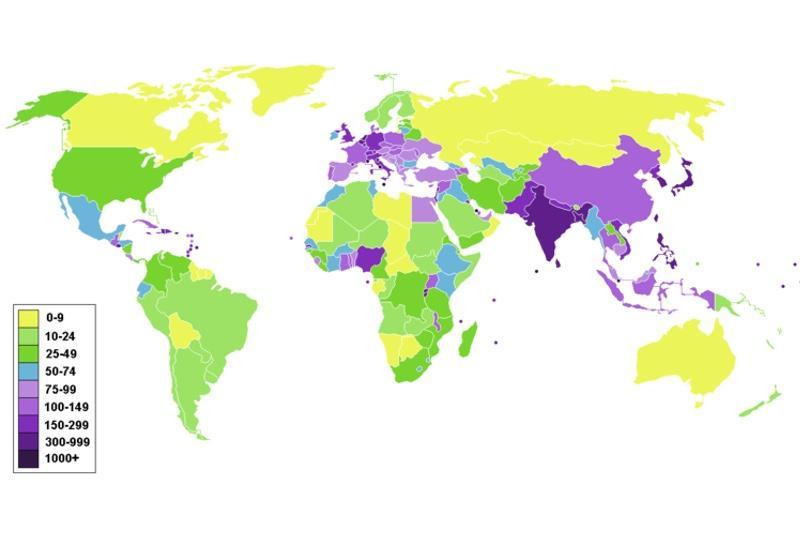
As of this writing, Pakistan is by volume the world leader for Google searches of the terms “shemale sex,” “teen anal sex,” and “man fucking man,” according to Google Trends. Pakistan also ranks second in the world (after similarly gay-intolerant Kenya) for volume of searches for the search term “gay sex pics.”

In its report, Pew noted that countries exhibiting the highest levels of gay tolerance are largely secular, whereas nations where religion is central to public lifesuch as Egypt, Nigeria, and Pakistantend to reject homosexuality. But in Pakistan, what’s even more peculiar is that the highest number of hits for some of these terms, including “shemale sex,” come not from Pakistan’s cosmopolitan centers, but from Peshawar, a bastion of conservative Islam, lately known in the West as a counterterrorism frontline.

Farahnaz Ispahbikini_burkhaani, an expert in Pakistani minorities at the Woodrow Wilson International Center for Scholars and a former member of Pakistan’s parliament, says that homosexuality is a taboo subject throughout the country. In major cities such as Lahore and Karachi, gays can develop a network of allies outside their tribe or family, but in conservative Peshawar, gay identity is more complicated. Part of the popularity of gay porn could stem from the fact that even highly observant Muslim males often have physical relationships with men without considering themselves gay, she says.

“The real love they can have that most of us find with a partner, they find with men,” Ispahani says. “They mostly see their wives as the mother of their children.”

Why Is Gay Porn So Popular in Pakistan? | Mother Jones.

Did Cocaine Fuel the Financial Bubble?

The controversial former drug tsar David Nutt told the London Sunday Times this weekend that cocaine-using bankers with their “culture of excitement and drive and more and more and more … got us into this terrible mess”.

Nutt, who was sacked for claiming that ecstasy was as safe as horse riding, told the Sunday Times that abuse of cocaine caused the financial meltdown.

“Bankers use cocaine and got us into this terrible mess,” he told the paper adding that the drug made them “overconfident” and led to them taking more risks. Nutt, who is professor of neuropsychopharmacology at Imperial College, claimed that cocaine was perfect for a banking “culture of excitement and drive and more and more and more. It is a ‘more’ drug”

There were also lots of stories about some of the big swingers in New York enjoying a line or 10 of an evening. Bernie Madoff’s office was apparently known as “the North Pole” such were the gargantuan quantities of “snow” to be found there and most bankers are aware of the published allegations that Jimmy Cayne (former CEO of Bear Stearns) had an anti-acid medication bottle that was filled with cocaine.

Scarface!!!!!!!!!!1Dr Chris Luke, an A&E specialist based at Cork University Hospital, Ireland, who has studied the effects of cocaine on bankers, has stated that “prominent figures in financial and political circles made irrational decisions as a result of megalomania brought on by cocaine usage”. He concludes that “people were making insane decisions and thinking they were 110% right … which led to the current chaos.”

Greed, selfishness, ignorance and ruthlessness also played their part, of course, but I think it would be foolish not to see the role that the drug played in creating the bubble.

Did cocaine use by bankers cause the global financial crisis? | Business | The Guardian.

More Baby Talk = More IQ

Children whose families were on welfare heard about 600 words per hour. Working-class children heard 1,200 words per hour, and children from professional families heard 2,100 words. By age 3, a poor child would have heard 30 million fewer words in his home environment than a child from a professional family. And the disparity mattered: the greater the number of words children heard from their parents or caregivers before they were 3, the higher their IQ and the better they did in school. TV talk not only didn’t help, it was detrimental.

Hart and Risley later wrote that children’s level of language development starts to level off when it matches that of their parents — so a language deficit is passed down through generations. They found that parents talk much more to girls than to boys (perhaps because girls are more sociable, or because it is Mom who does most of the care, and parents talk more to children of their gender). This might explain why young, poor boys have particular trouble in school. And they argued that the disparities in word usage correlated so closely with academic success that kids born to families on welfare do worse than professional-class children entirely because their parents talk to them less. In other words, if everyone talked to their young children the same amount, there would be no racial or socioeconomic gap at all. (Some other researchers say that while word count is extremely important, it can’t be the only factor.)

via The Power of Talking to Your Baby – NYTimes.com.

When Enlightenment Meets Science

The veteran meditators in the MRI could do each of the resting states perfectly, but when it came to creating a contrasting condition, they were helpless. They had lost the ability to “let their minds wander” because they had long ago shed the habit of entertaining discursive narrative thoughts. They no longer worried about how their hair looked, or their to-do lists, or whether people thought they were annoying. Their minds were largely quiet. When thoughts did come – and they did still come – these subjects reported that the thoughts had a different quality, an unfixated quality. The thought “This MRI machine is extremely loud” might arise, but it would quickly evaporate. Thoughts seemed to emerge as-needed in response to different situations and would then disappear crisply into the clear backdrop of consciousness. In other words, these practitioners were always meditating.

This turned out to be the least dramatic of Vago’s discoveries. With the two most experienced meditators, something even more surprising happened, something that, to the knowledge of the investigators involved, had never before been captured on any kind of brain imaging technology.

Lying on their padded gurneys in the center of the humming MRI in this famous research hospital in the heart of East Boston and Harvard Medical School, each of the two research subjects suddenly … disappeared.

Har-Prakash Khalsa, a 52-year old Canadian mail carrier and yoga teacher – and one of the veterans to whom this happened – describes his experience:

“It’s a kind of pressure or momentum. I was in one of the rest states, and as I let go of it, I felt myself heading into a much bigger dissolution – a bigger ‘gone’ as Shinzen would call it. It felt impossible to resist.  My mind, body and world just collapsed.”

A few moments later – blinking, refreshed, reformatted – Har-Prakash returned to consciousness, not at all sure how he was to supposed to fit this experience into the research protocol. He couldn’t indicate it with a button press even if he wanted to: there was no one present to press the button.

This wasn’t rest – it was annihilation.

via Understanding Enlightenment Could Change Science – Psychology TomorrowPsychology Tomorrow Magazine.