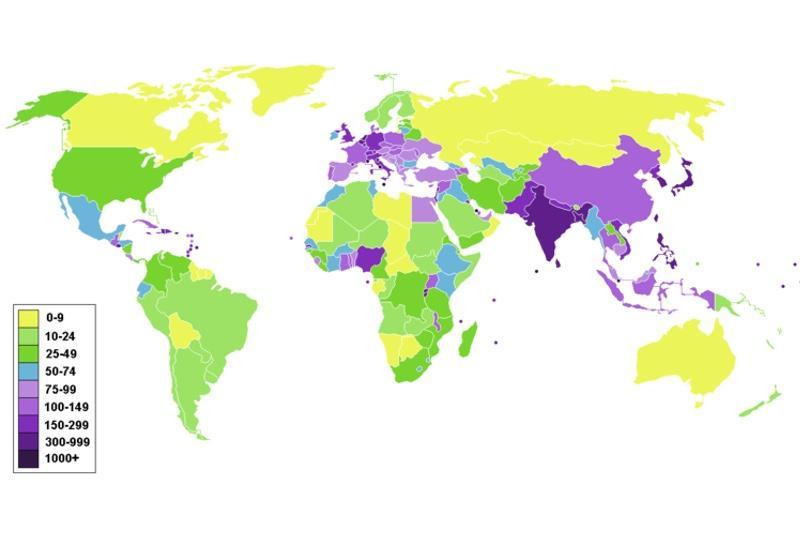
To gain perspective on just how differently people are living on this planet,

(Parts of Malaysia and Indonesia have been intentionally left out—without them, the red regions still contain more than 50.2% of the world’s population.)

Although they’re not particularly tall, every minute (on average) about four million cubic feet of water makes its way over the crest line of Niagara Falls. Located on the Niagara River and serving the natural purpose of draining Lake Erie into Lake Ontario, the combined falls that make up Niagara boast the highest flow rate of any waterfall in the world.
 Bruce Omori, owner of Extreme Exposures Fine Art Gallery in Hilo, received the Windland Smith Rice International Award for his lava photo titled “Volcanic Vortices,” which will be displayed at the Smithsonian Museum of Natural History’s annual exhibition in June. His winning photograph was selected from almost 20,000 submissions from photographers in 46 countries.
“On an early morning shoot at the Waikupanaha ocean entry, lava from the Kilauea volcano poured into the sea. This created a huge escape of steam, and as it rose, multiple vortices began spinning off of the huge plume,” Omori described in his photo submission description. “A vortex or two is a pretty rare sight—but when one after another kept forming, my fumbling with the lenses turned into a panicked rush to switch my telephoto to wide angle lens to capture this awesome scene of seven vortices in a row.” Thanks to Muriel Lighter
via Hilo Photographer Receives Smithsonian Museum Award | Hawaii Business.
 This beautiful painting by Donald Rusty hides more than meets the eye! Check it out and see if you can spot all the animals hidden somewhere inside it. How many are there? Don’t forget the proper way to submit your findings is using the “submit illusion” email link that can be found at the very bottom of this site. You are also free to post your outlined solution pics using “add image” option underneath the comment box. Happy hunting!
via Mount Zoomore Optical Illusion | Mighty Optical Illusions.
It’s possible to fracture gas-rich rock formations without using any water at all. Indeed, gas and oil companies have been using carbon dioxide this way for decades, albeit on a limited basis. Right now carbon dioxide fracking is used in places, like Wyoming, that already have carbon dioxide pipelines. But if this approach is going to be used on a large scale, it will require a major investment in infrastructure for getting carbon dioxide to fracking sites. And in some cases a price on carbon emissions may be the only way to make the economics work.
A price on carbon, for example, could create a big supply of cheap carbon dioxide by giving utilities incentive to capture it from power plants’ smokestacks. This might make sense in China, where the best shale gas deposits are in arid areas (see “China Has Plenty of Shale Gas, but It Will Be Hard to Mine”).
via Fracking with Carbon Dioxide Could Help Shale Gas Production in Arid Areas | MIT Technology Review.
Edinburgh University research suggests sunlight helps reduce blood pressure, cutting heart attack and stroke risks and even prolonging life.
Heart disease and stroke linked to high blood pressure are estimated to lead to about 80 times more deaths than those from skin cancer in the UK.
Dietary vitamin D supplements alone will not be able to compensate for lack of sunlight” Dr Richard Weller Edinburgh University
Production of the pressure-reducing compound, nitric oxide, is separate from the body’s manufacture of vitamin D, which rises after exposure to sunshine.
via BBC News – Sun’s blood pressure benefits ‘may outdo cancer risks’.
The climate will swing to extremes as it tries to find a new equilibrium, in response to the warming climate. Siberian winters will be colder, heat waves extended, etc. This report says that if you are in a rainy location, expect more deluges, and if you live in a dry area, expect more droughts. Specifically, the new study found that although the 14 climate models differ when it comes to the amount of rainfall in individual locations such as cities, over larger areas, they all point to the same average picture. That is, for every single degree Fahrenheit the global average temperature climbs, heavy rainfall will increase in wet areas by 3.9 percent, while dry areas will experience a 2.6 percent increase in time periods without any rainfall.
Rain will get more extreme thanks to global warming, says NASA study | The Verge.
 Colombia’s lush Cocora Valley, part of Los Nevados National Park, is the principal home for the country’s national tree, the palma de cera, or wax palm. The lanky tree is the world’s tallest palm tree, reaching up to 200 feet tall. Photograph by Alex Treadway
via Cocora Valley, Colombia — Travel 365 — National Geographic.
The data in this graphic come from the web site of the Centers for Disease Control & Prevention, but a graphic designer in Purchase, N.Y., named Leon Farrant has created a graphic that drives home what the data mean.
Below is a look at the past morbidity (how many people became sick) of what were once very common infectious diseases, and the current morbidity in the U.S.

via How Vaccines Have Changed Our World In One Graphic – Forbes.
A novel fabrication technique developed by a University of Connecticut engineering professor could provide the breakthrough technology scientists have been looking for to vastly improve the efficiency of today’s solar energy systems.
Silicon solar panels have a single band gap which, loosely speaking, allows the panel to convert electromagnetic radiation efficiently at only one small portion of the solar spectrum. The rectenna devices don’t rely on a band gap and may be tuned to harvest light over the whole solar spectrum, creating maximum efficiency.
The nano-antennas – known as “rectennas” because of their ability to both absorb and rectify solar energy from alternating current to direct current – must be capable of operating at the speed of visible light and be built in such a way that their core pair of electrodes is a mere 1 or 2 nanometers apart, a distance of approximately one millionth of a millimeter, or 30,000 times smaller than the diameter of human hair.
The potential breakthrough lies in a novel fabrication process called selective area atomic layer deposition (ALD) that was developed by Brian Willis, an associate professor of chemical and biomolecular engineering at the University of Connecticut and the former director of UConn’s Chemical Engineering Program.
The atomic layer deposition process is favored by science and industry because it is simple, easily reproducible, and scalable for mass production. Willis says the chemical process is particularly applicable for precise, homogenous coatings for nanostructures, nanowires, nanotubes, and for use in the next generation of high-performing semi-conductors and transistors.
Read more at: http://phys.org/news/2013-02-patented-fabrication-technique-key-solar.html#jCp
Read more at: http://phys.org/news/2013-02-patented-fabrication-technique-key-solar.html#jCp
Read more at: http://phys.org/news/2013-02-patented-fabrication-technique-key-solar.html#jCp
Read more at: http://phys.org/news/2013-02-patented-fabrication-technique-key-solar.html#jCp
Read more at: http://phys.org/news/2013-02-patented-fabrication-technique-key-solar.html#jCp
Read more at: http://phys.org/news/2013-02-patented-fabrication-technique-key-solar.html#jCp
Read more at: http://phys.org/news/2013-02-patented-fabrication-technique-key-solar.html#jCp
via New patented fabrication technique key to new solar power technology.