
The Rise Of Youthful Secularism

The most rapidly growing religious category today is composed of those Americans who say they have no religious affiliation. While middle-aged and older Americans continue to embrace organized religion, rapidly increasing numbers of young people are rejecting it.

As recently as 1990, all but 7% of Americans claimed a religious affiliation, a figure that had held constant for decades. Today, 17% of Americans say they have no religion, and these new “nones” are very heavily concentrated among Americans who have come of age since 1990. Between 25% and 30% of twentysomethings today say they have no religious affiliation — roughly four times higher than in any previous generation.

Sociologists Michael Hout and Claude Fischer of UC Berkeley were among the first to call attention to the ensuing rise in young “nones,” and in our recent book, “American Grace,” we have extended their analysis, showing that the association between religion and politics (and especially religion’s intolerance of homosexuality) was the single strongest factor in this portentous shift. In religious affinities, as in taste in music and preference for colas, habits formed in early adulthood tend to harden over time. So if more than one-quarter of today’s young people are setting off in adult life with no religious identification, compared with about one-20th of previous generations, the prospects for religious observance in the coming decades are substantially diminished.

via Religion, politics: Walking away from church – latimes.com.
Is It 3rd Party Time In 2012?

“We basically have two bankrupt parties bankrupting the country,” said the Stanford University political scientist Larry Diamond. Indeed, our two-party system is ossified; it lacks integrity and creativity and any sense of courage or high-aspiration in confronting our problems. We simply will not be able to do the things we need to do as a country to move forward “with all the vested interests that have accrued around these two parties,” added Diamond. “They cannot think about the overall public good and the longer term anymore because both parties are trapped in short-term, zero-sum calculations,” where each one’s gains are seen as the other’s losses.

We have to rip open this two-party duopoly and have it challenged by a serious third party that will talk about education reform, without worrying about offending unions; financial reform, without worrying about losing donations from Wall Street; corporate tax reductions to stimulate jobs, without worrying about offending the far left; energy and climate reform, without worrying about offending the far right and coal-state Democrats; and proper health care reform, without worrying about offending insurers and drug companies.

via Op-Ed Columnist – Third Party Rising – NYTimes.com.

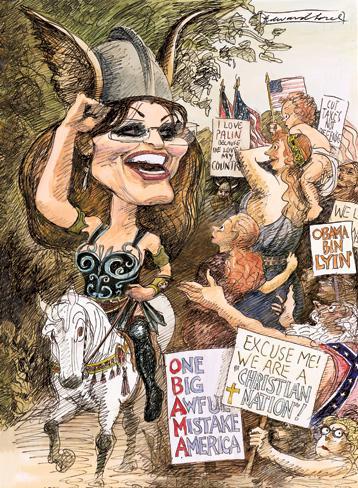
Sarah Palin the Sound and the Fury

Interesting that the author was a rural guy, who was sympathetic to her, before researching for this article.

Even as Sarah Palin’s public voice grows louder, she has become increasingly secretive, walling herself off from old friends and associates, and attempting to enforce silence from those around her. Following the former Alaska governor’s road show, the author delves into the surreal new world Palin now inhabits—a place of fear, anger, and illusion, which has swallowed up the engaging, small-town hockey mom and her family—and the sadness she has left in her wake.

via Sarah Palin the Sound and the Fury | Politics | Vanity Fair.

Religionization of American Politics

Obama isn’t the first president to have to deal with this. Abraham Lincoln, who never joined a church and was notoriously ambiguous and secretive about his religious beliefs, famously said, “The Bible is not my book nor Christianity my profession.” In his later years, despite denouncing those who were “enemies of” or “scoffed at” religion, he reiterated, “My earlier views of the unsoundness of the Christian scheme of salvation and the human origin of the scriptures, have become clearer and stronger with advancing years and I see no reason for thinking I shall ever change them.”

And Lincoln wasn’t alone, either. In fact, the United States was created by a very skeptical group of Founding Fathers. Continue reading “Religionization of American Politics”

Relax, We’ll Be Fine

The U.S. is on the verge of a demographic, economic and social revival, built on its historic strengths. The U.S. has always been good at disruptive change. It’s always excelled at decentralized community-building. It’s always had that moral materialism that creates meaning-rich products. Surely a country with this much going for it is not going to wait around passively and let a rotten political culture drag it down.

via Op-Ed Columnist – Relax, We’ll Be Fine – NYTimes.com. Continue reading “Relax, We’ll Be Fine”

What The Tea Party And Hippies Have In Common

About 40 years ago, a social movement arose to destroy the establishment. The people we loosely call the New Left wanted to take on The Man, return power to the people, upend the elites and lead a revolution.

About 40 years ago, a social movement arose to destroy the establishment. The people we loosely call the New Left wanted to take on The Man, return power to the people, upend the elites and lead a revolution.

via Op-Ed Columnist – The Wal-Mart Hippies – NYTimes.com. Continue reading “What The Tea Party And Hippies Have In Common”

Bill Maher: New Rule: Smart President ≠ Smart Country

Just because a country elects a smart president doesn’t make it a smart country.  (Bill Maher then goes on and rants about polling examples of public ignorance. Reminds me of the “Jay Walking” interviews on the “Tonight Show”, often with College Students.)

Until we admit there are things we don’t know, we can’t even start asking the questions to find out. Until we admit that America can make a mistake, we can’t stop the next one. A smart guy named Chesterton once said: “My country, right or wrong is a thing no patriot would ever think of saying… It is like saying ‘My mother, drunk or sober.'” To which most Americans would respond: “Are you calling my mother a drunk?”

via Bill Maher: New Rule: Smart President ≠ Smart Country.

Top 1% Taxes Exceeds That of Bottom 95%

IRS data shows that in 2007—the most recent data available—the top 1 percent of taxpayers paid 40.4 percent of the total income taxes collected by the federal government. This is the highest percentage in modern history. By contrast, the top 1 percent paid 24.8 percent of the income tax burden in 1987, the year following the 1986 tax reform act.

blogTax20090729-chart1Remarkably, the share of the tax burden borne by the top 1 percent now exceeds the share paid by the bottom 95 percent of taxpayers combined. In 2007, the bottom 95 percent paid 39.4 percent of the income tax burden. This is down from the 58 percent of the total income tax burden they paid twenty years ago.

To put this in perspective, the top 1 percent is comprised of just 1.4 million taxpayers and they pay a larger share of the income tax burden now than the bottom 134 million taxpayers combined.

Some in Washington say the tax system is still not progressive enough. However, the recent IRS data bolsters the findings of an OECD study released last year showing that the U.S.—not France or Sweden—has the most progressive income tax system among OECD nations. We rely more heavily on the top 10 percent of taxpayers than does any nation and our poor people have the lowest tax burden of those in any nation.

via The Tax Foundation – Tax Burden of Top 1% Now Exceeds That of Bottom 95%.

The Skeptical Doctor

One of the effects of the concentration on the lives of celebrities, who are often people of little obvious merit or achievement, is that it transforms ambition into daydreams. Constantly comparing your own life with the fairy-tale life of celebrities means that small but achievable ambitions appear trivial and meaningless; but actually civilization is maintained not only by major achievements and talents, but by the striving of millions of ordinary people. This is undermined, I believe, by celebrity culture

The Skeptical Doctor.

The New Deal Didn’t Always Work, Either

The traditional story is that President Franklin D. Roosevelt rescued capitalism by resorting to extensive government intervention; the truth is that Roosevelt changed course from year to year, trying a mix of policies, some good and some bad. It’s worth sorting through this grab bag now, to evaluate whether any of these policies might be helpful.

If I were preparing a “New Deal crib sheet,” I would start with the following lessons: Economic View – The New Deal Didn’t Always Work, Either – NYTimes.com