
Ok, not sure I’ve ever seen the water around Florida look quite like this before… at any time of year – Brian BMcNoldy, Senior University of Miami hurricane researcher.


Ok, not sure I’ve ever seen the water around Florida look quite like this before… at any time of year – Brian BMcNoldy, Senior University of Miami hurricane researcher.
On Oct. 12, 1979, Super Typhoon Tip’s central pressure dropped to 870 mb (25.69 inches Hg), the lowest sea-level pressure ever observed on Earth, according to NOAA. Peak wind gusts reached 190 mph (306 kph) while the storm churned over the western Pacific.
Besides having unsurpassed intensity, Super Typhoon Tip is also remembered for its massive size. Tip’s diameter of circulation spanned approximately 1,380 miles (2,220 km), setting a record for the largest storm on Earth. The storm’s huge diameter was exactly the same as the distance from New York City to Dallas.
Accuweather’s Mark Mancuso has the details: Super Typhoon
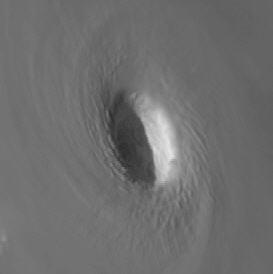 A time-lapse video of Category 4 Hurricane Igor. Click on the link below and be patient. It is a big file to load.Thanks to mariner Peter Chance.
100913_g15_igor_vis_anim_1931-2033UTC.gif (GIF Image, 960×720 pixels).

Click on this link from Randy Marks for a 28 picture slide show.
The short – but eventful – life of Ike – The Big Picture – Boston.com

[vodpod id=ExternalVideo.669909&w=425&h=350&fv=]
Map reveals US disaster hotspots – earth – 12 February 2008 – New Scientist Environment
 The resulting indices of vulnerability, going back to 1960 and with a projection to 2010, show a slight decrease in vulnerability nationwide (see map, right). Among the regions where things have got worse are California and the Texas-Mexico border, probably because low-income immigrant populations have settled there.
New York City and San Francisco have the greatest potential for suffering. A highly urbanised population means injuries, fatalities and infrastructure losses would be large, says Cutter. You can see where Florida is now a model for other States. Thanks to EPIC for link. Journal reference: Proceedings of the National Academy of Sciences (DOI: 10.1073/pnas.0710375105)
 IMAGES: