Trying To Prove We Live In A Virtual Reality

One of modern physics’ most cherished ideas is quantum chromodynamics, the theory that describes the strong nuclear force, how it binds quarks and gluons into protons and neutrons, how these form nuclei that themselves interact. This is the universe at its most fundamental.

So an interesting pursuit is to simulate quantum chromodynamics on a computer to see what kind of complexity arises. The promise is that simulating physics on such a fundamental level is more or less equivalent to simulating the universe itself.

There are one or two challenges of course. The physics is mind-bogglingly complex and operates on a vanishingly small scale. So even using the world’s most powerful supercomputers, physicists have only managed to simulate tiny corners of the cosmos just a few femtometers across. (A femtometer is 10^-15 metres.)

That may not sound like much but the significant point is that the simulation is essentially indistinguishable from the real thing (at least as far as we understand it).

It’s not hard to imagine that Moore’s Law-type progress will allow physicists to simulate significantly larger regions of space. A region just a few micrometres across could encapsulate the entire workings of a human cell.

Again, the behaviour of this human cell would be indistinguishable from the real thing.

It’s this kind of thinking that forces physicists to consider the possibility that our entire cosmos could be running on a vastly powerful computer. If so, is there any way we could ever know?

Today, we get an answer of sorts from Silas Beane, at the University of Bonn in Germany, and a few pals. They say there is a way to see evidence that we are being simulated, at least in certain scenarios.

via The Measurement That Would Reveal The Universe As A Computer Simulation | MIT Technology Review. Continue reading “Trying To Prove We Live In A Virtual Reality”

See Inside Google’s Brain

Data centers – Google Data centers.

Photo of the brains behind Paw (dad for those that don’t speak Country). Does have a Sci-Fi  Matrix-like look to it. This link will take you to a wall of photos, of various Google Data centers, inside and out. Google has also posted a video.

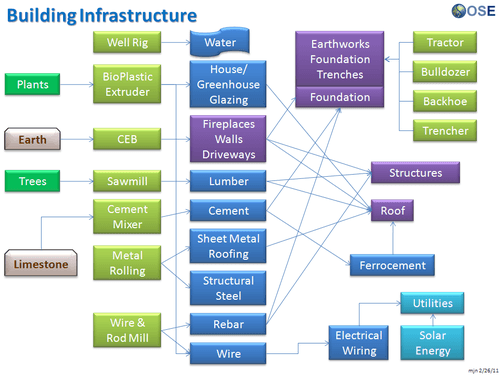
Civilization’s Tools, Just Add People – Open Source Ecology

If you escaped to a Utopia and wanted to bring the discoveries that feed, build and power our civilizations along, these are the machines you would want to bring with you. The only thing that I see missing is the means to defend your colony from others who may want your technology, rather than build it themselves. Some of these have come to fruition, such as an inexpensive machine that can create 16 earth rammed bricks a minute. This creation should have great 3rd world applications today –  in the best Stewart Brand “Whole Earth Catalog” tradition from the 60’s.

The Global Village Construction Set (GVCS) is a modular, DIY, low-cost, high-performance platform that allows for the easy fabrication of the 50 different Industrial Machines that it takes to build a small, sustainable civilization with modern comfortset these.

 via Open Source Ecology – GVCS.

Why the Arabic World Turned Away from Science

From coffee to cheques and the three-course meal, the Muslim world has given us many innovations that we take for granted in daily life. Click on this link to see 20 of the their greatest discoveries. How Islamic inventors changed the world – Science – News – The Independent.

Today Muslims are a fifth of the world’s population, yet contribute only 7% of the world’s GDP. Arabs comprise 5 percent of the world’s population, but publish just 1.1 percent of its books, according to the U.N.’s 2003 Arab Human Development Report. Between 1980 and 2000, Korea granted 16,328 patents, while nine Arab countries, including Egypt, Saudi Arabia, and the U.A.E., granted a combined total of only 370, many of them registered by foreigners.

What went wrong?

The Islamic turn away from scholarship actually preceded the civilization’s geopolitical decline — it can be traced back to the rise of the anti-philosophical Ash’arism school among Sunni Muslims, who comprise the vast majority of the Muslim world.

While the Mu’tazilites had contended that the Koran was created and so God’s purpose for man must be interpreted through reason, the Ash’arites believed the Koran to be coeval with God — and therefore unchallengeable. At the heart of Ash’ari metaphysics is the idea of occasionalism, a doctrine that denies natural causality. Put simply, it suggests natural necessity cannot exist because God’s will is completely free. Ash’arites believed that God is the only cause, so that the world is a series of discrete physical events each willed by God.

The Ash’ari view has endured to this day. Its most extreme form can be seen in some sects of Islamists. For example, Mohammed Yusuf, the late leader of a group called the Nigerian Taliban, explained why “Western education is a sin” by explaining its view on rain: “We believe it is a creation of God rather than an evaporation caused by the sun that condenses and becomes rain.” As Robert R. Reilly argues in The Closing of the Muslim Mind (2010), “the fatal disconnect between the creator and the mind of his creature is the source of Sunni Islam’s most profound woes.”

Inquiry into the history of Arabic science, and the recovery and research of manuscripts of the era, may have a beneficial effect — so long as it is pursued in an analytical spirit. That would mean that Muslims would use it as a resource within their own tradition to critically engage with their philosophical, political, and founding flaws. If that occurs, it will not arise from any Western outreach efforts, but will be a consequence of Muslims’ own determination, creativity, and wisdom — in short, those very traits that Westerners rightly ascribe to the Muslims of the Golden Age
The New Atlantis » Why the Arabic World Turned Away from Science.

The End of Cheap Food

Ever since the days of Thomas Malthus, who famously predicted in the 18th century that population increases would far outstrip gains in food production, those who have foreseen global famine have been proved relentlessly wrong.

Twice before, our species has been saved from starvation by science. But as we move towards a planet of eight billion people, we are in uncharted territory. Let’s hope a new Norman Borlaug is waiting in the wings.

Shortly after Malthus made his grim prediction, we saw the first Agricultural Revolution – the systematic application of science and technology to farming. New varieties of crops, an understanding of crop rotation and the development of mechanisation saw yields soar. Hunger was also averted by the development of a global trade in food, spurred by the advent of steam ships and refrigeration.

Still, the population kept rising – but along came a saviour in the form of Norman Borlaug, one of the most important human beings ever to have lived. Hitler will always be famous for killing millions; yet Dr Borlaug, an American food scientist, saved billions, and yet relatively few of us have heard of him. In the 1960s, he bred new varieties of wheat and rice and other crops, a breakthrough now called the Green Revolution. If it hadn’t been for him, then Asia and perhaps South America would have seen serious famine in the 1970s.

Now we are reaching the limits of the Green Revolution.


via Can science prevent the great global food crisis? – Telegraph.

Galactic Camouflage –“Advanced ET Civilizations May be Undetectable”

“Intelligent species might reasonably worry about the possible dangers of self-advertisement and hence incline towards discretion” — the “Undetectability Conjecture,” put forth by Beatriz Gato-Rivera, a theoretical physicist at the Instituto de Fisica Fundamental (previously Instituto de Matematicas y Fisica Fundamental) of the CSIC (Spanish Scientific Research Council) in Madrid.

According to Gato-Rivera, we may find ourselves in a universe in which there exist intelligent technological civilizations but they have chosen to be undetectable, camouflaging themselves mainly for security reasons (because advanced civilizations could also be aggressive).

Stephen Hawking says “there ought to be many other stars, whose planets have life on them. Some of these stellar systems could have formed 5 billion years before the Earth. So why is the galaxy not crawling with self-designing mechanical or biological life forms?”

Why hasn’t the Earth been visited, and even colonized? Hawking asks. “I discount suggestions that UFO’s contain beings from outer space. I think any visits by aliens, would be much more obvious, and probably also, much more unpleasant.”

via Galactic Camouflage –“Advanced ET Civilizations May be Undetectable” (Today’s Most Popular).

Russia’s Bridge to Nowhere

Alaska doesn’t have the biggest boondoggle bridge project.  Putin just wasted over a billion dollars on a bridge to show off at this week’s 21-member Asia-Pacific Economic Cooperation (APEC) conference.  The bridge to the Russky island, the world’s largest cable-stayed bridge, dead-ends just beyond the bridge, meaning that the 5,000 local residents, who live on the other side of the island and have no access to telephones, public lighting or running water, still have to use a ferry to reach the mainland.

via Bridge to Russky Island – Wikipedia, the free encyclopedia.

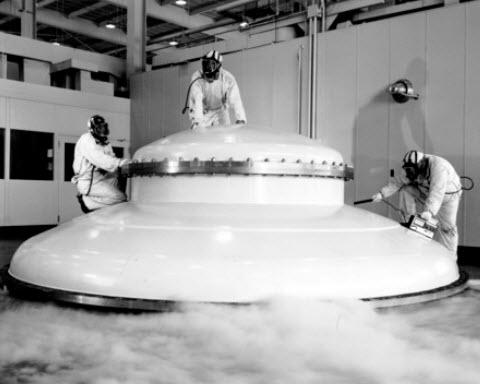
Movie Deal for 14 year-old’s Garage Fusion Reactor

Taylor Wilson always dreamed of creating a star. Now he’s become one. This story about a 14 year old prodigy will be directed by Take Shelter director Jeff Nichols. Wilson gained notoriety for experimenting with nuclear materials with his parents’ approval, and achieving nuclear fusion by the age of 14.

When his grandmother became ill with cancer, Wilson also attempted to develop a cure for the disease using short-lived isotopes.

The film will reportedly contrast Wilson’s story with the similar tale of Michigan teenager David Hahn, whose attempt to build a breeder reactor in his parents’ shed achieved results that were more dangerous than desirable. Link below is to original story. Picture is of Taylor in his garage.

via The Boy Who Played With Fusion | Popular Science.

A Computer Built For Mars

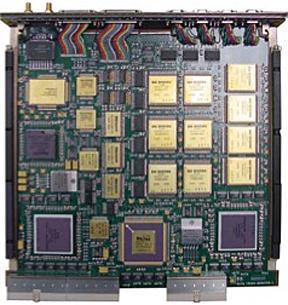
The PowerPC RAD750 chip at the heart of the Curiosity Mars rover’s central computer can withstand temperature extremes and massive doses of space radiation without the dreaded ‘blue screen of death.’

“First, you have to develop the radiation hardening techniques and actually implement them in the design,” said Scott Doyle, a BAE systems engineer for satellite electronics. “The next step is you have to qualify each of those individual components and that qualification is normally a year, a year-and-a-half, just to do that.””Then they get integrated on the board, and that board has to go through qualification activity to prove out the board. Then once that board gets integrated into the satellite at the system level, there’s several years worth of qualification testing that goes in at the satellite level. You add all that up, you’re talking five to eight years of qualification work.”

The resulting computers can cost anywhere from $200,000 to a half-million dollars. While all that might seem like overkill to an outsider, space-based computers simply have to work. “There’s no repairman in space,” Doyle said.

But given the unavoidable limitations in processing speed and memory, Curiosity’s programmers face a daunting task when it comes to writing software. “What’s hard about this, my phone has a processor that’s 10 times as fast as the processor that’s on Curiosity and it has 16 times as much storage as Curiosity has and my phone doesn’t have to land anything on Mars,” Cichy said. “All my phone has to do is follow (a friend’s) Twitter feed.”

via Slow, but rugged, Curiosity’s computer was built for Mars | Cutting Edge – CNET News.