Explore A Virtual Human Body With Stunning Graphics

bdhumanIn the old days, learning about the components of the human body meant poring over a copy of Grey’s Anatomy. Or, if you were studying medicine, you could take a scalpel to a real cadavre of course.
Now, thanks to a fabulous web site at www.biodigitalhuman.com, you can learn about the makings of the human body without having to resort to boring textbooks or a lab.

With nothing more than a web browser and a decent internet connection you can browse the virtual skeleton.  You can choose between male and female, zoom and rotate the skeleton, and turn on/off the display of specific bodily systems such as reproductive, cardiovascular and so on. You can also view the location and symptoms of hundreds of common diseases.

via Explore A Virtual Human Body With Stunning Graphics.

Rise of the Asian Welfare State

Although poorer countries still limit themselves to ad hoc welfare offerings, fitting the spending level to revenues one budget at a time, there is an increasing trend towards entitlements served by statutory institutions that will outlive the budgetary cycle. As these systems mature, welfare provision will be demand-led, not supply-driven; welfare will become integral to the state. Asia’s tigerish economies are turning marsupial, carrying their dependants along with them as they prowl.

Some of the national leaders who unleashed those tiger economies would be shocked and disturbed by the development. To them the welfare state was a Western aberration that would serve only to undermine thrift, industry and filial duty.

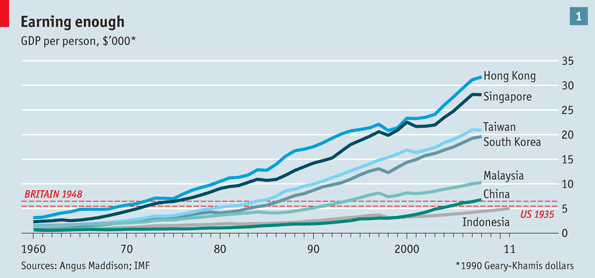
It seems that every country that can afford to build a welfare state will come under mounting pressure to do so. And much of Asia has hit the relevant level of prosperity (see chart 1). Indonesia is now almost as developed as America was in 1935 when it passed the landmark Social Security Act, according to figures compiled by the late Angus Maddison, an economic historian. China is already richer than Britain was in 1948, when it inaugurated the National Health Service (NHS) which, to judge by political ructions—and Olympic opening ceremonies—has become crucial to its sense of national identity.

via Asian welfare states: New cradles to graves | The Economist.

You Can’t Blame Your Stress On Work

Work stress, job satisfaction and health problems due to high stress have more to do with genes than you might think.

The lead author of “Genetic influences on core self-evaluations, job satisfaction, work stress, and employee health: A behavioral genetics mediated model,” published in Organizational Behavior and Human Decision Processes, Judge studied nearly 600 twins — some identical, some fraternal — who were raised together and reared apart. He found that being raised in the same environment had very little effect on personality, stress and health. Shared genes turned out to be about four times as important as shared environment.

via Feeling stressed by your job? Don’t blame your employer, study shows.

Bird Flu Blamed for Seal Deaths

First there was swine flu. Now, while everyone’s attention is on another  Ebola outbreak there may be seal flu.

In the wake of a pneumonia outbreak that killed 162 harbor seals in New England last year, researchers are blaming the deaths on an avian flu virus.

The virus is similar to one circulating in North American birds since 2002 but shows signs of having recently adapted to mammals, according to according to Ian Lipkin, MD, of Columbia University’s Mailman School of Public Health in New York City and colleagues.

The outbreak is “particularly significant,” they wrote, because the virus has naturally acquired mutations that may make it a candidate to cause disease in humans.

via Medical News: Bird Flu Blamed for Seal Deaths – in Infectious Disease, Flu & URI from MedPage Today.

AARP- an Insurance Company in Non-Profit Clothes

AARP, under the guise of an orginization offering discounts to Seniors,  sells their names to companies, who pay heftily to be their exclusive supplier. A recent Hearing Aid company bankruptcy revealed that the deal is very lucrative for AARP.  A lion-share of AARP payments come from Seniors into their captive for-profit corporation, which has grown into the 6th largest US Insurance company, with almost half-a-billion dollars in profits. Planned cuts in Medicare, will encourage more Seniors to purchase Medigap Insurance, through AARP’s exclusive agent – United, to the tune of an estimated $1 billion during the next 10 years. The chart shows the decreasing share that is returned to the non-profit side of AARP, except, by non-profit standards, the lush salaries and perks management enjoys, while being on both Boards. Read the full report at AARP_Report.pdf (application/pdf Object).

12 year old Autistic Artist

David Barth Kunst » Portretten.

This link will take you to the Portfolio of an amazing 12 year-old Autistic Artist from Rotterdam.

from an email from David’s mother to Jill Mullen, who runs an Autistic Artists website:

His drawings often represent his current obsessions. In the attachment I send you, it’s not hard to guess what’s keeping him busy right now. There are almost 400 birds on it and he knows the names and Latin names of most of them.

Click on the picture to enlarge. Thanks to Caroline Collier.

New Insights Into Pleasure & Addiction

Do you, like many, think that drug addicts become drug addicts be­cause they derive greater reward from getting high than others? The biology says no. They actually seem to want it more but like it less.  The scientific definition of addiction is actually rooted in the brain’s inability to experience pleasure.

“There are variants in genes that turn down the function of dopamine signaling within the pleasure circuit,” explains Linden,  a professor of neuroscience at the Johns Hopkins University School of Medicine and the chief editor of the Journal of Neurophysiology.” For people who carry these gene variants, their muted dopamine systems lead to blunted pleasure circuits, which in turn affects their pleasure-seeking activities, he says. “In order to get to that same set point of pleasure that others would get to easily — maybe with two drinks at the bar and a laugh with friends — you need six drinks at the bar to get the same thing.”

It is important to realize that our pleasure circuits are the result of a combination of genetics, stress and life experience, beginning as early as the womb. Crucially, brain imaging studies show that giving to charity, paying taxes, and receiving information about future events all activate the same neural plea­sure circuit that’s engaged by heroin or orgasm or fatty foods.

via ‘The Compass Of Pleasure’: Why Some Things Feel So Good : NPR.

Global Aging

Worldwide, there is a 50 percent chance that the population will be falling by 2070, according to a recent study published in Nature. By 2150, according to one U.N. projection, the global population could be half what it is today.

Those who predict a coming Asian Century have not come to terms with the region’s approaching era of hyper-aging. Asia will also be plagued by a chronic shortage of women in the coming decades, which could leave the most populous region on Earth with the same skewed sex ratios as the early American West. Due to selective abortion, China has about 16 percent more boys than girls, which many predict will lead to instability as tens of millions of “unmarriageable” men find other outlets for their excess libido. India has nearly the same sex-ratio imbalance and also a substantial difference in birth rates between its southern (mostly Hindu) states and its northern (more heavily Muslim) states, which could contribute to ethnic tension.

Birth rates are falling dramatically across Latin America, especially in Mexico, suggesting a tidal shift in migration patterns. Consider what happened with Puerto Rico, where birth rates have also plunged: Immigration to the mainland United States has all but stopped despite an open border and the lure of a considerably higher standard of living on the continent. In the not-so-distant future, the United States may well find itself competing for immigrants rather than building walls to keep them out.

via Think Again: Global Aging – By Phillip Longman | Foreign Policy.