More Deaths Caused by Obesity than Hunger

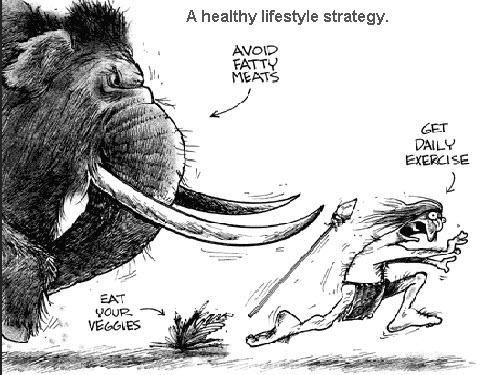
Obesity has become a bigger threat to global health than child hunger, according to a major study.

More than three million deaths in 2010 were attributable to excess body weight, three times the death toll due to malnutrition.

The largest investigation of disease ever undertaken, published yesterday, also found that high blood pressure, smoking and drinking alcohol have become the world’s biggest health risks.

So-called diseases of the western industrialised nations have become more prevalent as developing nations become more affluent. Fewer infants are dying of starvation in the poorest countries while a fast expanding middle-class in the emerging economies. ibeatanorexia

Obesity kills more than hunger in march of ‘progress’ | The Times.

Mt. Everest – In Incredible Composite Detail

This gigapixel image of the Khumbu glacier was captured by David Breashears during the spring of 2012, from the Pumori viewpoint near Mount Everest. The Khumbu Icefall is clearly visible here, and one can easily see the hustle and bustle of Everest Base Camp below.

EverestClick the image to enter gigapixel navigation, then use the controls at the bottom of the screen to zoom and pan and find climbers on the glacier and around the base camp tents, which will give you perspective on the scale of what you are viewing.

via Khumbu Glacier – Mt. Everest – The Glaciers of the Himalayas.

Arctic Ocean Flowers

ArcticOcean Flowers These spiky little bunches of ice form on thin and new ice in the Arctic Ocean. But these badboys can only form under very special conditions:

1) Calm winds. We can’t have these beauties blown away can we?

2) Cold, cold air. It has to be about 20C less than the water and since seawater freezes around -2C, that means the air must be about -22C or -7.6F. BRRR.

Frost flowers form when newly formed ice sublimates, that is ice changes directly from a solid to a gas totally bypassing the liquid stage. Initially, the water vapor formed by sublimation is the same temperature as the sea ice, but gets quickly cooled by the cold air. The air is then becomes supersaturated with water vapor, which means the air has too water much in it. Air really doesn’t want to hold all that excess water vapor, so when the supersaturated air touches another ice crystal the water vapor quickly turns back into ice. (Click the image to enlarge)

via The icy plumage of the Arctic | Deep Sea News. Continue reading “Arctic Ocean Flowers”

Lenticular Clouds Over Mt. Rainier

Credit & Copyright: Tim Thompson

Moist air forced to flow upward around mountain tops can create lenticular clouds. Water droplets condense from moist air cooled below the dew point, and clouds are opaque groups of water droplets. Waves in the air that would normally be seen horizontally can then be seen vertically, by the different levels where clouds form. On some days the city of Seattle, Washington, USA, is treated to an unusual sky show when lenticular clouds form near Mt. Rainier, a large mountain that looms just under 100 kilometers southeast of the city. This image of a spectacular cluster of lenticular clouds was taken in 2008 December. Click picture to enlarge. Credit & Copyright: Tim Thompson

via APOD: 2012 November 4 – Lenticular Clouds Over Washington.

Trying To Prove We Live In A Virtual Reality

One of modern physics’ most cherished ideas is quantum chromodynamics, the theory that describes the strong nuclear force, how it binds quarks and gluons into protons and neutrons, how these form nuclei that themselves interact. This is the universe at its most fundamental.

So an interesting pursuit is to simulate quantum chromodynamics on a computer to see what kind of complexity arises. The promise is that simulating physics on such a fundamental level is more or less equivalent to simulating the universe itself.

There are one or two challenges of course. The physics is mind-bogglingly complex and operates on a vanishingly small scale. So even using the world’s most powerful supercomputers, physicists have only managed to simulate tiny corners of the cosmos just a few femtometers across. (A femtometer is 10^-15 metres.)
That may not sound like much but the significant point is that the simulation is essentially indistinguishable from the real thing (at least as far as we understand it).

It’s not hard to imagine that Moore’s Law-type progress will allow physicists to simulate significantly larger regions of space. A region just a few micrometres across could encapsulate the entire workings of a human cell.

Again, the behaviour of this human cell would be indistinguishable from the real thing.

It’s this kind of thinking that forces physicists to consider the possibility that our entire cosmos could be running on a vastly powerful computer. If so, is there any way we could ever know?

Today, we get an answer of sorts from Silas Beane, at the University of Bonn in Germany, and a few pals. They say there is a way to see evidence that we are being simulated, at least in certain scenarios.

via The Measurement That Would Reveal The Universe As A Computer Simulation | MIT Technology Review. Continue reading “Trying To Prove We Live In A Virtual Reality”

Most Powerful Storm Ever Recorded

On Oct. 12, 1979, Super Typhoon Tip’s central pressure dropped to 870 mb (25.69 inches Hg), the lowest sea-level pressure ever observed on Earth, according to NOAA. Peak wind gusts reached 190 mph (306 kph) while the storm churned over the western Pacific.

Besides having unsurpassed intensity, Super Typhoon Tip is also remembered for its massive size. Tip’s diameter of circulation spanned approximately 1,380 miles (2,220 km), setting a record for the largest storm on Earth. The storm’s huge diameter was exactly the same as the distance from New York City to Dallas.

Accuweather’s Mark Mancuso has the details: Super Typhoon

Earth’s Strongest, Most Massive Storm Ever.

Oldest Evidence of Regular Meat Consumption by Human Ancestors Found

Meat-eating was an important factor affecting early hominin brain expansion, social organization and geographic movement. Stone tool butchery marks on ungulate fossils in several African archaeological assemblages demonstrate a significant level of carnivory by Pleistocene hominins, but the discovery at Olduvai Gorge of a child’s pathological cranial fragments indicates that some hominins probably experienced scarcity of animal foods during various stages of their life histories. The child’s parietal fragments, excavated from 1.5-million-year-old sediments, show porotic hyperostosis, a pathology associated with anemia. Nutritional deficiencies, including anemia, are most common at weaning, when children lose passive immunity received through their mothers’ milk. Our results suggest, alternatively, that (1) the developmentally disruptive potential of weaning reached far beyond sedentary Holocene food-producing societies and into the early Pleistocene, or that (2) a hominin mother’s meat-deficient diet negatively altered the nutritional content of her breast milk to the extent that her nursing child ultimately died from malnourishment. Either way, this discovery highlights that by at least 1.5 million years ago early human physiology was already adapted to a diet that included the regular consumption of meat.

via PLOS ONE: Earliest Porotic Hyperostosis on a 1.5-Million-Year-Old Hominin, Olduvai Gorge, Tanzania.

Civilization’s Tools, Just Add People – Open Source Ecology

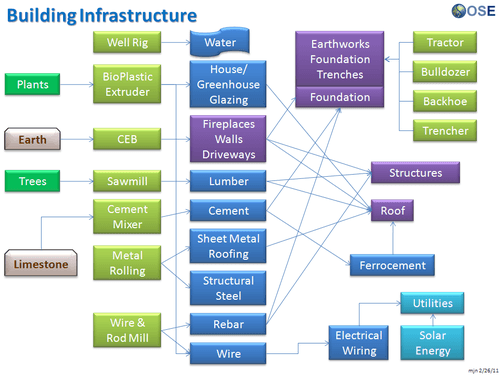
If you escaped to a Utopia and wanted to bring the discoveries that feed, build and power our civilizations along, these are the machines you would want to bring with you. The only thing that I see missing is the means to defend your colony from others who may want your technology, rather than build it themselves. Some of these have come to fruition, such as an inexpensive machine that can create 16 earth rammed bricks a minute. This creation should have great 3rd world applications today –  in the best Stewart Brand “Whole Earth Catalog” tradition from the 60’s.

The Global Village Construction Set (GVCS) is a modular, DIY, low-cost, high-performance platform that allows for the easy fabrication of the 50 different Industrial Machines that it takes to build a small, sustainable civilization with modern comfortset these.

 via Open Source Ecology – GVCS.