Colombia’s lush Cocora Valley, part of Los Nevados National Park, is the principal home for the country’s national tree, the palma de cera, or wax palm. The lanky tree is the world’s tallest palm tree, reaching up to 200 feet tall. Photograph by Alex Treadway
Click on the link to earth_art-ebook to download a pdf file of an amazing collection of earth views from 16 NASA satellites
Some of the instruments aboard the satellites collect data in different ranges of wavelengths of light. These “spectral bands” break up all the visible and invisible light into chunks: the reds, the blues, the greens and even infrared, a wavelength of light that humans can’t see.
When researchers piece the image data back together, they can be selective about which “bands” of light are displayed in the final image. “The selection depends on the intent of the analysis,” Friedl wrote in an email. “An analysis of vegetation would probably select the red, green and infrared bands — vegetation is ‘bright’ in those bands and the analyst could differentiate between the types or health of vegetation.”
Phytoplankton Bloom, Baltic Sea, 2005 Massive congregations of greenish phytoplankton swirl in the dark water around Gotland, a Swedish island in the Baltic Sea. Phytoplankton are microscopic marine plants that form the first link in nearly all ocean food chains. Blooms of phytoplankton, occur when deep currents bring nutrients up to sunlit surface waters.
Friedl says analysts generally don’t go out of their way to make images look surreal, but this kind of spectral analysis can be used to great effect. “There are whole books written on what band combinations to use to bring out certain features,” he told me. Like rocks: When studying the retreat of the glaciers of the Himalayas, Friedl says, you can train software to recognize the light signature of exposed rock. And instead of directly measuring the glaciers themselves, you can see where new rock is getting exposed year over year.
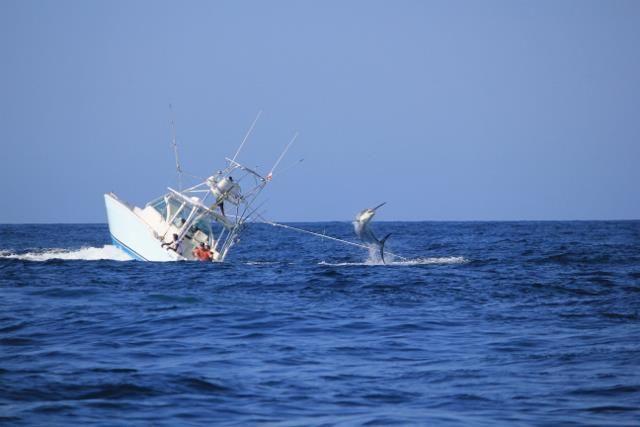
Not all the details are in, but apparently the captain began backing down on the huge fish, a common practice in big-game fishing when a fish is taking line. He puts the boat in reverse to chase the fish.
One commenter on Marlin Magazine’s Facebook post who apparently had some knowledge of the incident said that the captain fell as he was backing down on the fish at full throttle. The boat took on too much water and, finally, there was no correcting the situation. So, indirectly, the fish sank the boat.
Marlin Magazine reported that the boat went to the bottom of the sea and everybody on board was rescued by the photo boat. And, of course, the fish got away. Or as Marlin Magazine put it on its Facebook post, “Marlin Wins!” Thanks Randy Marks
Reddit user mygrapefruit and self-taught colorizer Sanna Dullaway has colorized famous photographs in history. You can find the entire 34-image collection on Imgur . http://imgur.com/a/wapUe Using a Wacom bamboo tablet and Photosohp, each photo takes anywhere from 20 minutes to 2 hours.
The photograph is real, no photoshop, no digital manipulation, no nothing, in fact it was shot on slide film Fuji Provia 100 using a Nikon F5 Camera and 17-35 mm lens. For those conspiracy fans who still doubt its authenticity please read how I took the photograph.
To capture this image I tied myself to the tower of the research boat Lamnidae and leaned into the void, precariously hanging over the ocean while waiting patiently for a white shark to come along. I wanted to shot a photograph that would tell the story of our research efforts to track white sharks using kayaks. When the first shark of the day came across our sea kayak it dove to the seabed and inspected it from below. I quickly trained my camera on the dark shadow which slowly transformed from diffuse shape into the sleek outline of a large great white. When the shark’s dorsal fin broke the surface I thought I had the shot, but hesitated a fraction of a second and was rewarded with marine biologist Trey Snow in the kayak turning around to look behind him. I pressed the shutter and the rest was history. Throughout the day I shot many more images, most showing the kayak following the shark, but all lacked the power of that first image of the great white tracking the kayak.
This picture is claimed to be from Malaysia, where workers cutting a road through the jungle inadvertently killed this estimated to be 120 year-old snake with the pictured excavator. The driver supposedly felt so bad that he cried at what he had done.
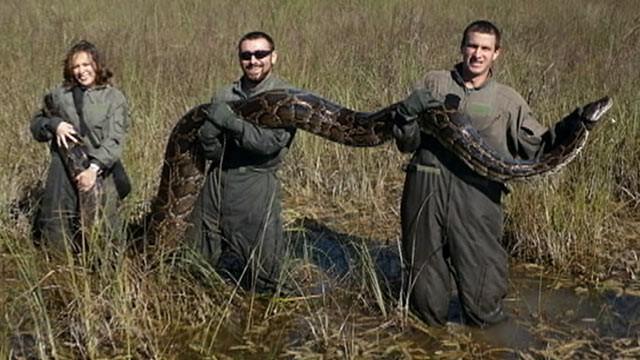
Some estimate that nearly 150,000 pythons are living in the Florida Everglades. Officials say the Burmese pythons are eating wildlife and with no natural predator, the population is overwhelming. The Everglades have become crowded with the snakes and the pythons have started to move into nearby neighborhoods. Last year, a Burmese python was caught and registered more than 17 feet long and 160 pounds. The catch set a new Everglades National Park record.
In this astonishing new book, legendary wildlife photographer Art Wolfe turns to one of nature’s most fundamental survival techniques: the vanishing act. His portraits show animals and insects disappearing into their surroundings, using deceptions, disguises, lures, and decoys to confuse the eye of both predator and prey. Click on this link and hit the “Slideshow” option and see how many you can find.
This gigapixel image of the Khumbu glacier was captured by David Breashears during the spring of 2012, from the Pumori viewpoint near Mount Everest. The Khumbu Icefall is clearly visible here, and one can easily see the hustle and bustle of Everest Base Camp below.
Click the image to enter gigapixel navigation, then use the controls at the bottom of the screen to zoom and pan and find climbers on the glacier and around the base camp tents, which will give you perspective on the scale of what you are viewing.
 Colombia’s lush Cocora Valley, part of Los Nevados National Park, is the principal home for the country’s national tree, the palma de cera, or wax palm. The lanky tree is the world’s tallest palm tree, reaching up to 200 feet tall. Photograph by Alex Treadway