What The Russian Fires Reveal

The disastrous Russian heat wave has exposed a key failing of Russian society: The flow of information has stopped.

A New York journalist friend often drills me on the state of Russia. As I find myself saying, “I don’t know” more frequently, I think he has begun to suspect me of being evasive. The truth is, no one, inside or outside the country, knows what is going on in Russia—unless something catches fire or blows up. Until then, we are in a haze, in silence.

There is not a single newspaper that even strives to be national in its coverage. The television is not only controlled by the Kremlin; it is made by the Kremlin for the Kremlin, and it is entirely unsuited to gathering or conveying actual information. Even the Russian blogosphere is bizarrely fragmented: Researchers who “mapped” it discovered that, unlike any other blogosphere in the world, it consists of many non-overlapping circles. People in different walks of life, different professions, and different parts of the country simply do not talk to one another. The same is true of political institutions: Since the Russian government effectively abolished representative democracy, canceling direct elections, there is no reason—and no real mechanism—for Moscow politicians to know what is going on in the vast country. Nor do governors need concern themselves with the lives and the disasters in their regions—they, too, are no longer elected but are appointed by the Kremlin.

As a result, no one knows where the fires are burning—unless they are burning right next to you. The government, too, lacks the information that would be required to evacuate vulnerable towns and villages, to mobilize the resources necessary to fight the fires, or even to know exactly where they are burning.

via The deadly fires have exposed a key problem in today’s Russia: No one knows what’s going on. – By Masha Gessen – Slate Magazine.

The Balfour Declaration: The Origin of the Arab Israeli Conflict

According to Schneer (London 1900), an expert in modern British history at Georgia Tech, intrigue and British doubledealing defined the 1917 Balfour Declaration of British support for a Jewish “national home” in Palestine as much as bravery and vision, leading to the disillusionment, distrust, and resentment that still dominate the region today. British Jewish chemist and Zionist leader Chaim Weizmann orchestrated the campaign to persuade powerful men that support for Zionism would benefit Britain’s wartime cause and the ensuing peace. Perhaps most shrewdly, Weizmann lobbied former prime minister Arthur James Balfour, then a member of Britain’s War Council. Meanwhile, Grand Sharif Hussein and his sons had won British backing for an Arab kingdom, which would presumably include Palestine, and with British encouragement rebelled against the Ottomans in 1916. Through British duplicity, the French also believed they had a interest in Palestine. And three months after the Balfour Declaration, British prime minister Lloyd George proposed a separate peace with Turkey, with the Ottomans remaining in Palestine.

via Amazon.com: The Balfour Declaration: The Origins of the….

Update on The Mexican Drug Wars

Good LA Times article about the war with the upstart Zeta and La Familia Cartels. Here is the dirty little secret that has been whispered around for awhile.

The arrests have been unevenly distributed. Fewer than 1,000 of the 53,000 drug-trafficking arrests studied in a report this year by Edgardo Buscaglia, an international expert on organized crime and a legal scholar at the Autonomous Technological Institute of Mexico, involved people working for the Sinaloa cartel, the oldest and mightiest of the narco-empires.

Those figures have led many in Mexico to conclude that Calderon’s government is going easy on the Sinaloa traffickers, whose leader is the country’s most wanted fugitive, billionaire Joaquin “Chapo” Guzman. The motive, this argument goes, would be to reduce violence by allowing one group to essentially win. Calderon has vehemently denied favoritism.

via Mexico drug cartels: Mexico drug cartels thrive despite Calderon’s offensive – latimes.com.

Is College Tuition the Next Bubble?

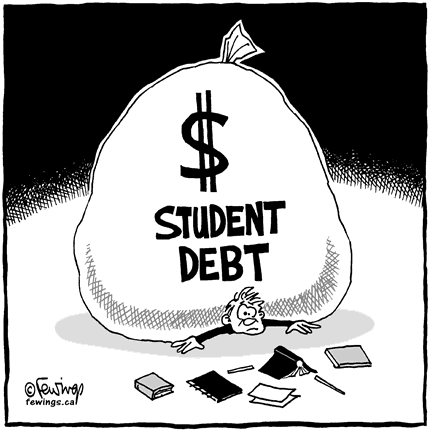
Right now, people are still borrowing heavily to pay the steadily increasing tuitions levied by higher education. But that borrowing is based on the expectation that students will earn enough to pay off their loans with a portion of the extra income their educations generate. Once people doubt that, the bubble will burst.

Many people with college educations are already jumping the tracks to become skilled manual laborers:  plumbers, electricians, and the like.  And the Bureau of Labor Statistics predicts that seven of the ten fastest-growing jobs in the next decade will be based on on-the-job training rather than higher education.  (And they’ll be hands-on jobs hard to outsource to foreigners).  If this is right, a bursting of the bubble is growing likelier.

via Glenn Harlan Reynolds: Further thoughts on the higher education bubble | Washington Examiner.

Maybe You Shouldn’t “Make Your Bed”

Researcher Dr Stephen Pretlove said: “We know that mites can only survive by taking in water from the atmosphere using small glands on the outside of their body.

“Something as simple as leaving a bed unmade during the day can remove moisture from the sheets and mattress so the mites will dehydrate and eventually die.”  Thanks to Suzanne in France.

via BBC NEWS | Health | Untidy beds may keep us healthy.

Burkas for Blackberry

New laws in Saudi Arabia and the United Arab Emirates will require that every Blackberry user dress their phone a miniature burqa and face veil.

‘The Blackberry burqa means that people can still use their phones,’ said a Saudi government official, ‘but the tiny niqab that covers the screen will stop them from reading emails or accessing the Internet.’

The introduction of the burqa is intended to conceal the Blackberry from unwanted attention. With the veil in place only a tiny slit remains revealing just the time and date, thus preserving its modesty.

via Gulf states order Blackberry users to cover their phones in a tiny burqa | NewsBiscuit. Continue reading “Burkas for Blackberry”