
Can Russia Modernize?

Putin is the tsar. He has both money — the government’s budget and the oligarchs’ fortunes — and the coercive power of the state firmly in his hand. He is the arbiter at the top and the trouble-shooter in social conflicts below. His most precious resource is his personal popularity, which adds a flavor of consent to his authoritarian regime.

But none of that is good enough. The 75 percent of Russians who make up the Putin majority are essentially passive and seek only the preservation of a paternalistic state. Putin can sit comfortably on their support, but he cannot ride forward with it. The best and brightest are not there.

Enter Medvedev. His Internet-surfing, compassionate and generally liberal image helps recruit a key constituency — those beyond the reach of Putin himself — to Putin’s plan. They include the country’s most apolitical citizens and its brainy, techy youth. Whether the plan succeeds is another matter.

via The Kremlin Two-Step | Opinion | The Moscow Times.

Why is Haiti so Poor?

Haiti, once called The Jewel of the Antilles, was the richest colony in the entire world. Economists estimate that in the 1750s Haiti provided as much as 50% of the Gross National Product of France. The French imported sugar, coffee, cocoa, tobacco, cotton, the dye indigo and other exotic products. In France they were refined, packaged and sold all over Europe. Incredible fortunes were made from this tiny colony on the island of Hispaniola.

The ultimate causes of Haiti’s misery are human. They are rooted in greed and power. Both the international community and Haiti’s rulers have continuously assured the destruction of Haiti’s colonial wealth and the creation and continuance of her misery.

1. The international community’s role.

1. French colonial contribution.

2. The international boycott of the new nation of 1804.

3. The French debt of 1838.

4. The United States Occupation, 1915-1934.

5. Post World War II United States domination.

2. The role of Haiti’s rulers.

1. Slave-like labor systems in the early republic.

2. The elite’s protection of its wealth.

3. Haitian corruption.

4. Human rights violations as a tool of oppression.

via Why is Haiti so Poor?. Continue reading “Why is Haiti so Poor?”

‘Doomsday Clock’ Moves One Minute Away From Midnight

Pervez Hoodbhoy, member, BAS Board of Sponsors, professor of high energy physics, and head, Physics Department, Quaid-e-Azam University, Islamabad, Pakistan, said: “We may be at a turning point, where major powers realize that nuclear weapons are useless for war-fighting or even for deterrence. Threats to security are more likely to come from economic collapse, groups bent on terrorizing civilians, or from resource scarcity exacerbated by climate change and exploding populations, rather than from conflict between nuclear-armed superpowers. Against these new threats, nuclear weapons are a liability because their possession by a few countries stimulates desire in other countries and complicates things immensely.”

via ‘Doomsday Clock’ Moves One Minute Away From Midnight — NEW YORK, Jan. 14 /PRNewswire-USNewswire/ —.

Is Ayatollah Sistani Iran Regime’s Biggest Threat?

Yet ironically, the regime may face its greatest threat not from within, but from outside the country. Ever since June’s contested election, observers have been keeping a close watch on Grand Ayatollah Ali al-Sistani (who hails from Iran but resides in the holy city of Najaf, Iraq), considered the highest living authority in all of Shiite Islam. Sistani comes from the “quietist” tradition of Shiite theology, one that, unlike the Islamic Republic’s ruling doctrine of velayat-eh faqih, holds that clerics should abstain from becoming directly involved in politics. So far, he has refrained from condemning the regime’s actions. But his clout is so strong in the Shiite world that, were this to change, the Islamic Republic would arguably no longer face just a political crisis within Iran, but also a crisis of religious confidence among all Shiites.

via WPR Article | Iran Faces Down Its Grand Ayatollahs.

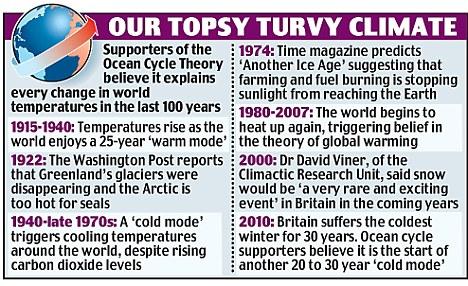
Could we be in for 30 years of global COOLING?

Oceanic cycles have switched to a ‘cold mode’, where data shows that the amount of Arctic summer sea ice has increased by more than a quarter since 2007.

The research has been carried out by eminent climate scientists, including Professor Mojib Latif. He is a leading member of the UN’s Intergovernmental Panel on Climate Change.

He and his colleagues predicted the cooling trend in a 2008 paper, and warned of it again at an IPCC conference in Geneva in September.

Working at the prestigious Leibniz Institute in Kiel University in Germany, he has developed methods for measuring ocean temperatures 3,000ft under the surface, where the cooling and warming cycles start.

For Europe, the crucial factor is the temperature in the middle of the North Atlantic Ocean. He said such ocean cycles – known as multi-decadal oscillations or MDOs – could account for up to half of the rise in global warming in recent years.

Professor Latif said: ‘A significant share of the warming we saw from 1980 to 2000 and at earlier periods in the 20th century was due to these cycles – as much as 50 per cent.

‘They have now gone into reverse, so winters like this one will become much more likely. All this may well last two decades or longer.

via Could we be in for 30 years of global COOLING? | Mail Online.

Half of China’s Moms-To-Be Have C-Sections

While In the U.S., where C-sections are at an all-time high of 31 percent, China’s 46 percent C-section rate was followed by Vietnam and Thailand with 36 percent and 34 percent, respectively. Cambodia and India had the lowest rates of 15 percent and 18 percent, respectively.

The study did not discuss specific reasons for the high number of C-sections, but it noted that more than 60 percent of the hospitals studied were motivated by financial incentives to perform surgeries

via Survey – Half of China’s Moms-To-Be Have C-Sections – NYTimes.com.

Avatar sparks 3-D Star Wars, Matrix, Lord of the Rings

Hollywood is preparing to re-release some past hits, including Star Wars and The Lord of the Rings trilogy, in 3-D following the record-breaking success of Avatar.

Experts now predict that 3-D will become the new multiplex standard within five years. This will be as dramatic a shift as when the “talkies” killed off silent movies in the early 20th century.

Retro-fitting a screen classic with 3-D imagery could take as little as four months, using software to manipulate a digital copy of the film.

via Avatar sparks 3-D makeover for action classics – Times Online.

Cracks in the Jihad

Today, the holy war is set to slip into three distinct ideological and organizational niches.

The first niche is occupied by local Islamist insurgencies, fueled by grievances against “apostate” regimes that are authoritarian, corrupt, or backed by “infidel” outside powers (or any combination of the three). Filling the second niche is terrorism-cum–organized crime, most visible in Afghanistan and Indonesia but also seen in Europe, fueled by narcotics, extortion, and other ordinary illicit activities. In the final niche are people who barely qualify as a group: young second- and third-generation Muslims in the diaspora who are engaged in a more amateurish but persistent holy war, fueled by their own complex personal discontents. Al Qaeda’s challenge is to encompass the jihadis who drift to the criminal and eccentric fringe while keeping alive its appeal to the Muslim mainstream and a rhetoric of high aspiration and promise.

Al Qaeda’s altered design has a number of immediate consequences. The global jihad is losing what David Galula called a strong cause, and with it its political character. This change is making it increasingly difficult to distinguish jihad from organized crime on the one side and rudderless fanaticism on the other. This calls into question the notion that war is still, as Clausewitz said, “a continuation of politics by other means,” and therefore whether it can be discontinued politically. Second, coerced by adversaries and enabled by the Internet, the global jihadi movement has dismantled and disrupted its own ability to act as one coherent entity. No leader is in a position to articulate the movement’s will, let alone enforce it. It is doubtful, to quote Clausewitz again, whether war can still be “an act of force to compel the enemy to do our will.” And because jihad has no single center of gravity, it has no single critical vulnerability. No matter what the outcome of U.S.-led operations in Afghanistan and other places, a general risk of terrorist attacks will persist for the foreseeable future.

via Cracks in the Jihad.

How America Can Rise Again

Is America going to hell? After a year of economic calamity that many fear has sent us into irreversible decline, the author finds reassurance in the peculiarly American cycle of crisis and renewal, and in the continuing strength of the forces that have made the country great: our university system, our receptiveness to immigration, our culture of innovation. In most significant ways, the U.S. remains the envy of the world. But here’s the alarming problem: our governing system is old and broken and dysfunctional. Fixing it—without resorting to a constitutional convention or a coup—is the key to securing the nation’s future. – by James Fallows

via How America Can Rise Again – The Atlantic (January/February 2010).