‘Nuclear Diesel’ Could Become A Gamechanger In Energy Markets | OilPrice.com

Advanced nuclear source energy costs can be 3.5 cents/kWh for electricity or 2 cents/kWh for high-temperature heat. This raw, source energy input cost to manufacture nuclear diesel is less than $1 per gallon. Even after adding new refinery capital costs and operations costs I expect new refineries could produce nuclear diesel at current wholesale prices near $3 per gallon.”

https://oilprice.com/Alternative-Energy/Nuclear-Power/Nuclear-Diesel-Could-Become-A-Gamechanger-In-Energy-Markets.html

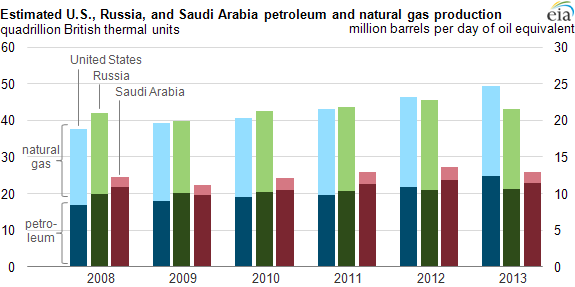
Did You Ever Think the U.S. Would be largest Energy Producer?

productionSince 2008, U.S. petroleum production has increased 7 quadrillion Btu, with dramatic growth in Texas and North Dakota. Natural gas production has increased by 3 quadrillion Btu over the same period, with much of this growth coming from the eastern United States. Russia and Saudi Arabia each increased their combined hydrocarbon output by about 1 quadrillion Btu over the past five years. Note: Petroleum production includes crude oil, natural gas liquids, condensates, refinery processing gain, and other liquids, including biofuels. Barrels per day oil equivalent were calculated using a conversion factor of 1 barrel oil equivalent = 5.55 million British thermal units (Btu).

via U.S. expected to be largest producer of petroleum and natural gas hydrocarbons in 2013 – Today in Energy – U.S. Energy Information Administration (EIA).

Fracking without Water

It’s possible to fracture gas-rich rock formations without using any water at all. Indeed, gas and oil companies have been using carbon dioxide this way for decades, albeit on a limited basis. Right now carbon dioxide fracking is used in places, like Wyoming, that already have carbon dioxide pipelines. But if this approach is going to be used on a large scale, it will require a major investment in infrastructure for getting carbon dioxide to fracking sites. And in some cases a price on carbon emissions may be the only way to make the economics work.

A price on carbon, for example, could create a big supply of cheap carbon dioxide by giving utilities incentive to capture it from power plants’ smokestacks. This might make sense in China, where the best shale gas deposits are in arid areas (see “China Has Plenty of Shale Gas, but It Will Be Hard to Mine”).

via Fracking with Carbon Dioxide Could Help Shale Gas Production in Arid Areas | MIT Technology Review.

Our Emerging Energy Independence

For more than five decades, the world’s oil map has centered on the Middle East. No matter what new energy resources were discovered and developed elsewhere, virtually all forecasts indicated that U.S. reliance on Mideast oil supplies was destined to grow. This seemingly irreversible reality has shaped not only U.S. energy policy and economic policy, but also geopolitics and the entire global economy.

But today, what appeared irreversible is being reversed. The outline of a new world oil map is emerging, and it is centered not on the Middle East but on the Western Hemisphere. The new energy axis runs from Alberta, Canada, down through North Dakota and South Texas, past a major new discovery off the coast of French Guyana to huge offshore oil deposits found near Brazil.

For the United States, these new sources of supply add to energy security in ways that were not anticipated. There is only one world oil market, so the United States — like other countries — will still be vulnerable to disruptions, and the sheer size of the oil resources in the Persian Gulf will continue to make the region strategically important for the world economy. But the new sources closer to home will make our supply system more resilient. For the Western Hemisphere, the shift means that more oil will flow north to south and south to north, rather than east to west. All this demonstrates how innovation is redrawing the map of world oil — and remaking our energy future.

via Oil’s new world order – The Washington Post.

Oil in Shale – New US Energy Source

Based on the industry’s plans, shale and other “tight rock” fields that now produce about half a million barrels of oil a day will produce up to three million barrels daily by 2020, according to IHS CERA, an energy research firm. Oil companies are investing an estimated $25 billion this year to drill 5,000 new oil wells in tight rock fields, according to Raoul LeBlanc, a senior director at PFC Energy, a consulting firm.

“This is very big and it’s coming on very fast,” said Daniel Yergin, the chairman of IHS CERA. “This is like adding another Venezuela or Kuwait by 2020, except these tight oil fields are in the United States.”

In the most developed shale field, the Bakken field in North Dakota, production has leaped to 400,000 barrels a day today from a trickle four years ago. Experts say it could produce as much as a million barrels a day by the end of the decade.

The Eagle Ford, where the first well was drilled only three years ago, is already producing more than 100,000 barrels a day and could reach 420,000 by 2015, almost as much as Ecuador, according to Bentek Energy, a consultancy.

via Oil in Shale Sets Off a Boom in Texas – NYTimes.com.

And Now – The Potato Battery

Potato battery basic composition and performance. Potato Zn/Cu galvanic cell battery basic structure. The battery (Kcell = 15.5 cm) was used to light two white LEDs.

The bioelectrolytic low power electrical energy source introduced in this study brings an extra dimension to the utilization of the globally fourth most abundant crop, accessible essentially all over the world, made of solid components, and requires low initial financial investment compared with solar or conventional batteries. Boiling and the simple assembly do not require special skills; it is both easy to operate and environment friendly. Last but not least, the power generated by Zn/Cu-potato is much cheaper than any conventional portable battery and produces with LED’s substantially cheaper lighting than kerosene. The proposed technology may be immediately implemented in the developing countries for improving the life quality on numerous people who do not have access to grid electricity.

via Zn/Cu-vegetative batteries, bioelectrical characterizations, and primary cost analyses | Issue 3 – Journal of Renewable and Sustainable Energy.

NASA Warns of 2013 Solar Storm

Every 22 years the Sun’s magnetic energy cycle peaks while the number of sun spots – or flares – hits a maximum level every 11 years. Dr Fisher, a Nasa scientist for 20 years, said these two events would combine in 2013 to produce huge levels of radiation.

We know it is coming but we don’t know how bad it is going to be,” Dr Richard Fisher, the director of Nasa’s Heliophysics division, said in an interview with The Daily Telegraph.

“It will disrupt communication devices such as satellites and car navigations, air travel, the banking system, our computers, everything that is electronic. It will cause major problems for the world.

“Large areas will be without electricity power and to repair that damage will be hard as that takes time.”

via Nasa warns solar flares from ‘huge space storm’ will cause devastation – Telegraph.

Natural Gas Replacing Oil Has Big Geopoltical Implications

The coal industry will not surrender the power sector without a fight. The gasification of transport, if it happens, could also take a less direct form, with cars fuelled by electricity generated from gas.

A gasified American economy would have profound effects on both international politics and the battle against climate change. Displacement of oil by natural gas would strengthen a trend away from crude in rich countries, where the IEA believes demand has already peaked as a result of the recent spike in oil prices. Another consequence of the energy market’s bull run, the unearthing of vast new supplies of gas, could bring further upheaval. If the past decade was characterised by the energy-security concerns of consumers, the coming years could give even the world’s powerful oil producers reason to worry, as a subterranean revolution shifts the geopolitics of global energy supply again.

via Natural gas: An unconventional glut | The Economist.

Future Predictions From Geography

People and ideas influence events, but geography largely determines them, now more than ever. To understand the coming struggles, it’s time to dust off the Victorian thinkers who knew the physical world best. A journalist who has covered the ends of the Earth offers a guide to the relief map—and a primer on the next phase of conflict.

via Foreign Policy: The Revenge of Geography.