Globalization’s Geopolical Future

Essay by a prescient Geo-strategist, whose work I follow.

Today’s globalization is suffering a populist blowback on a nearly global scale. Indeed, the only places not suffering such blowback are Latin America, Africa and Southeast Asia, frontiers where globalization’s widespread wealth creation is still resulting in very positive outcomes. Just about everywhere else, whether in the old West, the rising East or the Arab world, we’re seeing a build-up of social anger at globalization’s inequities and excesses that is stunning in its scope and persistence. In short, the world seems destined to either re-balkanize itself over these tensions or enter into a lengthy progressive era that corrects these imbalances and cleans up these corrupting trends.

bikini_burkhaHere’s where the value of the trans-Atlantic bond comes back in. For, remember, the old West has already processed the very same sort of mega-cycle back at the turn of the 20th century, when the world’s first version of a middle class initially came into its own as a potent political force. In that scary millenarian maelstrom, as today, terrorists, revolutionaries and radical fundamentalists abounded. In the end, both extremes of the ideological spectrum reached their catastrophically evil expression in the form of Stalinist Russia and Nazi Germany.

But not everybody in that old West got it wrong. Indeed, America and, to a lesser extent, Britain got it spectacularly right. Their shared Progressive Era was a classic example of co-evolution, in that both sides of “the pond” fed off each other’s experiments and successes — the women’s suffrage movement, social welfare, modern police departments, sanitation, mass transit, labor reforms, food and drug safety — while learning from their mistakes. But through it all, an economic landscape was substantially re-graded, leveled out, as it were, in a “fair deal” to the workingman that tamed all that raging populist anger. The leadership that was seen during the Progressive Era, embodied by the career of Theodore Roosevelt, is the same sort of leadership that America, and the world, needs today.Getting back to my “C-I-A” world of tomorrow, these three superpowers — two in the making, one actual — are currently in a race to see which can process its own domestic populist rage faster and more effectively.

via WPR Article | Trans-Atlantic Ties Still Key to Renewing U.S. Global Leadership.
Continue reading “Globalization’s Geopolical Future”

Predicting 2013 – Opportunities and Threats

This report is the synthesis of a 48-hour crowdsourced brainstorming exercise, where over 60 Wikistrat analysts from around the world collaboratively explored the issues that will dominate the foreign policy agenda in 2013..

The year 2012 helped bring answers to a few of the questions that loomed large for foreign observers when the year began. We now know who will lead the United States for the next four years. We have confirmation that the Muslim Brotherhood and its affiliated branches across the Arab Middle East remain the dominant, if often struggling, political force in the countries where revolutions have toppled dictators. And we have learned, to little surprise, that the much-touted efforts by Washington to pivot towards Asia will remain constrained by the pullback from continuing crises in the Middle East, where major long-standing unresolved conflicts—notably the stand-off with Iran over its nuclear program and Israeli-Palestinian tensions—still occupy the front burner.

The distinction between threats and opportunities was not always clear, particularly because a well-managed threat can turn into an opportunity, just as the reverse is true. As expected, the ongoing developments in the turbulent Middle East occupied much of the analysts’ thoughts, suggesting numerous possible outcomes. But other areas of the world and other supranational trends also made the cut.

Here are some of the top negative & positive scenarios from Wikistrat’s simulation.

via Predicting 2013 – Opportunities and Threats.

The Dirty Solar Panel Fight Over Clean Energy

Chinese technocrats set out to create an industry that would dominate the world, and they succeeded. They aided solar cell manufacturers with easy credit from state banks—perhaps as much as $18 billion of cheap loans—and, some say, subsidies. As a result of central and local government support, Chinese manufacturers began to expand rapidly. Chinese competitors now own 70% of the world’s wafer-producing capacity.

Make that overcapacity. “Massive subsidies and state intervention have stimulated overcapacity more than 20 times total Chinese consumption and close to double total global demand,” said Milan Nitzschke, president of EU ProSun, in a statement released late last month. The company alleges that 90% of Chinese production had to be exported and that Beijing used subsidies to keep its manufacturers in business.

The powerful Chinese National Development and Reform Commission wants to see two-thirds of panel makers go out of business.  Only the largest producers, which are presently nonviable, will survive.

In short, central government technocrats, to salvage their industrial policy, will now have to destroy what they worked so hard to create.

via Sun Sets on China’s Solar Industry – Forbes.

Rise of the Asian Welfare State

Although poorer countries still limit themselves to ad hoc welfare offerings, fitting the spending level to revenues one budget at a time, there is an increasing trend towards entitlements served by statutory institutions that will outlive the budgetary cycle. As these systems mature, welfare provision will be demand-led, not supply-driven; welfare will become integral to the state. Asia’s tigerish economies are turning marsupial, carrying their dependants along with them as they prowl.

Some of the national leaders who unleashed those tiger economies would be shocked and disturbed by the development. To them the welfare state was a Western aberration that would serve only to undermine thrift, industry and filial duty.

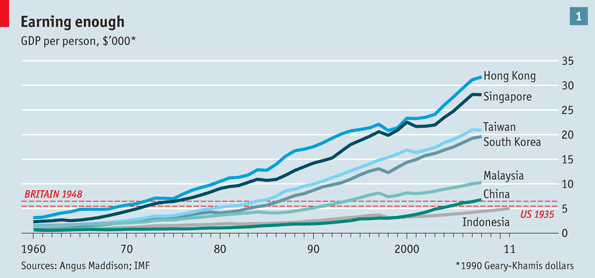
It seems that every country that can afford to build a welfare state will come under mounting pressure to do so. And much of Asia has hit the relevant level of prosperity (see chart 1). Indonesia is now almost as developed as America was in 1935 when it passed the landmark Social Security Act, according to figures compiled by the late Angus Maddison, an economic historian. China is already richer than Britain was in 1948, when it inaugurated the National Health Service (NHS) which, to judge by political ructions—and Olympic opening ceremonies—has become crucial to its sense of national identity.

via Asian welfare states: New cradles to graves | The Economist.

Everything You Think You Know About China Is Wrong

For the last 40 years, Americans have lagged in recognizing the declining fortunes of their foreign rivals. In the 1970s they thought the Soviet Union was 10 feet tall — ascendant even though corruption and inefficiency were destroying the vital organs of a decaying communist regime. In the late 1980s, they feared that Japan was going to economically overtake the United States, yet the crony capitalism, speculative madness, and political corruption evident throughout the 1980s led to the collapse of the Japanese economy in 1991.

Could the same malady have struck Americans when it comes to China? The latest news from Beijing is indicative of Chinese weakness: a persistent slowdown of economic growth, a glut of unsold goods, rising bad bank loans, a bursting real estate bubble, and a vicious power struggle at the top, coupled with unending political scandals. Many factors that have powered China’s rise, such as the demographic dividend, disregard for the environment, supercheap labor, and virtually unlimited access to external markets, are either receding or disappearing.

The current economic slowdown in Beijing is neither cyclical nor the result of weak external demand for Chinese goods. China’s economic ills are far more deeply rooted: an overbearing state squandering capital and squeezing out the private sector, systemic inefficiency and lack of innovation, a rapacious ruling elite interested solely in self-enrichment and the perpetuation of its privileges, a woefully underdeveloped financial sector, and mounting ecological and demographic pressures.


via Everything You Think You Know About China Is Wrong – By Minxin Pei | Foreign Policy.

How Our 1% Compares

It’s right out of 1880s America:

In China, less than 1% of households control more than 70% of private financial wealth.

In the US today, we’re talking somewhere between 40 and 45 percent.

Globally, says, John Bussey in the WSJ, the number is “nearly 40%,” so America’s not much off the norm.

For China to truly advance and become a genuine competitive threat, the political system has to decide to divorce wealth from political power.  Otherwise we’re looking at decay and decline and a very short “Chinese century.”

US hit that moment and launched itself into a multi-decade progressive era that cleaned up a lot of things but government most of all.

As I have said many times, the world needs a small army of Teddy Roosevelts right now – but China most of all.

via Thomas P.M. Barnett’s Globlogization – Blog – China’s looming populist problem.

China’s Cash Crunch

At first glance, that proposition seems preposterous. After all, the People’s Bank of China, the central bank, held $3.24 trillion of foreign currency reserves at the end of the first half of this year. Yet foreign currency, no matter how plentiful, has limited usefulness in a local currency crisis. In any event, the PBOC’s foreign currency holdings are almost evenly matched with renminbi-denominated liabilities that were incurred to acquire all those dollars, pounds, euros, and yen. As a result, the central bank cannot use the reserves without driving itself deep—actually, deeper—into insolvency.

When shops close to avoid predatory officials, we know China’s coffers are almost empty.  And to make matters worse, the country’s financial problems will be harder to solve now that the country’s balance of payments has turned negative.  The net outflow in the second quarter of this year was the first since 1998.  The country’s reserves also dropped in Q2.  We should not be surprised: there was perhaps $110 billion of capital flight during that period, and the gusher outflow looks like it continued in June.  Chinese citizens are losing confidence fast.

No developing country has ever escaped a major financial crisis.  The People’s Republic of China is about to have its first one now

via China Is Running Out Of Money – Forbes.

The Empire Strikes Back

Yale Prof. Charles Hill sees two very different kinds of challenges to the liberal, state-based world order. One, the aggressive kind, is exemplified by China. The other, very different, can be seen in the European Union.

“The way the world through almost all of history has been ordered is through empires. The empire was the normal unit of rule. So it was the Chinese empire, the Mughal empire, the Persian empire, and the Roman empire, the Mayan empire.”

What changed this was the Thirty Years War in Europe in the 17th century. “That was a war between the Holy Roman Empire and states, and states were new. They had come forward in northern Italy in the Renaissance and now they were taking hold in what we think of as a state-sized entity. The Netherlands and Sweden and France were among these. . . . France was both an empire and a state—and the key was when [Cardinal] Richelieu took France to the side of the states, which was shocking because France was Catholic and the empire was Catholic and the states were Protestant.”

“My view is that every major modern war has been waged against this international system. That is, the empire strikes back. World War I is a war of empires which comes to its culmination point when a state gets into it. That’s the United States.” And then we get something very interesting added: “That’s Woodrow Wilson and [the promotion of] democracy.”

“World War II, and I think this is uncomprehended although it’s perfectly clear, . . . World War II is a war of empires against the state system. It’s Hitler’s Third Reich. It’s Imperial Japan.” The Axis goal “is to establish an empire. The Nazi empire would be Europe going eastward into the Slavic lands. The Japanese empire in the Greater East Asia Co-Prosperity Sphere, as they called it.”

via The Weekend Interview with Charles Hill: The Empire Strikes Back – WSJ.com. Continue reading “The Empire Strikes Back”

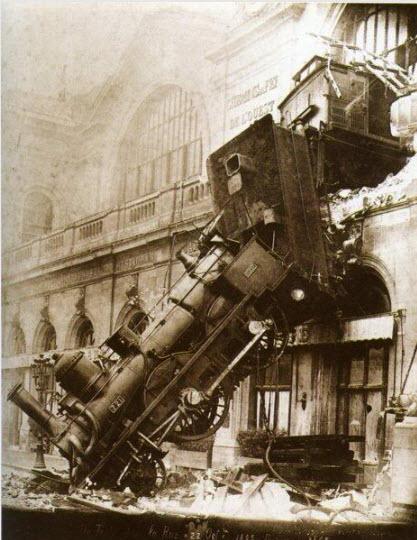
California Doesn’t Learn From China’s Train Wreck

In California’s Legislature just authorized to spend, with Federal assistance, an under-estimated $100 billion to build a route between San Francisco and Los Angeles that will consist of a government monopoly riding on tracks near one of the largest earthquake faults in the world for most of its length, all to deliver passengers slower and at greater overall cost between two fixed points.  Airlines give consumers a choice of carriers and airports on either end of that route, will deliver passengers more quickly, and probably with a much wider choice of departure and arrival times.

In China the problem — beyond the idea of spending untold billions on the antiquated technology of static choo-choo trains — is that the three people making all these wonderful decisions  now have a high-speed rail system plagued by failurecorruption, out-of-control costs and legitimate safety concerns

The fact is that China’s train wreck was eminently foreseeable. High-speed rail is a capital-intensive undertaking that requires huge borrowing upfront to finance tracks, locomotives and cars, followed by years in which ticket revenue covers debt service — if all goes well. “Any . . . shortfall in ridership or yield, can quickly create financial stress,” warns a 2010 World Bank staff report.

Such “shortfalls” are all too common. Japan’s bullet trains needed a bailout in 1987. Taiwan’s line opened in 2007 and needed a government rescue in 2009. In France, only the Paris-Lyon high-speed line is in the black.

via China’s train wreck – The Washington Post.

Trends In The Spread of Civilization

In his latest book, Civilization, The West and the Rest, the economic and financial historian Niall Ferguson argues that Western civilization’s rise to global dominance over the past 500 years was due mainly to six killer apps, as he calls them: competition, science, rule of law, modern medicine, consumerism, and the work ethic.

While “the Rest” lacked these concepts, they might not for much longer, as emerging markets are quickly catching up. Someday, they could even surpass the West. (On May 22 and 29, PBS will air a program based on Civilization.)

What made the West unusual was that risk takers were not only rewarded but honored, whether in science, exploration, or in trade. Spreading across the Atlantic from Europe is an anti-risk culture that manifests itself in two ways. One is the welfare state, designed to remove risk from your life by guaranteeing you an income from the cradle to the grave. That’s great because it means that nobody is starving in the streets for want of work. But it isn’t great if you create poverty traps and disincentives, so that people in the bottom quintile never work, which is the case in much of Europe.

The other way in which the anti-risk culture manifests itself is with the manic regulatory mentality that tries to prescribe rules for every eventuality, including the tiny, tiny risk that an asteroid will hit this building. Regulations that protect from every eventuality end up being paralyzing because the more things are proscribed, the more the ordinary entrepreneur has to be afraid that if he doesn’t comply, he will get sued.

via Is America Becoming an Anti-Risk Welfare State? – Barrons.com.