More Deaths Caused by Obesity than Hunger

Obesity has become a bigger threat to global health than child hunger, according to a major study.

More than three million deaths in 2010 were attributable to excess body weight, three times the death toll due to malnutrition.

The largest investigation of disease ever undertaken, published yesterday, also found that high blood pressure, smoking and drinking alcohol have become the world’s biggest health risks.

So-called diseases of the western industrialised nations have become more prevalent as developing nations become more affluent. Fewer infants are dying of starvation in the poorest countries while a fast expanding middle-class in the emerging economies. ibeatanorexia

Obesity kills more than hunger in march of ‘progress’ | The Times.

Europe Most Generous, Asia Stingiest For Paid Days Off

  • Workers in UK and Poland have most generous statutory employee holiday entitlements
  • Employees in the USA, Canada, Philippines, China and Thailand have the least generous
  • Colombia has greatest number of public holidays; Mexico the least
  • UK employees have access to a highest amount of potential holiday (36 days per year) but in reality fare worse than other European employees

According to Mercer Consulting, holiday entitlement is often more complex since actual holiday provisions often depends on company contracts and the number and treatment of public holidays. In the UK, for example, employees are entitled to 28 days holiday. With the UK also holding 8 public holidays each year, this suggests that employees in the UK could be on holiday for 36 days, or 10%, of each year. This would be one of the highest entitlements of all 62 countries. The reality is that companies are allowed to include the 8 public holidays as part of the 28 day entitlement so UK employees actually have fewer days’ holidays than their peers in the rest of Europe where, in general, the practice is for European employees to take public holidays in addition to their statutory entitlement. Employees in the Asia-Pac region have comparatively low levels of statutory entitlement but public holidays are taken in addition to this rather than as part of it. However, the levels of holiday entitlement in Asia-Pac are still below those of Western Europe.     Employee holiday entitlements around the world.

Oldest Evidence of Regular Meat Consumption by Human Ancestors Found

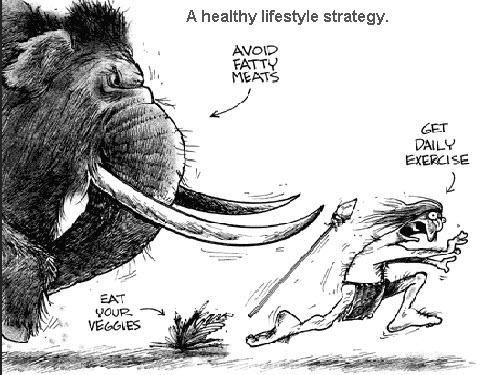
Meat-eating was an important factor affecting early hominin brain expansion, social organization and geographic movement. Stone tool butchery marks on ungulate fossils in several African archaeological assemblages demonstrate a significant level of carnivory by Pleistocene hominins, but the discovery at Olduvai Gorge of a child’s pathological cranial fragments indicates that some hominins probably experienced scarcity of animal foods during various stages of their life histories. The child’s parietal fragments, excavated from 1.5-million-year-old sediments, show porotic hyperostosis, a pathology associated with anemia. Nutritional deficiencies, including anemia, are most common at weaning, when children lose passive immunity received through their mothers’ milk. Our results suggest, alternatively, that (1) the developmentally disruptive potential of weaning reached far beyond sedentary Holocene food-producing societies and into the early Pleistocene, or that (2) a hominin mother’s meat-deficient diet negatively altered the nutritional content of her breast milk to the extent that her nursing child ultimately died from malnourishment. Either way, this discovery highlights that by at least 1.5 million years ago early human physiology was already adapted to a diet that included the regular consumption of meat.

via PLOS ONE: Earliest Porotic Hyperostosis on a 1.5-Million-Year-Old Hominin, Olduvai Gorge, Tanzania.

Rise of the Asian Welfare State

Although poorer countries still limit themselves to ad hoc welfare offerings, fitting the spending level to revenues one budget at a time, there is an increasing trend towards entitlements served by statutory institutions that will outlive the budgetary cycle. As these systems mature, welfare provision will be demand-led, not supply-driven; welfare will become integral to the state. Asia’s tigerish economies are turning marsupial, carrying their dependants along with them as they prowl.

Some of the national leaders who unleashed those tiger economies would be shocked and disturbed by the development. To them the welfare state was a Western aberration that would serve only to undermine thrift, industry and filial duty.

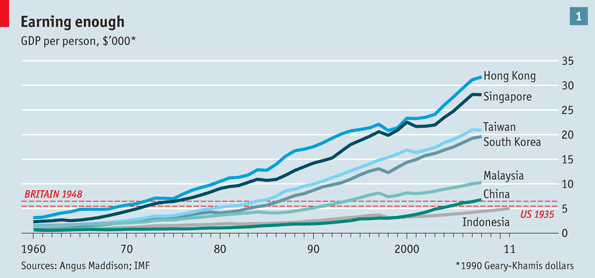
It seems that every country that can afford to build a welfare state will come under mounting pressure to do so. And much of Asia has hit the relevant level of prosperity (see chart 1). Indonesia is now almost as developed as America was in 1935 when it passed the landmark Social Security Act, according to figures compiled by the late Angus Maddison, an economic historian. China is already richer than Britain was in 1948, when it inaugurated the National Health Service (NHS) which, to judge by political ructions—and Olympic opening ceremonies—has become crucial to its sense of national identity.

via Asian welfare states: New cradles to graves | The Economist.

You Can’t Blame Your Stress On Work

Work stress, job satisfaction and health problems due to high stress have more to do with genes than you might think.

The lead author of “Genetic influences on core self-evaluations, job satisfaction, work stress, and employee health: A behavioral genetics mediated model,” published in Organizational Behavior and Human Decision Processes, Judge studied nearly 600 twins — some identical, some fraternal — who were raised together and reared apart. He found that being raised in the same environment had very little effect on personality, stress and health. Shared genes turned out to be about four times as important as shared environment.

via Feeling stressed by your job? Don’t blame your employer, study shows.