Psychologist and instructor at Harvard Medical School, Craig Malkin, who literally wrote the book on it, Rethinking Narcissism. “Narcissists are arrogant and argumentative, even the shy, quiet types (covert). They’re far more like to interrupt, glaze over when you speak, swear, post provocative pictures, and tag themselves in social media than ever use the word ‘I. “In fact,” adds Malkin, “it’s far more likely that narcissists would use the word ‘you’ because they blame people for everything and rarely take responsibility for their actions. It always about what did. ‘I-talk’ isn’t going to help much because not all narcissists like talking about themselves anyway. The authors are right. We’re used to the expression ‘it’s always me me me’ and immediately associate it with narcissism… Nothing could be further from the truth.”
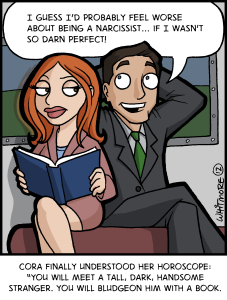 The truer mark of a narcissist is absolute clarity about a situation, and an undying commitment to his or her opinion. “Look for an unwavering certainty (‘No—that’s just wrong. Here’s the truth’), name-dropping, attention grabbing gestures, breathless monologues, constant interruptions, and above all, a disagreeable, arrogant style.”
And consider this: Another recent study found that spotting a narcissist can be as easy as using the wonderfully simple “Single Item Narcissism Scale,” which asks just one question: “To what extent do you agree with this statement: ‘I am a narcissist.’” Participants rate their agreement on a scale from one to seven. In other words, if you want to know whether someone’s a narcissist, you really just have to ask them.
via Can You Spot A Narcissist? It’s Not As Easy As You Think, Study Finds – Forbes.
Like this:
Like Loading...



 Many of the points mark the middle of an age range that scientists have identified, which means they are all determined by averages. Some are also surveys, not controlled trials, so there is a possibility the self-reports don’t capture the most accurate picture.But in many cases, the numbers keep cropping up for a reason, which is that life isn’t a downhill slide from youth.Here’s what you have to look forward to.

 Many years ago in another twin study we showed that underarm body odour as perceived by human sniffers had a genetic basis – with huge variability in how strong smells were perceived. This showed that we have gene variations controlling both the odours we perceive and the chemical odours we produce. In this way we are similar to mosquitoes because they also have big differences in which odours and chemicals attract and repel them.
