
The Wealth Report – WSJ.com : Why Richistan? Why Now?
The wealthy weren’t just getting wealthier — they were forming their own virtual country. They were wealthier than most nations, with the top 1% controlling $17 trillion in wealth. And they were increasingly building a self-contained world, with its own health-care system (concierge doctors), travel system (private jets, destination clubs) and language. (”Who’s your household manager?”) They had created their own breakaway republic — one I called Richistan.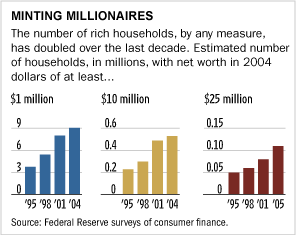
As the chart over there on the right shows, never before have so many Americans become so rich so quickly. The number of millionaire households at every level ($1 million, $10 million, $100 million) has more than doubled over the past decade. And there are no signs that the wealth explosion will slow.
The real story behind all this wealth, however, isn’t in the numbers. It’s in the people, and how they’re changing the culture and character of wealth in America. Richistan is largely about a country in flux — one in which Old Money is being shoved aside by self-made entrepreneurs, philanthropy is changing from passive check-writing to “high-engagement philanthropy,” and the progressive new rich are changing the politics of wealth. Most of all, Richistan is about the entertaining way that today’s rich are making, spending, donating and living with their wealth. (Like the guy in my book who has a house staff of 105 people.)
 Summer beach-reading season is just beginning, and already several books have broken out from the pack, such as Walter Isaacson’s biography of Albert Einstein, and Conn and Hal Iggulden’s “The Dangerous Book for Boys.”
 The godfather of the New Age led a secretive group of devoted followers in the last decade of his life. His closest “witches” remain missing, and former insiders, offering new details, believe the women took their own lives. What was a counter-culture icon on the cover of Time magazine has since been exposed as a fraud. In this Salon article it gets more sinister than that. Thanks to Bob Bopp for pointing this one out.
 Pithy quotes from Joefre’s speech to the Cranegie Institute. He is the editor and publisher of Germany’s most seriously weekly, Die Zeit. He has taught at Johns Hopkins, Harvard, and Princeton’s Woodrow Wilson School, and most recently at Stanford, where he was a fellow at the Hoover Institution and the Freeman Spogli Institute for International Studies.
 history. He includes some critical words about Christianity, but perhaps the most striking feature of his book is that he shows how religious and seemingly non-religious movement share many traits, and may sometimes be interchangeable: “Mass movements can rise and spread without belief in a God, but never without belief in a devil.”
 It sounds like an Oxymoron, but Professor Benard Lewis understands the axiom thet “Those who don’t learn history are bound to repeat it”. In February of 1998, he read in an obscure Arabic paper, which was published in London, Bin Laden’s American Jihad declaration.
 The first of these is that a Muslim’s relationship with his God is one of fear. A Muslim’s conception of God is absolute. Our God demands total submission. He rewards you if you follow His rules meticulously. He punishes you cruelly if you break His rules, both on earth, with illness and natural disasters, and in the hereafter, with hellfire.