
Predicting 2013 – Opportunities and Threats

This report is the synthesis of a 48-hour crowdsourced brainstorming exercise, where over 60 Wikistrat analysts from around the world collaboratively explored the issues that will dominate the foreign policy agenda in 2013..

The year 2012 helped bring answers to a few of the questions that loomed large for foreign observers when the year began. We now know who will lead the United States for the next four years. We have confirmation that the Muslim Brotherhood and its affiliated branches across the Arab Middle East remain the dominant, if often struggling, political force in the countries where revolutions have toppled dictators. And we have learned, to little surprise, that the much-touted efforts by Washington to pivot towards Asia will remain constrained by the pullback from continuing crises in the Middle East, where major long-standing unresolved conflicts—notably the stand-off with Iran over its nuclear program and Israeli-Palestinian tensions—still occupy the front burner.

The distinction between threats and opportunities was not always clear, particularly because a well-managed threat can turn into an opportunity, just as the reverse is true. As expected, the ongoing developments in the turbulent Middle East occupied much of the analysts’ thoughts, suggesting numerous possible outcomes. But other areas of the world and other supranational trends also made the cut.

Here are some of the top negative & positive scenarios from Wikistrat’s simulation.
via Predicting 2013 – Opportunities and Threats.

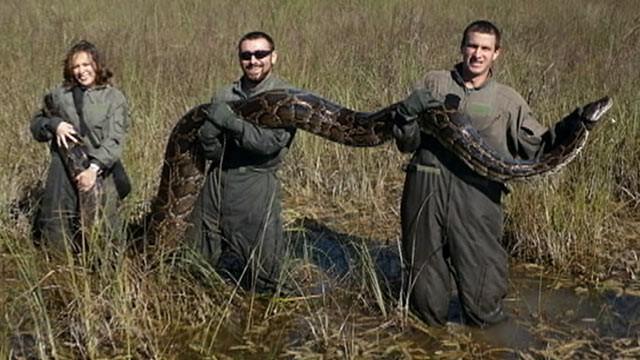
17′ Florida Python – The hunt is on for a new record

FlaPythonSome estimate that nearly 150,000 pythons are living in the Florida Everglades. Officials say the Burmese pythons are eating wildlife and with no natural predator, the population is overwhelming. The Everglades have become crowded with the snakes and the pythons have started to move into nearby neighborhoods. Last year, a Burmese python was caught and registered more than 17 feet long and 160 pounds. The catch set a new Everglades National Park record.

via Florida Python Hunt Launched to Curb Slithering Population – ABC News.

11 Obscure References in Classic Songs—Explained!

We’ve all heard these classic pop and rock hits a thousand times. But even if you know all the words, do you know what they were about?

“Hotel California,” The Eagles

“Warm smell of colitas rising up through the air”

According to the Eagles’ then-manager, “colitas” was explained to Don Henley and Glenn Frey as literally meaning “little buds” by their Mexican-American road manager, and further as Spanish slang for “marijuana.

“Bohemian Rhapsody,” Queen

“Scaramouche, Scaramouche, will you do the fandango?” … “Bismillah! No!”

Scaramouche is a traditional clown character featured in Italian commedia dell’arte. He is a stock character in Punch and Judy shows and often gets his head knocked off of his shoulders by Punch. The fandango is a lively couples dance usually accompanied by guitars, hand claps and castanets.

“Bismillah” is an Arabic word that means “in the name of God.” It is used at the head of almost every chapter in the Holy Quran

Why Are Indian Reservations So Poor?

At a time when there’s a spotlight on America’s richest 1%, a look at the country’s 310 Indian reservations–where many of America’s poorest 1% live–can be more enlightening. To explain the poverty of the reservations, people usually point to alcoholism, corruption or school-dropout rates, not to mention the long distances to jobs and the dusty undeveloped land that doesn’t seem good for growing much. But those are just symptoms. Prosperity is built on property rights, and reservations often have neither. They’re a demonstration of what happens when property rights are weak or non-existent.

The vast majority of land on reservations is held communally. That means residents can’t get clear title to the land where their home sits, one reason for the abundance of mobile homes on reservations. This makes it hard for Native Americans to establish credit and borrow money to improve their homes because they can’t use the land as collateral–and investing in something you don’t own makes little sense, anyway.

This leads to what economists call the tragedy of the commons: If everyone owns the land, no one does. So the result is substandard housing and the barren, rundown look that comes from a lack of investment, overuse and environmental degradation. It’s a look that’s common worldwide, wherever secure property rights are lacking—much of Africa and South America, inner city housing projects and rent-controlled apartment buildings in the U.S., Indian reservations.

via Why Are Indian Reservations So Poor? A Look At The Bottom 1% – Forbes.

Napoleon Wasn’t Short and 4 Other Historical Myths – Video

“In this four-minute video, C.G.P. Grey tackles five historical misconceptions, contrasting the commonly accepted stories with what the historical record actually shows.”

Vanishing Act: Camouflage in Nature

animal-camouflage-photography-art-wolfe-1In this astonishing new book, legendary wildlife photographer Art Wolfe turns to one of nature’s most fundamental survival techniques: the vanishing act. His portraits show animals and insects disappearing into their surroundings, using deceptions, disguises, lures, and decoys to confuse the eye of both predator and prey. Click on this link and hit the “Slideshow” option and see how many you can find.

Vanishing Act: Camouflage in Nature | Art Wolfe Stock Photography 888-973-0011.

animal-camouflage-photography-art-wolfe-2

When Will The College Bubble Burst?

Higher education’s business model is simply unsustainable.

Colleges have so far gotten away with their price hikes by making it easy for students to borrow money. But now the customers are tapped out. They owe $1 trillion, and they are having a rough time repaying that debt with the kinds of jobs available in today’s economy. Vedder notes that 115,000 janitors have bachelor’s degrees.

The system is ripe for an upheaval. Cheap online courses seem poised to deliver it. Traditional colleges at opposite ends of the glamour spectrum will probably survive. At one end, community colleges could deliver bankable skills in fields like nursing and computer network installation. At the other end, elite institutions like Princeton will carry on for a few more centuries.

In between? “It’s going to wipe out high-cost mediocre private schools without big endowments,” Vedder says.BSchoolBlues

via How Liberal Arts Colleges Could Go Bankrupt – Forbes.