
This South African’s board-mounted camera takes you right into the tube and then sucked over-the-falls and his painful paddle back to the beach. Thanks to Randy Marks.
Tag: Extreme Sports
Video: Surfing 64′ Wave
Surfing 50′ Waves at Jaws for X-mas
Tiger Woods – Adrenaline Junkie Control Freak
During a trip to New Zealand for his caddie’s wedding, Woods went bungee jumping off a cable car suspended 440 feet over a river valley. On the same trip, he climbed behind the wheel of a race car and traded paint with the competition on a dirt track.
Woods spent a week at Fort Bragg going through Special Forces training with the Marines and became a master scuba diver, capable of holding his breath for four minutes at a time while exploring the ocean. He could stay on the ocean floor even longer, Woods explained, when he used a regulator. But the scenery was so much better without one.
“You don’t want any bubbles because that scares the fish off,” he said. “The only problem is that when you don’t make any bubbles, the sharks come around, too.”
Extreme Waterfall Kayaking
[vodpod id=ExternalVideo.840021&w=425&h=350&fv=videoGUID%3D%7B82DFA750-FFC9-424A-961B-B45E558C7A0F%7D%26playerid%3D1000%26plyMediaEnabled%3D1%26configURL%3Dhttp%3A%2F%2Fwsj.vo.llnwd.net%2Fo28%2Fplayers%2F%26autoStart%3Dfalse%E2%80%9D+base%3D]
more about “White Water Daredevils Push Kayaking …“, posted with vodpod
Surf Slo-Mo Inside a 12′ Tube
Sports Gene Found?
A difference in just one amino acid in a protein might explain why some people learn new motor skills faster and reach higher levels of performance.
The protein, called brain-derived neurotrophic factor (BDNF), is a key driver of synaptic plasticity, the ability of the connections between brain cells to change in strength. This plasticity is an important factor in learning, explains neurologist Janine Reis, who led the study at the National Institutes of Health. According to Reis, this finding offers the first evidence that slight variations in BDNF’s structure affect learning ability.
Other groups have found that the BDNF version that Reis linked with poorer acquisition of skills is associated with reduced function of the hippocampus, a brain region involved in motor learning.
via Athletic Ability May Lie in a Single Gene: Scientific American.
Extreme Waves Getting Bigger

The largest waves in the Pacific Northwest are getting higher by seven centimeters a year, posing an increasing threat to property close to the shore. And the strange part is: Scientists aren’t sure why.
Oregon State researchers found that the danger to property from these larger extreme waves will outweigh the impacts of rising sea levels caused by global warming over the next several decades.
via Surfers, Rejoice: Some Extreme Waves Getting Bigger | Wired Science from Wired.com.
Surfing the World’s Longest Surfboard
 RIO DE JANEIRO: A Brazilian surfer broke his own record after riding a wave on an extra-long 30-foot (9.16-metre) surfboard for over ten seconds.
In 2006, Rico de Souza broke the Guinness World Record by riding a wave on a 25.6-foot board (8.05-m).From his prior experience, Souza developed the new 100-kilo (220-pound) surfboard with the adjustments he had missed before.
Souza said that surfing the lengthy board was a challenging, but thrilling experience.Souza also organized another record in September this year, when 88 people surfed the same wave for over ten seconds up four from 2007. VIDEO
Surfers take on Australia’s Heaviest Wave
The Australian – Photo galleries and slideshows – Surfers take on Australia’s heaviest wave
While pictures obsess with wave height, surfers appreciate the thickness of a wave. When you wipe-out, you’ll appreciate the difference. Hence the fascination with the thick tubes at Teahupoo. Click on the link above to see 43 pictures of this deepwater break off of Australia. Also an article on it. 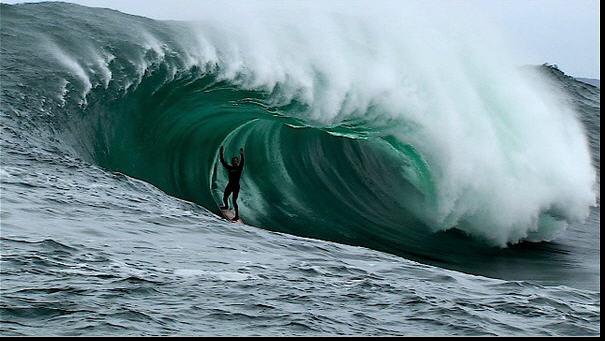 Thanks to Randy Marks for Pix.